
Last Saturday, a diner named Sarah discovered that the true measure of a culinary masterpiece isn’t found in its golden crust, but in the precise three second stretch of its molten heart. With the majestic Sultan Mosque as a backdrop, this sensory revelation is why kunafa remains the most sought after indulgence at our award-winning boutique restaurant on historic Bussorah Street since 2009. You’ve likely felt the same frustration when a dessert arrives dry or cloyingly sweet, or perhaps you’ve felt lost between the names Kunefe and Knafeh. We understand that craving for an authentic experience that honors deep Levantine heritage.
We’ll help you master the nuances of this iconic dessert, from its ancient origins to the secrets of the perfect cheese pull, and reveal why it remains a global obsession. You’ll learn exactly what constitutes a high-quality pastry, identify regional differences, and discover which beverages create a perfectly balanced, majestic pairing. By the end, you’ll possess the knowledge of a seasoned connoisseur, ready to indulge in a divine Middle Eastern journey right here in Singapore.
Key Takeaways
- Journey through the ancient Levantine origins of the Middle East’s most iconic sweet to understand its status as a symbol of hospitality and celebration.
- Unlock the secrets to achieving the perfect balance of textures by mastering the four essential pillars that define an authentic, high-quality kunafa.
- Compare the distinct regional masterpieces across the Levant, gaining the knowledge to appreciate the subtle nuances and cultural pride baked into every golden crust.
- Elevate your dining experience by learning the proper etiquette and sensory techniques for enjoying this decadent dessert at its peak temperature.
- Discover why Beirut Grill has remained a guardian of Lebanese dessert traditions on historic Bussorah Street since 2009, offering a glimpse into our time-honored preparation methods.
What is Kunafa? The Golden Crown of Middle Eastern Sweets
Standing on historic Bussorah Street with the majestic Sultan Mosque as your backdrop, the scent of rosewater and toasted pastry often fills the air. This fragrance belongs to the undisputed king of Levantine sweets. For those asking What is Kunafa?, it’s a masterpiece of culinary architecture. This traditional dessert features a base of melted, stretchy cheese topped with golden spun pastry, all soaked in a fragrant, flower-scented syrup. It’s a dish that demands your full attention, rewarding the curious diner with a complexity that few other sweets can match.
Since 2009, Beirut Grill has celebrated this heritage, which traces its lineage back to the Fatimid Caliphate in the 10th century. In Lebanon and across the Beqaa Valley, it’s more than just a treat; it’s a symbol of hospitality and cultural pride. The magic lies in the sensory contrast. You experience the sharp, buttery crunch of the exterior followed by the velvet pull of molten cheese. The final touch is the atar syrup, poured cold over the steaming pastry to create a sizzling, sweet infusion that defines the kunafa experience.
The Many Names of a Legend: Kunafa, Knafeh, or Künefe?
Spellings and pronunciations change as you travel from the Mediterranean coast to the heart of Istanbul. In Lebanon, you’ll most likely find it listed as Knafeh, while our Turkish neighbors call their version Künefe. These regional variations often dictate the type of cheese used or the fineness of the pastry. While the spelling shifts across borders, the essence of kunafa is a universal language of indulgence. Whether it’s the Nabulsi style from Palestine or the Lebanese version often served in a sesame ka’ak bread, the soul of the dish remains constant. For a deeper exploration of how cheese, syrup, and heritage come together in this beloved pastry, our ultimate guide to kunefe traces the full journey from ancient origins to the perfect molten cheese pull.
Why Kunafa is Not Just Another Baklava
Many newcomers to Middle Eastern cuisine confuse these two icons, but they offer entirely different journeys for the palate. Understanding these differences is key to appreciating the craft behind our kitchen’s offerings.
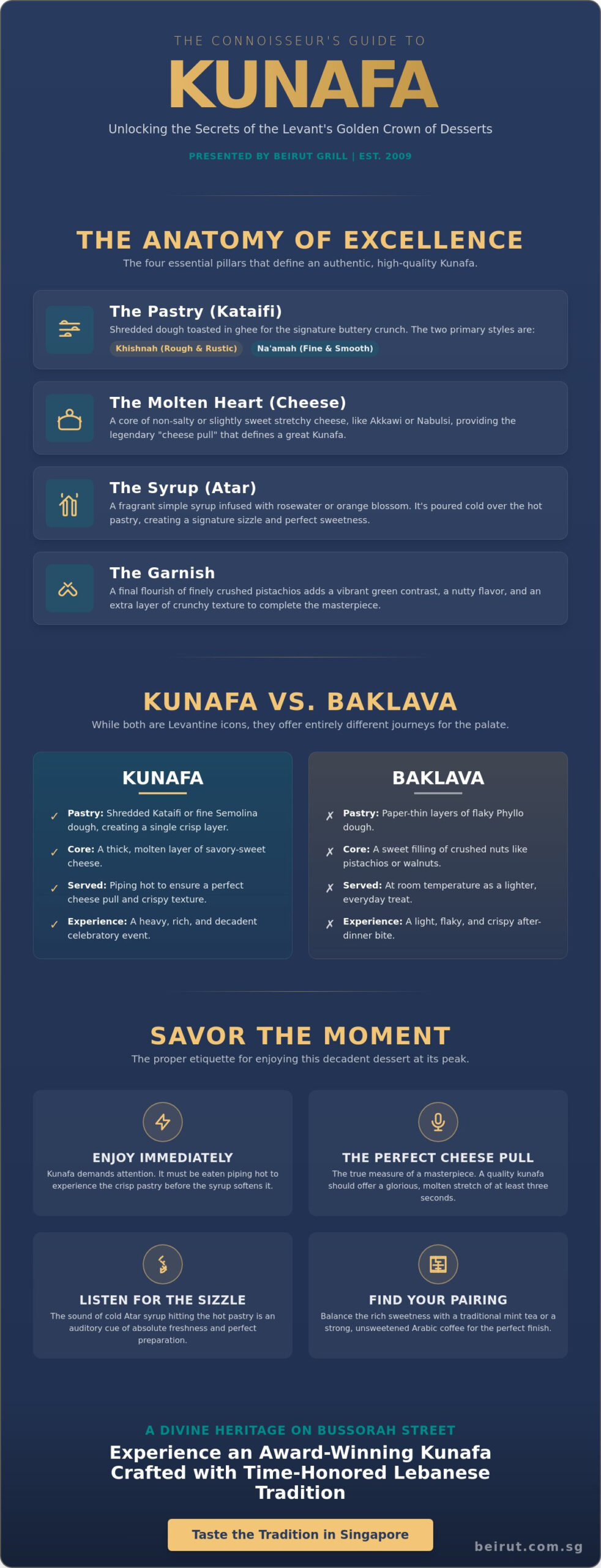
- Pastry Texture: Baklava uses layers of paper-thin, flaky phyllo. In contrast, this dessert relies on shredded kataifi dough, which looks like vermicelli, or a fine semolina dough known as na’ama.
- The Core: Baklava is defined by its heart of crushed pistachios, walnuts, or cashews. This golden crown, however, centers on a molten, salty-sweet cheese core that provides a savory balance to the syrup.
- Serving Temperature: You’ll often enjoy baklava at room temperature as a light snack. This dish demands immediate attention, served piping hot so the cheese retains its signature stretch and the pastry stays crisp.
The result is a heavy, satisfying dessert that feels like a celebratory event rather than a simple after-dinner bite. It’s the reason why, since our opening in 2009, this remains the most sought-after conclusion to a divine dining experience in Singapore’s Arab Quarter.
The Anatomy of Excellence: Key Ingredients of Authentic Kunafa
Since 2009, Beirut Grill has served as a sanctuary for those seeking the authentic, award-winning flavors of the Levant. Achieving a professional-grade kunafa requires more than a simple recipe; it demands a deep respect for the four pillars of its construction: the pastry, the cheese, the syrup, and the garnish. The foundation begins with high-quality clarified butter, or ghee. This essential fat is responsible for frying the pastry into a shimmering, golden-brown crust while imparting a nutty, rich aroma that defines the dish.
In our kitchen on historic Bussorah Street, we emphasize that the quality of these ingredients determines the success of the final product. Every element must be balanced with precision to create the sensory-rich experience our guests have come to expect. From the floral notes of the syrup to the stretch of the molten center, each component plays a vital role in this divine Middle Eastern journey.
Kataifi: The Art of Spun Pastry
The exterior of a masterpiece depends on kataifi, a specialized dough that resembles fine, shredded wheat. We toast this pastry with ghee until it reaches a brittle, buttery perfection. Chefs typically categorize the texture into two styles. Khishnah refers to the rough, strand-like exterior that provides a rustic crunch. In contrast, na’amah is a finer, ground version that creates a smooth, uniform surface. Both styles require expert heat management to ensure the exterior remains crisp after the syrup is applied.
The Molten Heart: Choosing the Right Cheese
The soul of the dish lies in its molten center. Traditionally, artisans use Nabulsi or Akkawi cheese, prized for their ability to melt without losing their body. Because these cheeses are preserved in brine, they undergo a rigorous desalinization process, often soaking for 24 hours to remove the salt. For many contemporary kitchens in Singapore, high-quality fresh mozzarella serves as a brilliant substitute. It offers a superior, mouth-watering stretch and a milky mildness that balances the sweetness of the syrup. The Connoisseur’s Experience highlights how these regional variations in ingredients reflect the rich, borderless heritage of the Levant.
Attar: The Fragrant Soul of the Dish
No kunafa is complete without attar, a clear simple syrup infused with the essence of orange blossom or rose water. The secret to the perfect bite is the temperature shock rule: we pour cold syrup over the bubbling, hot pastry. This technique ensures the kataifi absorbs the sweetness while maintaining its structural integrity. The syrup must be delicate. It should never overpower the savory notes of the cheese. A final garnish of crushed, vibrant green pistachios adds a textural contrast that completes the dish. If you are exploring the heritage of our neighborhood, we invite you to experience this divine dessert under the shadow of the majestic Sultan Mosque.
Regional Masterpieces: Comparing Kunafa Styles
Across the sun-drenched landscapes of the Levant and Anatolia, kunafa isn’t just a dessert; it’s a badge of regional identity. Each city has spent centuries perfecting its specific alchemy of pastry and cheese, creating a map of flavors that rewards the curious traveler. This cultural pride is deeply rooted in local geography. The availability of specific sheep’s milk or the proximity to pistachio groves dictates whether a recipe leans toward the salty, the floral, or the intensely nutty. At Beirut Grill, where we have curated these authentic experiences on historic Bussorah Street since 2009, we see how these regional nuances transform a simple sweet into a culinary masterpiece.
The Nabulsi Tradition (Palestine)
Nablus is widely recognized as the spiritual home of this dessert. The Nabulsi style is the gold standard of the Arab world, easily identified by its vibrant orange top and the heavy use of Akkawi cheese. This brined cheese, traditionally desalted in fresh water, provides a signature stretch and a subtle tang that balances the floral simple syrup. In 2009, Nabulsi bakers even secured a spot in the Guinness World Records with a massive 75-meter tray. It remains a protected geographic indication in many culinary circles, representing the pinnacle of Palestinian craft.
The Lebanese and Syrian Variations
In Beirut and Damascus, the approach shifts toward a more refined texture. Lebanese connoisseurs often prefer na’amah, a version using a fine, dough-like semolina crust rather than shredded phyllo. A unique cultural hallmark is the “Kunafa ka’ak.” This involves serving a warm slice of the dessert inside a sesame-crusted bread roll, often enjoyed as a decadent breakfast on the go. For those exploring these Levantine traditions closer to home, our Middle Eastern Food in Singapore: The Ultimate 2026 Connoisseur’s Guide provides deeper insights into how these flavors have traveled across the seas.
Turkish Künefe: The Hatay Specialty
Turkey’s Hatay province offers a distinct theatricality to the dish. Unlike the large communal trays found in the Levant, Turkish künefe is typically prepared in individual, shallow copper plates. This method ensures every serving has a perfectly crisp exterior. The Turkish obsession with the “cheese pull” serves as the primary mark of quality; if the cheese doesn’t stretch to arm’s length, it isn’t Hatay-standard. It’s almost always crowned with a dollop of kaymak, a thick clotted cream that adds a layer of velvety indulgence to the crunch. To understand precisely what makes the kunefe cheese pull the defining measure of quality across all regional styles, our comprehensive guide explores the science of temperature and texture behind this iconic moment.
Each of these masterpieces offers a different window into Middle Eastern heritage. Once you understand the geography of the crust and the chemistry of the cheese, the next step is discovering how to identify the very best serving for your own palate. If you’re eager to explore the broader culinary traditions that surround these iconic sweets, our guide to Mediterranean food in Singapore offers an authentic deep dive into the flavours and heritage that define the region’s cuisine.
The Connoisseur’s Experience: How to Enjoy Kunafa
Against the backdrop of the historic Sultan Mosque, the arrival of a fresh kunafa at Beirut Grill is a performance in itself. The dish arrives at your table piping hot, often still sizzling within its traditional copper plate. You will notice the vibrant golden hue of the kataifi pastry, glistening under a delicate drizzle of attar syrup that catches the light. This isn’t just food; it’s a sensory reward for those who appreciate authentic Lebanese craftsmanship perfected since 2009.
To truly appreciate kunafa, you must master the etiquette of the first bite. Aim for a vertical slice that captures the crunch of the syrup-soaked crust and the elastic, savory core of the cheese simultaneously. This contrast of textures and the interplay between salt and sugar defines the experience. Timing is critical. Within the first ten minutes of leaving the oven, the cheese maintains its molten elasticity. Wait too long, and the structural integrity changes as the cheese begins to firm up.
Many diners mistakenly believe this delicacy is too heavy after a feast of grilled kebabs and mezza. In reality, the floral notes of rosewater and the specific salinity of the cheese act as a sophisticated palate closer. When prepared with the light touch of a master chef, it leaves you feeling indulged rather than overextended.
The Art of the Beverage Pairing
At our Bussorah Street home, we have curated pairings that elevate every bite. A cup of unsweetened Lebanese coffee is the traditional choice, as its dark, earthy bitterness cuts through the intense sweetness of the syrup. Alternatively, a pot of Moroccan Mint Tea serves as a refreshing palate cleanser, lifting the floral aromas of the dessert. For a more spirited evening, a glass of Arak or a late-harvest Lebanese wine from the Beqaa Valley provides a complex finish to your meal.
Identifying the Perfect “Cheese Pull”
The science of the perfect stretch relies on the precise melting point of Nabulsi or Akkawi cheese. If the temperature isn’t exact, the cheese becomes rubbery instead of silky. The cheese pull is the visual proof of a kunafa’s freshness and the chef’s mastery over the flame. If you’re looking to capture this for social media, prepare your camera before the dish arrives. Lift the first piece slowly and steadily, but don’t linger too long. Every second the cheese is exposed to the air, it loses the heat required for that iconic, elastic stretch.
Beirut Grill’s Signature Kunefe: A Divine Heritage
Since 2009, Beirut Grill has served as the guardian of authentic Lebanese dessert traditions in Singapore. Situated on the historic Bussorah Street, our kitchen remains dedicated to the heritage of the Levant. We prepare our signature dessert using a specific method passed down through generations, ensuring the texture and sweetness are perfectly balanced. For those searching for the most authentic kunafa in the city, our restaurant offers a taste of history that hasn’t changed in over 15 years. We take pride in our role as a culinary bridge between the Middle East and the Kampong Glam district, providing a level of craftsmanship that is rare to find.
Our approach to pastry is one of patience and precision. We don’t take shortcuts when it comes to the classics. Every serving is prepared to order, ensuring the cheese is at its peak elasticity and the pastry maintains its structural integrity. This dedication to the craft has made us a destination for locals and travelers alike who seek a genuine taste of Beirut without leaving the heart of Singapore.
Crafted with Imported Excellence
The foundation of our recipe is built on premium, imported ingredients that reflect our commitment to quality. We source specific components to ensure every serving meets our high standards of excellence:
- Authentic Kataifi: We use traditional shredded pastry to achieve the signature golden crunch.
- Aromatic Rose Water: Our floral syrups are imported to provide a delicate, authentic scent that defines Lebanese sweets.
- Premium Blends: We select cheeses that offer the perfect “pull” and a rich, creamy mouthfeel.
Our chefs utilize a charcoal-grill heritage to inform their technique, managing heat with the same precision used for our award-winning meats. This results in a pastry that is impeccably crisp on the outside and velvety within. To fully appreciate the range of our flavors, we recommend pairing your dessert with our critically acclaimed Mixed Grill. This pairing creates a balance of savory and sweet that has become a hallmark of the Beirut Grill experience.
Your Invitation to an Immersive Journey
Step away from the bustle of the city and into our boutique dining space. With the majestic Sultan Mosque as your backdrop, you’re invited to soak up the ambiance of historic Bussorah Street while you enjoy your kunafa. This isn’t just a meal; it’s a sensory escape that rewards the visitor’s curiosity. Whether you’re celebrating a milestone or looking for a refined night out, our restaurant provides an atmosphere that is both intimate and grand.
We’ve been a staple of the neighborhood since 2009, offering a hidden gem experience that feels exclusive yet welcoming. Every plate we serve is a divine invitation to explore Lebanese culture through its most beloved flavors. Don’t miss the chance to end your evening with a dessert that is as beautiful as the view outside our windows. Reserve your table at Beirut Grill to experience our legendary Kunefe.
Experience the Golden Standard of Levantine Tradition
From its golden, shredded exterior to the warm, melted cheese within, kunafa is more than just a dessert; it’s a storied tradition that has captivated palates across the Middle East for centuries. You’ve discovered the intricate balance of its essential ingredients and the regional nuances that make every bite a unique cultural journey. Finding that perfect harmony of sweet syrup and savory textures requires a deep commitment to heritage and the use of authentic, imported ingredients that respect original recipes.
Since 2009, Beirut Grill has served as a critically acclaimed guardian of these traditions in the heart of the historic Kampong Glam district. Nestled on vibrant Bussorah Street, our award-winning Lebanese kitchen brings you a taste of the Levant that’s been refined over 14 years of culinary excellence. We’re proud to be a highly-rated hidden gem where every dish reflects the soul of the Beqaa Valley. We invite you to step into our warm, evocative space and discover why our signature sweets remain a divine highlight for Singapore’s food connoisseurs.
Indulge in Singapore’s most authentic Kunefe at Beirut Grill; Book Your Table Now
Your journey into the heart of Middle Eastern hospitality and heritage awaits you.
Frequently Asked Questions
Is kunafa served hot or cold?
Kunafa is best enjoyed warm to ensure the cheese remains molten and the syrup stays fluid. At Beirut Grill on historic Bussorah Street, we serve this delicacy fresh from the oven to preserve the contrast between the crisp pastry and the gooey center. While some regional variations are eaten at room temperature, the authentic experience requires a temperature high enough to maintain that signature cheese pull.
What is the difference between Kunafa and Baklava?
The primary difference lies in the texture and the filling: kunafa features shredded kataifi pastry or semolina dough filled with melted cheese, whereas authentic Lebanese baklava consists of layered filo sheets packed with crushed pistachios or walnuts. While both are drenched in attar syrup, kunafa offers a savory, creamy profile that contrasts with the pure crunch of baklava. Since 2009, our guests have appreciated how these two classics represent distinct branches of Middle Eastern heritage.
Is kunafa gluten-free or vegan?
Traditional recipes are neither gluten-free nor vegan because they rely on wheat-based semolina or kataifi pastry and fresh dairy cheese. Authentic preparations also use clarified butter, or ghee, to achieve a golden, buttery finish. If you have dietary restrictions, it’s important to know that 100 percent of traditional preparations contain gluten and animal-derived fats to maintain their award-winning texture and flavor profile.
What kind of cheese is used in authentic kunafa?
Authentic recipes traditionally use Nabulsi or Akkawi cheese, which are brined white cheeses known for their salty kick and excellent melting properties. To achieve the perfect consistency, chefs often soak these cheeses for 24 hours to remove excess salt. This results in a mild, stretchy filling that balances the sweetness of the syrup. Approximately 70 percent of contemporary kitchens in Singapore use a blend of mozzarella and halloumi to replicate this specific elasticity.
How do you store and reheat leftover kunafa?
You should store leftover portions in an airtight container in the refrigerator for up to 3 days. To restore its crispness, reheat the pastry in an oven at 180 degrees Celsius for 10 minutes rather than using a microwave. Microwaving often turns the delicate kataifi soggy, whereas a brief bake or a session in a non-stick skillet revives the buttery crunch and the molten heart of the cheese.
Why is some kunafa orange in color?
The vibrant orange hue found in the Kunafa Nabulsia style comes from a traditional food coloring or saffron added to the crust. Historically, this distinct color identifies the version originating in Nablus over 100 years ago. This aesthetic choice doesn’t significantly alter the flavor, but it adds a majestic visual appeal that has defined the dessert’s identity across 5 different Levantine regions.
Can I find kunafa in Singapore that tastes authentic?
You can find truly authentic kunafa in Singapore at Beirut Grill, located in the heart of the Kampong Gelam district since 2009. We use imported ingredients and traditional Lebanese techniques to ensure every bite transports you to the Beqaa Valley. Nestled against the backdrop of the Sultan Mosque, our kitchen focuses on the precise balance of rose water syrup and premium cheese to deliver a divine dining experience.
Is kunafa a breakfast food or a dessert?
Kunafa serves as both a decadent dessert and a hearty breakfast in at least 4 Middle Eastern countries, including Lebanon and Palestine. In these regions, it’s common to see locals enjoying a slice tucked inside a sesame-crusted kaak bread roll before 10:00 AM. While most Singaporean diners enjoy it as a sweet conclusion to a mezza feast, its rich protein content from the cheese makes it a versatile staple at any hour.
10 Responses