
What if the vibrant Tabbouleh or smoky Baba Ghanoush on your table today is actually the result of a five-millennia dialogue between empires? While many enthusiasts appreciate the sensory allure of the Levant, it’s common to see these complex traditions oversimplified as a single, uniform monolith. You likely recognize the comforting creaminess of Hummus or the aromatic char of Shish Taouk, yet without understanding the history of lebanese cuisine, these dishes remain beautiful flavors stripped of their profound cultural context. This culinary journey is not just about food; it’s a testament to a heritage that has survived and thrived through centuries of transformation.
You’ll gain a deep understanding of the specific historical milestones that shaped this prestigious tradition, from the ancient Phoenician traders who first mastered the sea to the Ottoman influences that refined the art of the feast. We’ll explore why ingredients like golden olive oil and tender lamb became so dominant in our kitchens and identify the precise origins of the staples you love. By the end of this narrative, you’ll appreciate how the sacred ritual of hospitality turned a simple meal into a sophisticated cultural destination, recently recognized by TasteAtlas as the top culinary tradition in the Arab world for 2025 to 2026.
Key Takeaways
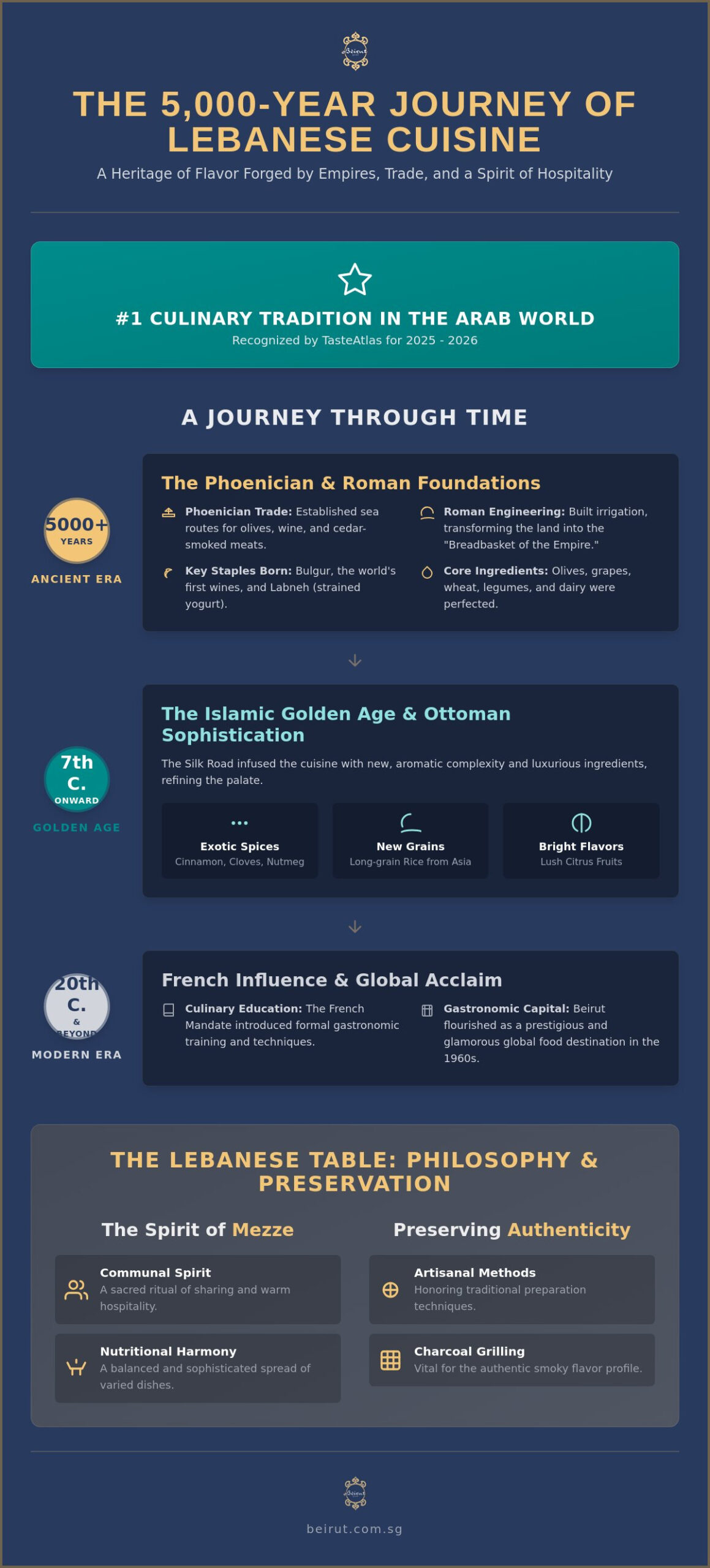
- Trace the 5,000-year lineage of Levantine flavors back to Phoenician maritime traders who established the region as a vital crossroads of the ancient world.
- Uncover how the Silk Road and the Islamic Golden Age redefined the history of lebanese cuisine by introducing exotic spices, citrus, and rice to the ancestral table.
- Examine the impact of the French Mandate on culinary education and the subsequent rise of Beirut as a prestigious global gastronomic capital during the 1960s.
- Decode the communal philosophy of the mezze ritual, exploring how it balances nutritional harmony with the warm, inviting spirit of Lebanese hospitality.
- Learn why preserving artisanal methods, like the use of traditional charcoal grills, is vital for maintaining the authentic sensory profile of heritage dishes today.
The Ancient Foundations: From Phoenician Traders to Roman Granaries
To truly grasp the history of lebanese cuisine, one must look toward the sun-drenched horizon where the Mediterranean meets the rugged, cedar-crowned peaks of Mount Lebanon. For over five millennia, this strip of land has functioned as a vibrant tapestry woven from the threads of empire, migration, and trade. Positioned at the strategic crossroads of the ancient world, the Levant was never merely a transit point; it was a sanctuary of flavor. It sits at the absolute heart of the Fertile Crescent, the sacred birthplace of organized agriculture where humanity first transitioned from wandering to the rhythmic cycles of the harvest. We still honor the ancestral techniques born in this era, from the patient stone-pressing of olives for liquid gold to the meticulous sun-drying of fruits and grains that allowed our ancestors to preserve the season’s bounty through the winter months.
The Phoenician Legacy: Olives, Grapes, and the First Maritime Spice Trade
The Phoenicians were the master architects of the Mediterranean’s first great trade networks, yet their most enduring legacy remains rooted in the deep red soil of the Bekaa Valley. They were the world’s first true viticulturists, domesticating the vines that still produce our prestigious Lebanese Wine. As they navigated their cedar ships to distant ports, they carried more than just timber; they exported salt, cedar-smoked meats, and a comprehensive overview of Lebanese cuisine to the known world. This era saw the perfection of wheat-based staples like bulgur. This parboiled, cracked grain remains the structural heart of our most iconic salads, serving as a textural link to a maritime past that valued endurance and earthiness.
The Roman and Byzantine Era: The Breadbasket of the Empire
When the Romans arrived, they reimagined the landscape as the prestigious breadbasket of their vast empire. They didn’t just harvest; they engineered. Through the introduction of sophisticated irrigation systems, they transformed arid plains into lush gardens of legumes and vegetables that define our modern mezze. This period cemented the Levant as a premier source of grain for the Roman elite, establishing a standard of quality that persists today. During the subsequent Byzantine era, the focus shifted toward the ingenious preservation of dairy in mountain villages. The birth of Labneh, our signature strained yogurt, was a triumph of necessity, allowing shepherds to preserve the richness of their milk through the changing seasons. It remains a cornerstone of the history of lebanese cuisine, always served with a sense of pride and a drizzle of heritage oil.
These ancient foundations created a culinary language that is both specialized and accessible. The Phoenician drive for trade and the Roman mastery of the land ensured that the Lebanese table would always be a place of abundance. It’s a legacy that rewards the curious guest with flavors that have been refined over fifty centuries of continuous civilization.
The Islamic Golden Age and Ottoman Culinary Sophistication
As the Arab conquests swept across the Levant, they brought a new, aromatic complexity that forever altered the history of lebanese cuisine. This era marked a departure from the rustic simplicity of ancient grains toward a more perfumed and intricate palate. The Silk Road functioned as a vital artery, pulsing with the scents of cinnamon, cloves, and nutmeg that had traveled thousands of miles to reach our shores. It was during this golden age that long-grain rice made its prestigious debut, arriving from distant Asian fields to become the elegant companion to our hearty stews and celebratory pilafs. Lush citrus groves began to dot the Mediterranean coastline, adding the bright, acidic notes that now define our most refreshing salads and marinades.
Spices, Rice, and the Refinement of the Arab Palate
The culinary philosophy of the Golden Age prioritized a balance of textures and luxury. You can see this legacy in dishes like our Lamb Kofta, where the richness of the meat is expertly cut by the addition of toasted pine nuts and warm, earthy spices. This period also refined the ritual of the gathering. Lebanese Coffee emerged not just as a beverage, but as a sacred symbol of hospitality. It’s a dark, cardamom-scented brew that demands you slow down and immerse yourself in the conversation. If you are seeking to experience this timeless tradition, you might discover the authentic flavors of our heritage in a setting that honors these ancient roots.
The Ottoman Legacy: Mezze Culture and the Masterful Mixed Grill
While the Arab conquests provided the ingredients, it was the four centuries of Ottoman rule that provided the architectural structure of the meal. The “Palace Style” of the imperial kitchens in Istanbul trickled down to the provincial governors in Beirut, transforming simple mountain appetizers into the sophisticated Mezze culture we celebrate today. This was a deliberate move toward presentation and variety, where small plates like Hummus and Moutabal were elevated to culinary art forms. The Ottomans also perfected the Mixed Grill, turning nomadic fire-cooking into a precise science. The Shish Taouk, for instance, evolved through the use of slow-charcoal techniques to ensure the chicken remained succulent while absorbing the smoky essence of the wood. This era also gifted us the decadent complexity of Baklava and Kunefe, sweets that were once the exclusive domain of the sultan’s royal confectioners, crafted with hundreds of layers of paper-thin pastry and local honey.
The French Mandate and the Birth of Modern Lebanese Gastronomy
The 20th century ushered in a transformative chapter in the history of lebanese cuisine, characterized by a sophisticated dialogue between East and West. During the period of the French Mandate, the rugged, sun-drenched flavors of the Levant met the meticulous rigor of European culinary education. This era wasn’t a replacement of our ancestral traditions, but rather a prestigious elevation of them. Lebanese chefs began to master the art of the reduction and the delicate balance of the roux, skillfully blending French butter-based techniques with our deep-rooted olive oil foundations. It was during these decades that the role of the “Restaurateur” emerged as a professionalized vocation, shifting the perception of hospitality from a domestic duty to a refined, world-class craft.
Culinary Fusion: European Techniques Meet Levantine Flavours
French influence left an indelible mark on the sweet finale of the Lebanese feast. Traditional milk puddings, such as our delicate Mouhalabieh, were refined by the silky textures and precise tempering associated with European flans and custards. The presentation of the meal also underwent a dramatic shift. The Mezze, while remaining communal at its heart, was reimagined as a curated sequence of visual delights, where every small plate was treated as a canvas. This period saw the graceful merging of French dining etiquette with Middle Eastern warmth, creating a unique hybrid of structured service and inviting intimacy.
The Paris of the Middle East: Beirut’s 20th-Century Influence
By the 1960s, Beirut had firmly established itself as the “Paris of the Middle East,” serving as a global gastronomic capital that dazzled international food critics and travelers alike. The city’s cosmopolitan nature demanded a new level of consistency, leading to the standardization of heritage recipes. Iconic staples like Tabbouleh and Hummus were codified with precise ratios, ensuring their integrity remained intact as they began their journey to global fame. This commitment to excellence and culinary professionalization is exactly why Lebanon continues to set the benchmark for sophisticated Mediterranean food in Singapore and beyond. It’s a legacy of cosmopolitan pride that rewards every guest who seeks an authentic, elevated journey through the history of lebanese cuisine.
The Philosophy of the Table: Mezze, Wine, and Communal Spirit
The Lebanese table is far more than a simple gathering for a meal; it’s a prestigious ritual of social bonding that has been refined over millennia. Central to this philosophy is the concept of “Mouneh,” the traditional heritage pantry that once dictated the survival of rural mountain communities. For centuries, families dedicated their summers to the art of preservation, stone-pressing olives for oil and pickling the season’s finest vegetables to ensure that hospitality could be offered year-round. This deep-seated culture of abundance is the backbone of the history of lebanese cuisine, where the host’s pride is measured by the variety and generosity found upon the table. Each sitting is a deliberate sensory journey. You’ll find the bright, citrusy crunch of Fattoush contrasting with the smooth, earthy depth of Baba Ghanoush, all while the air is perfumed with the unmistakable, evocative scent of meats sizzling over natural charcoal.
The Art of the Mezze: A Historical Framework for Sharing
The modern mezze spread is a sophisticated evolution of ancient rustic traditions, which often consisted of little more than olives, mountain bread, and a bowl of Labneh. Today, it has become a structured art form designed to slow time and encourage conversation. The ritual follows a specific, time-honored sequence: cold mezze arrive first, featuring vibrant dishes such as the meticulously hand-rolled Warak Enab. These stuffed grape leaves are a testament to communal labor, traditionally prepared by generations of family members sharing stories as they work. This is followed by hot delicacies like Sambousek or Grilled Halloumi, before the arrival of the Mixed Grill. This progression ensures a perfect nutritional harmony, pairing fiber-rich legumes and fresh herbs with high-quality lean meats.
Arak and Lebanese Wine: 5,000 Years of Viticulture
Lebanon’s relationship with the vine is one of the oldest in the world, centered in the prestigious Bekaa Valley. With over 5,000 years of viticulture history, this region continues to produce world-class labels that carry the essence of our sun and soil. This enduring viticulture is a vital pillar within the history of lebanese cuisine, linking the ancient Phoenician traders to the modern connoisseur. For those seeking the ultimate pairing, authentic Lebanese wine offers a complex acidity that perfectly complements the char of our Beirut Lamb Chops. No exploration of our liquid heritage is complete without Arak. Known as “Lion’s Milk” for its milky white appearance when mixed with water, this anise-flavored spirit undergoes a traditional triple-distillation process. It’s the definitive palate cleanser for a long, indulgent afternoon. To experience this level of cultural immersion yourself, we invite you to reserve your place at our table today.
Savouring the Legacy: Authentic Lebanese Cuisine in the Modern Era
The global diaspora acts as a living bridge, carrying the prestigious secrets of the Levant to every corner of the world. While Lebanon itself navigates significant economic shifts in 2026, the cultural pride rooted in the history of lebanese cuisine remains an unbreakable anchor. A heritage restaurant serves as more than a place to dine; it’s a sanctuary where ancient recipes are protected from the dilution of modern convenience. In an age of rapid industrialization, the decision to remain artisanal is a deliberate act of cultural preservation. This commitment ensures that the sensory allure of our ancestors’ tables isn’t lost to time, but rather celebrated by a new generation of global connoisseurs.
Preserving Tradition: The Importance of Authentic Techniques
The soul of our food lives in the details that machines simply cannot replicate. Take the preparation of Tabbouleh, for instance. Hand-chopping the parsley ensures the herb retains its vibrant structure and essential oils, whereas a processor would merely bruise the leaves into a bitter paste. This commitment to quality extends to the sourcing of high-status markers like premium, imported Lebanese olive oil and tart, sun-dried sumac. The chef functions as a guardian of cultural memory, ensuring that the smoky allure of the Mixed Grill is achieved through traditional charcoal embers rather than the sterile heat of gas alternatives. It’s this dedication to the flame that creates the deep, evocative char that defines our culinary identity.
An Immersive Journey at Beirut Grill
Since 2009, Beirut Grill has stood as a prestigious destination for those seeking to immerse themselves in this 5,000-year culinary narrative. Our kitchen honors the seasoned expertise of the past, utilizing time-honored charcoal techniques to perfect the char on every Shish Taouk and Beirut Lamb Chop. We invite you to slow down and reward your curiosity by experiencing the sensory details that have earned Lebanese food the top spot in the Arab world for 2025 to 2026. This global recognition reflects a surging international demand for the authentic, health-conscious principles we’ve practiced for millennia. Conclude your historical journey with the indulgent warmth of a traditional Kunafa, paired with a dark, aromatic Lebanese Coffee. It’s a final, sweet testament to a heritage that continues to inspire and transport guests through every bite.
Join a Living Legacy at the Lebanese Table
The history of lebanese cuisine is a living narrative told through every hand-rolled vine leaf and smoky, charcoal-kissed skewer. We’ve traveled from the ancient maritime trade of the Phoenicians to the sophisticated “Palace Style” of the Ottoman era, discovering that true hospitality is a sacred, five-millennia-old ritual. You now understand that the Lebanese table isn’t just a meal; it’s a sensory preservation of a heritage that values communal bonding and artisanal precision above all else. This journey through time proves that while empires may rise and fall, the integrity of a perfectly balanced mezze remains eternal.
Since 2009, we’ve remained dedicated to these ancestral standards in the heart of Singapore. Our award-winning menu features traditional charcoal-grilled meats and hand-crafted mezze that honor the techniques of our forefathers. To complete your cultural immersion, we offer a curated selection of authentic Lebanese wines and triple-distilled Arak, ensuring every sip and bite transports you to the sun-drenched Bekaa Valley. It’s an experience designed to reward your curiosity and indulge your senses.
Experience the heritage of Lebanon—Book your table at Beirut Grill today. We look forward to welcoming you to a setting where history is served with pride and every guest is treated as a prestigious traveler.
Frequently Asked Questions
What is the oldest known Lebanese dish?
Neolithic grain porridges and early forms of unleavened flatbread are among the most ancient staples of the region. These simple preparations eventually evolved into bulgur-based dishes like Kibbeh, which have anchored the history of lebanese cuisine for thousands of years. They represent the very dawn of organized agriculture in the Fertile Crescent.
How did the Silk Road influence Lebanese food?
The Silk Road functioned as a prestigious aromatic bridge that introduced long-grain rice, citrus fruits, and exotic spices like cinnamon and cloves to our shores. These ingredients transformed rustic mountain diets into the sophisticated culinary experiences we recognize today. They allowed for the creation of intricate pilafs and the bright, acidic profiles that define our modern palate.
Why is Lebanese cuisine different from other Middle Eastern styles?
Lebanese food distinguishes itself through a unique Mediterranean focus on fresh herbs, garlic, lemon, and olive oil rather than the heavier fats or yogurt-based stews found in neighboring regions. This coastal geography creates a lighter, more vibrant sensory experience. It’s a specialized balance that prioritizes the natural integrity and color of seasonal produce over heavy masking agents.
What is the historical significance of Mezze?
Mezze is far more than a collection of appetizers; it’s a structured ritual of hospitality designed to foster deep social connections. It evolved from simple mountain snacks into a lavish, curated sequence of visual delights that encourages guests to slow down and immerse themselves in the meal. This tradition ensures that every guest is treated with the warmth and prestige they deserve.
Is Lebanese food healthy according to its history?
The traditional diet is inherently healthy because it aligns with ancient Mediterranean principles of nutritional harmony. It emphasizes fiber-rich legumes, fresh vegetables, and heart-healthy fats derived from stone-pressed olive oil. This historical reliance on the land’s bounty has created a cuisine that’s both indulgent and restorative, long before modern nutritional science existed.
What role did the French play in Lebanese food history?
The French Mandate introduced a new level of professionalization and technical rigor to Levantine kitchens. This influence refined our presentation styles and introduced European pastry techniques that influenced desserts like Mouhalabieh. It helped establish the “Restaurateur” as a prestigious vocation and cemented Beirut’s reputation as a global gastronomic capital during the 20th century.
Why is the Bekaa Valley so important to Lebanese culinary heritage?
The Bekaa Valley is the spiritual and agricultural heart of the Levant, serving as one of the world’s oldest and most prestigious centers for viticulture. Its fertile soil and unique microclimate have supported 5,000 years of continuous wine and grain production. This region remains a vital pillar in the history of lebanese cuisine, providing the prestigious regional markers we use today.
How has the history of Lebanese cuisine been preserved in Singapore?
We’ve preserved these ancient traditions in Singapore since 2009 through our commitment to authentic charcoal grilling and hand-crafted mezze. By sourcing specific regional ingredients and following the time-honored methods of our ancestors, we ensure the heritage of Lebanon remains vibrant and accessible. It’s a cultural journey that rewards the curiosity of every guest who dines with us.