
Could a single ingredient hold the weight of a thousand-year history within its molten, salted depths? For the true connoisseur, the legendary “cheese pull” isn’t just a visual spectacle for the camera; it’s a testament to the provenance and preparation of traditional kunefe cheese. Whether you’re wandering the ancient streets of Hatay or dining in a refined setting in Singapore, the difference between a mediocre sweet and a culinary masterpiece lies in the artisanal cheese used at its core. In March 2023, the European Union recognized this cultural weight by granting “Antakya Künefesi” Protected Geographical Indication status, ensuring that only the most authentic methods are honored.
It’s understandable to feel frustrated when a promising dessert turns out rubbery or lacks that characteristic tang. You likely recognize that the soul of this iconic dish shouldn’t be masked by generic substitutes or confusing labels. This guide promises to demystify the complexities of Levantine dairy, identifying the specific roles of Akkawi and Nabulsi cheeses that define the dish’s identity. We’ll preview the meticulous process of desalting and stretching these heritage ingredients, while guiding you toward a prestigious destination in Singapore where this heritage is preserved with the utmost pride.
Key Takeaways
- Uncover the cultural lineage of this iconic dessert, tracing its origins from the ancient city of Nablus to its role as a cornerstone of Lebanese hospitality.
- Identify the precise characteristics of Akkawi and Nabulsi varieties that form the foundation of traditional kunefe cheese, providing the signature texture and flavor profile.
- Differentiate between regional variations, including the semolina-based Na’ameh and shredded Khishneh styles of the Levant versus the Turkish traditions of Hatay.
- Equip yourself with the knowledge to perform a sensory audit of any Kunefe, evaluating the golden-orange hue and the specific resistance that signals authentic preparation.
- Gain insight into how a dedicated Lebanese kitchen in Singapore honors these artisanal techniques, maintaining a legacy of excellence that dates back to 2009.
The Heritage of Kunefe: More Than Just a Dessert
To understand the allure of Kunefe is to embark on a journey through the storied landscapes of the Levant. It isn’t merely a confection; it’s a cultural artifact that has graced the tables of caliphs and commoners alike for centuries. This dish represents a masterclass in the balance of textures, where the crunch of golden pastry meets the soft, yielding heart of melted dairy. In Lebanese culture, Kunefe serves as a vibrant symbol of hospitality and celebration, often marking the height of weddings, births, and religious festivals. It’s a gesture of welcome that says as much about the host’s generosity as it does about the region’s rich culinary history.
The Legend of Nablus and the First Kunefe
The city of Nablus in Palestine stands as the undisputed cradle of this masterpiece. Here, the unique topography of the West Bank provided the lush grazing lands necessary for the high-quality dairy that defines traditional kunefe cheese. Historical accounts often trace the dish back to the Umayyad Caliphate, where it was allegedly created to satisfy the hunger of royals during the long hours of Ramadan fasting. The vessel used is just as vital as the ingredients. Large, round copper plates allow for the even heat distribution required to achieve that perfect, crisp underside while keeping the cheese core in a state of molten perfection. This ancient marriage of copper and fire remains the gold standard for any chef who values heritage over convenience.
Kunefe in the Modern Culinary Lexicon
Today, the dish has transcended its origins as a cherished street food to become the crowning jewel of sophisticated Middle Eastern dining. By 2026, the global culinary landscape has shifted significantly toward transparency and provenance. Diners are no longer satisfied with commercial shortcuts; they seek the authentic experience that only comes from centuries-old techniques. The transition from a simple breakfast staple in the Levant to an elevated restaurant finale in cities like Singapore reflects a growing appreciation for artisanal craft. The specific characteristics of traditional kunefe cheese ensure that the dish remains a prestigious choice for those who value authenticity in a world of mass-produced alternatives.
The iconic “cheese pull” that dominates modern digital feeds is far more than a visual trend. It’s a testament to the meticulous preparation of the curds. This legendary stretch is rooted in the ancient technique of desalting the cheese, a process that requires patience and precision. When you witness that perfect, elastic pull, you’re seeing the result of a lineage of knowledge passed down through generations. It’s a moment of culinary theater that honors the past while delighting the modern palate, proving that true quality never goes out of style.
The Anatomy of Traditional Kunefe Cheese: Nabulsi and Akkawi
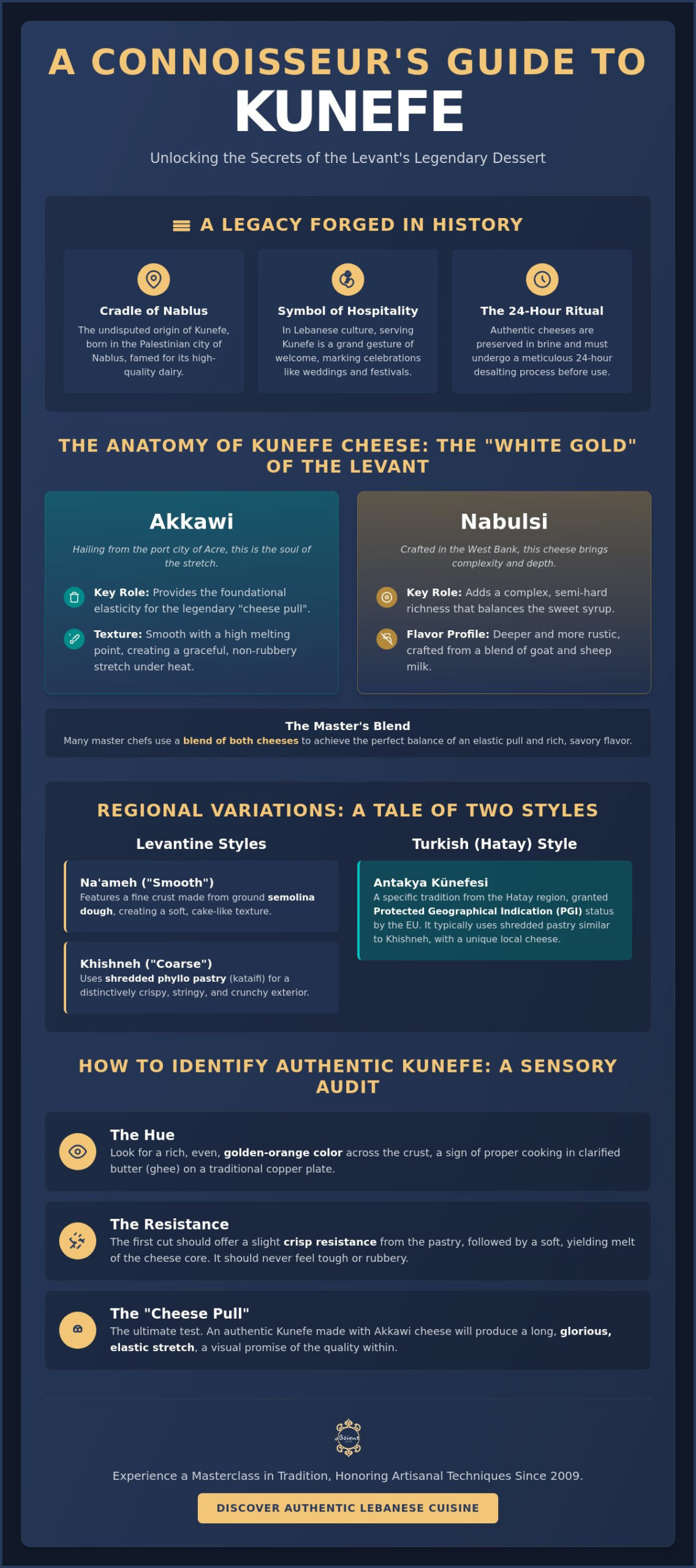
The secret to a truly transformative dessert experience lies in what connoisseurs often call the “White Gold” of the Levant. While many modern interpretations settle for the convenience of industrial mozzarella, the soul of a masterpiece is found in traditional kunefe cheese varieties like Akkawi and Nabulsi. These aren’t just ingredients; they’re heritage products that require a skilled hand to unlock their full potential. Akkawi, originally hailing from the port city of Acre, provides the foundational elasticity that creates the legendary stretch. Nabulsi cheese, crafted from a blend of goat and sheep milk in the West Bank, brings a complex, semi-hard richness that lingers on the palate long after the first bite.
Akkawi vs. Nabulsi: A Comparative Study
Akkawi is prized for its smooth texture and high melting point, behaving with a graceful elasticity under heat. Nabulsi offers a deeper, more rustic flavor profile. Many master chefs prefer a blend of the two. This combination ensures the dessert has both the structural integrity for a perfect pull and the fatty richness that balances the sweetness of the sugar syrup. When these cheeses meet the heat of the copper plate, they transform into a creamy, unified layer that anchors the entire dish.
The Art of Desalting the Cheese
Because these cheeses are traditionally preserved in heavy brine, they must undergo a rigorous desalting ritual. This isn’t a task for the impatient. It requires a 24-hour soaking process, with water changed frequently to draw out the salt without compromising the integrity of the curds. The temperature of the water is critical; it must be just right to preserve the precious fats that provide the stretch. Unlike mozzarella, which offers only a neutral chew, authentic traditional kunefe cheese retains subtle floral notes and a slight tang that cuts through the richness of the pastry.
To truly appreciate this artisanal process, one must taste the results of a kitchen that refuses to take shortcuts, such as the authentic Kunefe prepared with these heritage techniques. It’s this dedication to the slow, traditional method that defines a truly prestigious dining experience. By prioritizing the provenance of the dairy, a chef honors the centuries of tradition that have made this dessert a global icon of Middle Eastern hospitality.
Regional Variations: Lebanese vs. Turkish Styles
The world of Middle Eastern sweets is a tapestry of regional pride, where subtle shifts in technique create vastly different sensory experiences. While the heart of the dish remains the traditional kunefe cheese, the “clothing” it wears, the pastry, and the manner of its cooking vary from the shores of Beirut to the mountains of Hatay. In Singapore’s diverse culinary landscape, discerning diners can now distinguish between these storied traditions, appreciating how Syrian, Palestinian, and Lebanese influences have shaped the local dessert scene. Each style offers a unique dialogue between the crisp exterior and the molten core.
The Lebanese Signature: Na’ameh and Khishneh
In Lebanon, the culinary conversation often centers on the texture of the crust. The Na’ameh style is a feat of refined patisserie, featuring a smooth, golden topping made from fine semolina dough. This creates a cohesive, almost cake-like lid that traps the heat, allowing the traditional kunefe cheese to reach a state of uniform melt. Conversely, the Khishneh style offers an audible, dramatic crunch. It utilizes long strands of shredded phyllo, known as Kataifi, which are buttered and toasted until they achieve a deep amber hue. While the Na’ameh style provides a sophisticated, velvety mouthfeel, the Khishneh’s textural contrast often highlights the elastic stretch of the cheese more dramatically, making it a favorite for those who enjoy a play of opposites.
The Turkish Künefe Distinction
Venturing north to Turkey, specifically the Hatay province, the preparation takes on a different character. Turkish Künefe is traditionally served in individual, shallow copper pans, which ensures a high ratio of scorched pastry to molten cheese. In March 2023, the European Union recognized “Antakya Künefesi” with Protected Geographical Indication status, cementing the specific use of local Hatay cheese and the precise layering of two kadayif sheets. Unlike the Lebanese versions which might use a blend of Akkawi and Nabulsi, the Turkish variant often relies on Dil Peyniri or specific Hatay curds that offer a milder, stringier profile designed for an intense sear.
The final masterstroke in any variation is the application of Attar, the scented sugar syrup. In Turkish preparations, the syrup ratio is often higher, creating a more indulgent, saturated dessert that leans into a deep sweetness. Lebanese chefs tend to favor a slightly lighter touch, often infusing their syrup with rose water or orange blossom to complement the floral notes of the desalted cheese. This delicate balance ensures that the sweetness never overwhelms the heritage of the dairy, allowing the complex flavors of the Levant to shine through in every bite. Whether you prefer the individual portions of Anatolia or the grand, sharable plates of the Levant, the result is a prestigious celebration of ancient technique.
How to Identify Authentic Kunefe in a Restaurant
Discerning the difference between a commercial imitation and a heritage masterpiece requires a sensory audit that begins the moment the plate arrives. An authentic presentation is a choreographed balance of temperature, aroma, and structural integrity. For the true connoisseur, the first indicator of quality is the visual allure. You’re looking for a characteristic golden-orange hue that appears vibrant but natural, never neon. This color is a nod to the traditional use of saffron or specific coloring agents in the Nabulsi tradition, signaling that the kitchen respects the visual history of the Levant.
The true test of traditional kunefe cheese, however, lies in the “texture test.” When you lift the first piece, the cheese should offer a graceful, elastic stretch rather than a stubborn, rubbery chew. This distinction is vital. While mozzarella substitutes often feel bouncy and resilient, heritage cheeses like Akkawi and Nabulsi provide a soft, molten resistance that yields easily to the palate. As the dish cools slightly, the cheese should remain supple. If it separates into oily pools or becomes a singular, tough block, it’s a sign that industrial shortcuts have replaced artisanal curds.
Signs of a Master Chef at Work
A prestigious kitchen reveals itself through the precision of the pastry layer. Whether you’ve ordered the fine Na’ameh or the shredded Khishneh, the thickness must be uniform across the entire copper plate. A master chef ensures the dessert is served piping hot, as the traditional kunefe cheese is at its most expressive when molten. Look closely at the garnishes. Authentic versions feature bright green, hand-crushed pistachios that provide a fresh, nutty counterpoint to the richness. The “Attar” or sugar syrup should be clear and fragrant, absorbed into the pastry to provide sweetness without leaving a soggy, cloying pool at the bottom of the vessel.
Common Red Flags to Avoid
Diners should remain vigilant against several hallmarks of low-quality versions. Excessive oiliness is a primary concern, often indicating an over-reliance on cheap fats rather than clarified butter. A soggy bottom crust suggests the dish was prepared too far in advance or that the syrup was applied at the wrong temperature. Perhaps the most disappointing red flag is a syrup that is overly sweet. A refined Attar should carry the delicate, floral whispers of rose water or orange blossom, enhancing the dairy’s natural tang rather than masking it. To experience this meticulous balance firsthand, we invite you to reserve a table and discover how true heritage tastes when no detail is overlooked.
The aroma should be the final confirmation of authenticity. Before the first bite, a gentle steam should carry the scent of warm butter and floral infusions. This fragrance, combined with the sight of steam rising from the molten cheese, creates a moment of culinary theater that has remained unchanged for centuries. When these elements align, you aren’t just eating a dessert; you’re participating in a storied tradition of Middle Eastern hospitality.
The Beirut Grill Experience: A Masterclass in Tradition
Since 2009, Beirut Grill has served as a sanctuary for those seeking the genuine flavors of the Levant within the atmospheric heart of Singapore’s historic district. We don’t merely serve a menu; we curate an immersive experience that honors the meticulous standards of our ancestors. At the center of our dessert offerings is a steadfast commitment to the integrity of traditional kunefe cheese. We understand that the soul of this dish resides in the quality of the curds and the patience of the chef. Our kitchen team follows the time-honored rituals of desalting and precise temperature control, ensuring that every plate delivered to your table possesses the legendary elasticity and subtle tang that defines the authentic Middle Eastern experience.
Crafted with Prestigious Ingredients
Our signature version is a masterclass in balance. We source only the finest heritage cheeses, avoiding the bland profiles of modern substitutes to ensure a rich, complex foundation for every serving. The Kataifi pastry is prepared with an artisanal touch, buttered and toasted until it achieves a vibrant, golden-amber hue. You can explore the depths of this craft in our Ultimate Guide to Kunafa, which details the nuances that separate a simple sweet from a cultural icon. The first bite offers an audible crunch, followed by the warm, molten embrace of the desalted cheese, finally giving way to the lingering, floral whispers of rose water and orange blossom.
A Sophisticated Finale to Your Feast
No culinary journey through our menu is truly complete without this storied finale. It serves as the perfect, indulgent counterpoint to the savory intensity of a Middle Eastern Mixed Grill, cleansing the palate with its delicate sweetness. As you sit amidst the evocative surroundings of Bussorah Street, we invite you and your guests to immerse yourselves in a journey of Mediterranean heritage that rewards curiosity with depth of flavor. This is where history and hospitality meet.
To enhance the experience, we recommend pairing your Kunefe with our robust Lebanese Coffee, infused with cardamom, or a refreshing pot of Moroccan Mint Tea. These traditional beverages provide a sophisticated balance to the richness of the traditional kunefe cheese, allowing the complex layers of the dessert to unfold gracefully on the tongue. It’s a moment of slow, atmospheric indulgence that celebrates the enduring legacy of Lebanese hospitality, offered by a host who takes immense pride in their cultural roots. We invite you to slow down, savor the surroundings, and discover why this dessert remains the most iconic treasure of the Middle East.
Embark on Your Own Levantine Heritage Journey
The pursuit of the perfect dessert is ultimately a search for authenticity. You’ve discovered that the secret to a truly transformative experience isn’t found in modern substitutes, but in the meticulous preparation of traditional kunefe cheese. From the ancient dairy traditions of Nablus to the sophisticated patisserie of Beirut, every element must be honored to achieve that legendary balance of salt, sweet, and silk. Understanding the nuances of the cheese pull and the aromatic whispers of Attar ensures you can now navigate any menu with the confidence of a true connoisseur.
At Beirut Grill, we’ve remained steadfast in our commitment to these artisanal techniques since our founding in 2009. Located in Singapore’s historic heritage district, our kitchen serves as a living tribute to Lebanese culinary excellence. We invite you to slow down and immerse yourself in the sensory allure of our surroundings, where every dish is a chapter of a much larger story. Book Your Table at Beirut Grill to Experience Authentic Kunefe and witness the culmination of centuries of heritage on a single, golden plate. We look forward to welcoming you to our table for a finale that lingers in the memory.
Frequently Asked Questions
What is the best cheese for traditional kunefe?
The most authentic choices for this dessert are undoubtedly Akkawi and Nabulsi cheeses, which are prized for their heritage and unique melting properties. These specific varieties are the foundation of traditional kunefe cheese, providing a complex, slightly tangy profile that mass-produced substitutes simply cannot replicate in a professional kitchen.
Is kunefe cheese the same as mozzarella?
Traditional cheese is distinct from mozzarella in both its cultural origin and its sensory profile. While mozzarella is often used in commercial settings for its convenience, it lacks the subtle floral tang and rustic texture that define authentic heritage curds. Authentic Levantine varieties offer a more delicate, molten stretch when desalted correctly by a skilled hand.
Why is traditional kunefe cheese salty before preparation?
These cheeses are traditionally stored in a concentrated salt brine to ensure preservation in the warm Mediterranean climate. This ancient method necessitates a rigorous desalting process before cooking, which carefully removes the salt while retaining the precious fats needed for a perfect melt. It’s a ritual that requires patience and precision to achieve the desired creamy sweetness.
How do you get the perfect cheese pull in kunefe?
The secret to the perfect pull is a combination of artisanal desalting and serving the dish at its peak temperature. By soaking the curds for 24 hours and changing the water frequently, the chef ensures the cheese remains supple and elastic. The dessert must be served immediately from the oven while the core is still molten and expressive.
Can I find authentic Lebanese kunefe in Singapore?
Authentic Lebanese versions are crafted with pride at Beirut Grill in Singapore, where we’ve preserved these culinary rituals since 2009. Located in the historic heritage district, our kitchen remains a prestigious destination for those seeking the true flavors of the Mediterranean. We ensure every serving honors the traditional methods passed down through generations.
What is the difference between Kunafa and Künefe?
The difference lies primarily in regional terminology and specific pastry styles used across the Levant and Turkey. Kunafa generally refers to the Lebanese and Palestinian traditions featuring Na’ameh or Khishneh crusts. Turkish Künefe often utilizes individual copper pans and specific regional cheeses to create a more intensely seared, individual portion.
Is kunefe served hot or cold?
It’s essential to enjoy this dessert while it’s piping hot to experience the cheese at its most molten and expressive. If allowed to cool, the heritage dairy will begin to firm up, losing the delicate stretch and creamy mouthfeel that make the dish so iconic. The contrast between the hot cheese and the cool syrup is part of the allure.
What are the best drinks to pair with traditional kunefe?
To complement the richness of the traditional kunefe cheese, we recommend a robust Lebanese Coffee or a fragrant Moroccan Mint Tea. These traditional beverages provide a sophisticated, bitter or herbal counterpoint that cuts through the sweetness of the syrup. They allow the complex layers of the dairy and pastry to unfold gracefully on the palate.