
The most profound cultural dining experience in Singapore isn’t found in the flash of a camera lens; it lives in the quiet, aromatic steam rising from a freshly baked loaf of pita. In a city where “instagrammable” decor often masks a lack of soul, it’s natural to feel weary of dining concepts that prioritize spectacle over substance. You’ve likely experienced the disappointment of a beautifully themed room that serves dishes lacking the heartbeat of tradition. It’s often difficult to distinguish between genuine heritage and a commercialized facade when you’re simply seeking a meal that feels like a true escape.
This article promises to lead you beyond the gimmicks to a place where hospitality is an ancient, living art form. You’ll discover how to identify a truly immersive Lebanese culinary journey that honors heritage through every imported spice and shared story. We’ll explore the nuances of traditional etiquette, the significance of the 2024 Epicurean Star Award for Best Middle Eastern Restaurant, and the sensory delights of the Hummus Festival 2025. Prepare for a transportive exploration of the Levant that rewards your curiosity with a prestigious destination of seasoned expertise and authentic flavor.
Key Takeaways
- Understand the pillar of “Karam,” the Lebanese tradition of boundless generosity that elevates a simple dinner into a profound act of hospitality.
- Learn to distinguish between “novelty dining” and a true cultural dining experience in Singapore by focusing on historical rituals and culinary integrity.
- Master the traditional sequence of a Middle Eastern feast, starting with refreshing cold mezze before transitioning to the rich, spiced warmth of hot dishes.
- Discover how to navigate a Lebanese menu with confidence, ensuring your selections create a balanced tapestry of authentic flavors and textures.
- Gain a reliable recommendation for a prestigious heritage destination that has been recognized for its commitment to preserving Levantine traditions.
Defining the Cultural Dining Experience in Singapore
In the heart of a city renowned for its culinary diversity, a true cultural dining experience in Singapore is more than just a meal; it’s a deliberate act of time travel. While many venues rely on neon lights or theatrical gimmicks to capture attention, a heritage-led destination invites you into a living history. This holistic immersion goes beyond the plate, weaving together a specific region’s history, ancestral rituals, and the precise, uncompromised flavors of its soil. It is an invitation to step out of the urban rush and into a space where every detail is a curated echo of a distant home.
We often see “novelty dining” where the environment is a mere backdrop for a social media post, offering a fleeting thrill that lacks a foundation. In contrast, “heritage dining” is built on an authenticity that rewards the visitor’s curiosity with depth and narrative. Singapore’s unique multicultural landscape has allowed it to become a global hub for these deep-rooted encounters. It’s a place where a single evening can transport a diner to the sun-drenched shores of the Mediterranean without ever leaving the city’s borders, providing a sensory escape that feels both exclusive and welcoming.
The Shift from Themed to Transformative
Singaporean diners have evolved significantly, moving away from superficial “themes” toward a search for genuine truth. They no longer want a caricature of a culture; they seek a transformative encounter that resonates long after the final course. Heritage restaurants act as cultural embassies, using old-world hospitality to tell stories that a mere “themed” bistro cannot. Through the strategic use of traditional architecture and specific sensory cues, these spaces create a profound sense of place. When you enter a room filled with the intricate patterns of Levantine design and the warm glow of traditional lanterns, the environment prepares your palate for the heritage it’s about to receive.
The Pillars of Authenticity
True authenticity rests upon three non-negotiable pillars: time-honored techniques, the use of premium imported ingredients, and the preservation of cultural ritual. At the heart of a prestigious Lebanese culinary tradition, this includes a strict adherence to pork-free preparations, ensuring the menu remains faithful to its ancestral origins. Whether it’s the exact, laborious texture of a silk-smooth Hummus or the smoky, hand-turned char of a Mixed Grill, these details represent a commitment to excellence. Cultural dining serves as a bridge between historical legacy and modern indulgence. By honoring these pillars, a restaurant becomes a reliable guardian of culture rather than just a provider of food.
The Sensory Pillars of Lebanese Hospitality
At the heart of every authentic Levantine table lies “Karam,” a philosophy of boundless generosity that dictates every interaction. This ancient ethos ensures that no guest ever leaves hungry, and no plate is ever left lonely. In a truly immersive cultural dining experience in Singapore, this spirit of hospitality is what separates a prestigious destination from a mere commercial enterprise. It’s an atmospheric commitment that begins the moment you’re seated, ensuring your journey is as transportive as it is delicious.
Mezze: The Communal Language of Lebanon
The visual allure of the Lebanese table begins with the mezze, a vibrant tapestry of cold and hot dishes that defines the authentic cultural dining experience singapore has to offer. These aren’t just appetizers; they’re the opening notes of a long, melodic conversation. Staples like Hummus, Baba Ghanoush, and Moutabal represent a mastery of texture and balance, while delicate Warak Enab (stuffed vine leaves) and savory Fried Kibbeh offer a glimpse into the labor-intensive traditions of the Lebanese kitchen. This communal structure encourages a slower pace, allowing guests to engage in the lost art of meaningful connection over a shared feast.
The Charcoal Grill Mastery
The olfactory impact of the charcoal grill is perhaps the most evocative element of the evening. Traditional techniques are employed to prepare signature dishes such as Shish Taouk, Beef Kebab, and succulent Lamb Kofta, ensuring the meat remains tender while acquiring a distinct, smoky depth. The Mixed Grill often serves as the centerpiece, a grand display of culinary expertise that pays homage to the open-fire cooking of the Levant. The intoxicating aroma of charcoal-grilled meats, seasoned with ancestral spice blends, serves as a sensory hallmark of authentic Middle Eastern food in Singapore.
Arak and Lebanese Wine: The Liquid Heritage
To truly complement the richness of the cuisine, one must explore the liquid heritage of the region. Arak, known affectionately as “Lion’s Milk,” is a potent, anise-flavored spirit traditionally prepared by diluting it with water and ice until it turns a cloudy white. For those who prefer the vine, Lebanese Wine offers a taste of history from one of the oldest wine-producing regions on the planet. These beverages aren’t merely drinks; they’re cultural markers that have been perfected over millennia. You might consult our Middle Eastern Food in Singapore: The Ultimate 2026 Connoisseur’s Guide to refine your palate before your next visit.
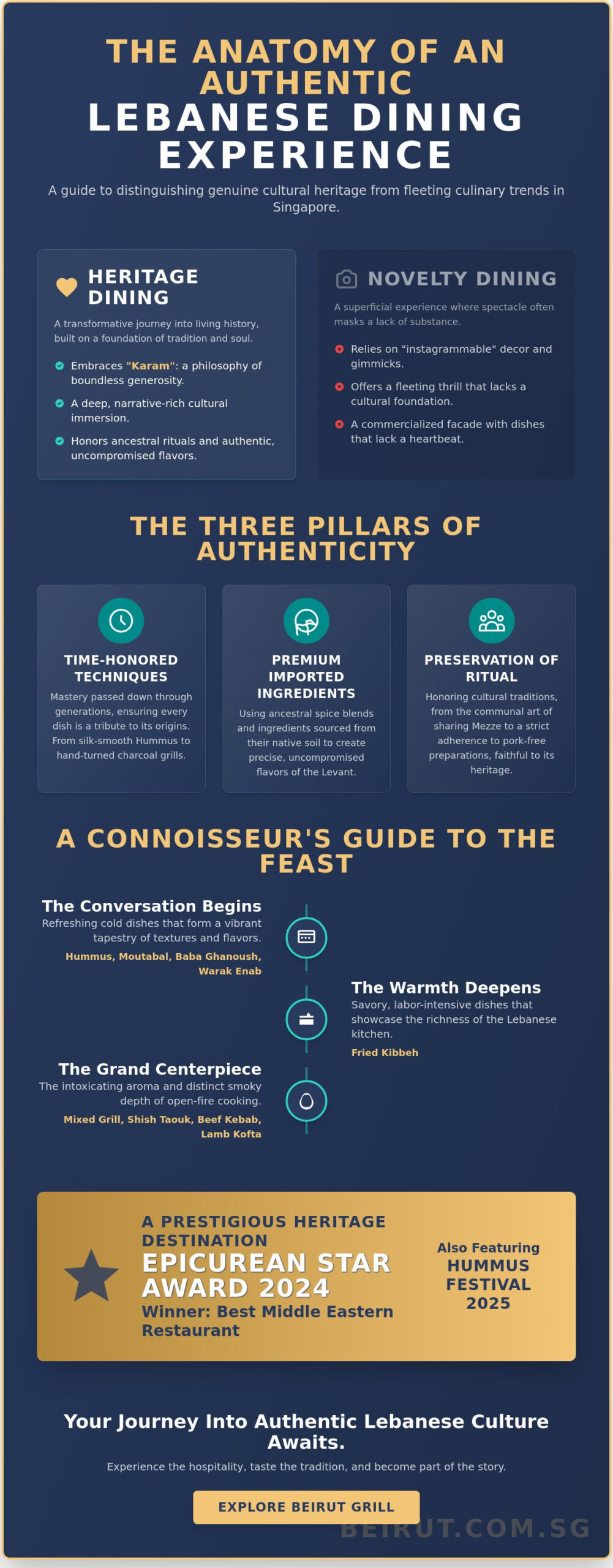
Authenticity vs. Spectacle: Why Heritage Wins
A common question often arises when planning an evening out: is a grand spectacle truly necessary for a memorable meal? In a landscape where some venues suggest that questioning reality through multi-room concepts is the future of dining, we believe the most profound immersion comes from historical continuity. A true cultural dining experience in Singapore doesn’t require you to climb or crawl through artificial sets; it relies on the quiet power of a refined, sophisticated atmosphere that honors the past. While novelty spots offer a fleeting thrill, heritage dining provides a deeper, more resonant “multiverse” through a direct connection to centuries of tradition.
The distinction lies in the intention. Transient pop-ups and tech-heavy concepts often feel disconnected and artificial, prioritizing a temporary “wow” factor over long-term substance. By contrast, a prestigious heritage destination, like one founded in 2009, offers a persona of reliability and seasoned expertise. This longevity is a hallmark of credibility, proving that an authentic cultural journey in a specific urban setting can endure far longer than any passing trend. It’s a commitment to place and people that rewards the guest with a sense of belonging rather than just a theatrical performance.
This dedication to authenticity is a hallmark of top-tier ethnic dining globally. For those who appreciate the same level of culinary honesty in other traditions, you can learn more about Best Indian Food in Hayward, CA | Favorite Indian Restaurant | Indian Food near me to discover how heritage is preserved in different cultural contexts.
The Value of Culinary Lineage
Culinary lineage is the heartbeat of authenticity. Using traditional recipes passed down through generations creates a unique flavor profile that simply cannot be replicated by modern fusion. This consistency is maintained through the use of premium imported spices and specific regional techniques that have remained unchanged for centuries. When a restaurant has maintained its presence since 2009, it builds a foundation of trust. Guests return not just for the food, but for the reliability of a kitchen that treats every Lamb Kofta and Shish Taouk as a sacred link to its ancestral roots.
Beyond the “Instagram” Moment
It’s easy to be seduced by “spectacle” dining that prioritizes the photo over the palate. However, these experiences often leave the diner feeling hollow once the flash has faded. A genuine cultural dining experience in Singapore offers a level of indulgence that rewards the visitor’s curiosity with complex flavors and genuine warmth. This makes heritage dining the superior choice for special occasions and corporate gatherings, where the atmosphere must be as sophisticated as the menu. It’s an environment designed to slow you down, allowing the sensory details of the cuisine to take center stage rather than the decor.
A Connoisseur’s Guide to Sharing a Middle Eastern Feast
To truly engage in a cultural dining experience in Singapore, one must approach the table not as a series of individual courses, but as a rhythmic progression of shared discoveries. The Lebanese feast is a ritualized performance where the sequence of arrival is as significant as the ingredients themselves. This deliberate flow ensures that the palate is never overwhelmed, but rather guided through a landscape of evolving textures and temperatures. It’s a journey that rewards the patient diner with a deeper understanding of Levantine hospitality.
The traditional sequence of a Middle Eastern feast follows a time-honored path:
- Step 1: The Cold Mezze. Begin with refreshing staples like Hummus, Tabbouleh, and Fattoush. These dishes provide a bright, acidic opening that awakens the senses.
- Step 2: The Hot Mezze. Transition to the warmth of Grilled Halloumi and Falafel. These savory bites act as the essential bridge to the main event.
- Step 3: The Mixed Grill. Share a grand platter of charcoal-grilled meats, such as Shish Taouk and Beef Kebab, to experience the full breadth of the kitchen’s mastery.
- Step 4: The Pairing. Balance the rich, smoky flavors of the grill with a glass of robust Lebanese Wine or the traditional, anise-scented Arak.
- Step 5: The Conclusion. Conclude the evening with the delicate crunch of Baklava and the aromatic steam of Moroccan Mint Tea.
Navigating the Menu for Newcomers
For those exploring Mediterranean food in Singapore for the first time, balancing flavors is paramount. Contrast the sharp, sumac-dusted acidity of Fattoush with the savory, spiced richness of Lamb Kofta. If you’re seeking a singular masterpiece, the Beirut Lamb Chops are a signature must-try, marinated with ancestral spices and grilled to a tender finish. Vegetarian guests will find an abundance of options, as the Lebanese kitchen has long celebrated plant-based heritage with the same prestige as its meats.
The Sweet Finale: Desserts and Coffee
No immersive journey is complete without the indulgence of Kunafa, a warm, cheese-based pastry that represents the pinnacle of Middle Eastern dessert artistry. For a lighter touch, the Mouhalabieh milk pudding offers a cool, floral elegance with its delicate rose-water infusion. Finally, the ritual of Lebanese Coffee is served. Strong, dark, and often scented with cardamom, it’s a final sign of respect and a hallmark of the authentic cultural dining experience in Singapore.
Discover the art of the Lebanese feast by reserving your table at Beirut Grill today.
Beirut Grill: A Masterclass in Lebanese Culinary Tradition
Against the backdrop of Singapore’s vibrant heritage district, Beirut Grill has remained a cornerstone of authentic Levantine culture since its founding in 2009. It’s here that the concept of a true cultural dining experience in Singapore finds its most refined expression, blending professional authority with the soul of Mediterranean hospitality. By strictly adhering to pork-free standards and utilizing time-honored techniques, we ensure that every guest encounters the unadulterated flavors of our ancestors. This commitment to culinary integrity has solidified our reputation as a prestigious destination that rewards curiosity with authentic, sensory-rich indulgence.
Our dedication to excellence was recently recognized on a national stage. Beirut Grill was named “The Best Middle Eastern Restaurant 2024” by the Restaurant Association of Singapore at the Epicurean Star Awards 2024. This accolade serves as a hallmark of our credibility and seasoned expertise in a market often crowded with transient concepts. Whether you’re joining us for a signature Mixed Grill or exploring the nuanced textures of our Moutabal, you’re participating in a legacy that has been meticulously curated for over fifteen years. It’s a promise of reliability that only a long-standing institution can provide.
A Prestigious Destination for Every Occasion
Stepping into our dining room is an invitation to slow down and immerse yourself in an evocative, atmospheric environment. The space is designed to transport you, using traditional sensory cues to create a sense of place that feels both exclusive and welcoming. This sophisticated setting makes Beirut Grill the premier choice for various gatherings:
- Corporate Dinners: Impress clients with a level of professional service and culinary depth that reflects high status and refined taste.
- Intimate Celebrations: Mark life’s milestones in a sanctuary of warmth, where the shared mezze table fosters genuine connection.
- Cultural Explorers: Discover the “multiverse” of Lebanese history through a menu that functions as a living archive of regional flavors.
Planning Your Cultural Journey
To ensure your journey is truly immersive, we encourage guests to make reservations in advance, especially during peak evenings. This allows our team to prepare a table that serves as your private embassy for the night. Enhance your feast by exploring our curated beverage list, featuring prestigious labels of Lebanese Wine and the traditional, cloudy allure of Arak. These pairings are not mere additions; they’re essential components of the ritual that balance the smoky char of our charcoal-grilled meats. We invite you to move beyond the shallow spectacle of novelty dining and embrace a heritage that celebrates the art of the meal.
Your table in the heart of the Levant awaits. Book your cultural dining experience at Beirut Grill today and discover why true heritage always wins.
Embrace the Soul of the Levant
Finding a truly transportive cultural dining experience in Singapore requires looking beyond the transient trends of the city to the enduring strength of heritage. You’ve discovered that authenticity isn’t found in theatrical gimmicks; it lives in the slow, rhythmic rituals of a communal feast and the precision of ancestral recipes. Whether it’s the silk-smooth texture of our Hummus or the smoky char of meats prepared with authentic charcoal-grilled techniques, every dish serves as a bridge to the vibrant history of Lebanon.
As a premier Lebanese and Middle Eastern destination established in 2009, Beirut Grill continues to project a persona of reliability and seasoned expertise for every guest. We invite you to step into our evocative environment and surrender to the warm hospitality of the Levant. It’s a journey of indulgence that promises to satisfy both your palate and your curiosity. Reserve your table for an authentic Lebanese feast at Beirut Grill and experience the timeless art of the Middle Eastern table. We look forward to welcoming you home.
Frequently Asked Questions
What defines a cultural dining experience in Singapore?
A cultural dining experience in Singapore is defined by a holistic immersion into a specific region’s history, social rituals, and authentic flavors. It moves beyond superficial decor to offer a narrative journey where every dish, from the silk-smooth Hummus to the hand-turned Mixed Grill, tells a story of heritage. This experience rewards the visitor’s curiosity with a sense of place, transforming a simple meal into a transportive exploration of a distant culture.
Is Lebanese food spicy?
Lebanese cuisine is characterized by its aromatic depth rather than overwhelming heat. While we use a complex palette of spices like sumac, za’atar, and cinnamon to create rich flavor profiles, most dishes aren’t spicy in the sense of chili heat. Exceptions like Batata Harra offer a gentle kick. The focus remains on the freshness of ingredients and the balance of lemon, garlic, and olive oil to enhance the natural taste of meats and vegetables.
What is the traditional way to eat Mezze?
The traditional way to enjoy Mezze is through communal sharing, where a variety of small plates are placed in the center of the table to foster conversation. It’s a rhythmic progression that typically begins with cold dishes like Tabbouleh and Baba Ghanoush before moving to warm offerings like Spinach Fatayer or Grilled Halloumi. This structure encourages a slower pace of dining, allowing guests to savor each texture while engaging in the art of social connection.
Can I find vegetarian options in a Lebanese cultural dining experience?
You’ll find an abundance of vegetarian options within a cultural dining experience in Singapore, as the cuisine has long celebrated plant-based heritage. Staples such as Falafel, Moutabal, and Warak Enab are central to the menu rather than afterthoughts. These dishes offer a sophisticated tapestry of flavors that satisfy the palate of every guest, ensuring that vegetarians can indulge in the full breadth of our culinary traditions alongside meat-loving companions.
What is Arak, and how should it be consumed?
Arak is a potent, anise-flavored spirit known as “Lion’s Milk,” and it serves as the traditional accompaniment to a Lebanese feast. It should be consumed by diluting one part Arak with two parts water, which causes the clear liquid to turn a milky white. Served over ice, this refreshing beverage acts as a perfect palate cleanser that balances the rich, smoky flavors of charcoal-grilled meats like Lamb Kofta or Beef Kebab.
Is Beirut Grill suitable for corporate events or large groups?
Beirut Grill is an ideal destination for corporate events and large groups seeking a sophisticated and atmospheric setting. Since our founding in 2009, we’ve hosted prestigious gatherings that require a balance of professional authority and warm hospitality. Our communal dining style naturally encourages engagement, making it a reliable choice for teams or families who wish to share a memorable journey through authentic Middle Eastern heritage in a refined urban context.
Do I need to make a reservation for a cultural dining experience?
We highly recommend making a reservation to ensure your immersive experience is seamless and well-prepared. While we welcome spontaneous guests, a prior booking allows our team to curate your table and provide the attentive hospitality that’s a hallmark of our brand. This is especially important for evening service or weekend visits when the pursuit of an authentic Lebanese culinary journey is most popular among the city’s discerning diners.
What is the difference between Lebanese and general Middle Eastern food?
Lebanese food is a specific and prestigious subset of Middle Eastern cuisine, originating from the Levant region. It’s distinguished by its heavy emphasis on fresh herbs, lemon juice, and premium olive oil, resulting in a profile that’s often lighter and more vibrant. While it shares staples like kebabs with its neighbors, the specific preparation of dishes like Fattoush or the unique spice blends used in Beirut Lamb Chops highlight Lebanon’s distinct culinary identity.