
What if the pinnacle of pastry isn’t found in heavy sugar saturation, but in the delicate crunch of a thousand paper-thin layers and the subtle fragrance of a blooming orange grove? Many enthusiasts often mistake all Middle Eastern sweets for the dense, syrup-soaked varieties found elsewhere, missing the refined artistry that sets authentic Lebanese baklava apart. Since 2009, we’ve shared the secret that the true beauty of this dessert lies in its restraint, where premium nuts and floral waters take center stage over cloying sweeteners.
In this exploration of the golden art, you’ll discover the heritage, intricate craftsmanship, and evocative aromas that define a truly prestigious pastry in Singapore. We’ll guide you through the sensory markers of high-quality craftsmanship, from the audible snap of the phyllo to the lingering notes of rose and orange blossom. You’ll also learn how to perfectly conclude a meal of shish taouk or lamb kofta by pairing these golden treasures with a bitter Lebanese coffee or a refreshing Moroccan mint tea for a complete cultural journey.
Key Takeaways
- Learn to distinguish the refined, floral-scented profile of authentic lebanese baklava from the heavier, syrup-saturated varieties found in other regional traditions.
- Discover the architectural precision behind forty layers of paper-thin phyllo pastry and why premium pistachios and cashews are the preferred choice for a superior crunch.
- Master the art of the pairing by discovering how the bitterness of traditional Lebanese Coffee or Moroccan Mint Tea balances the delicate sweetness of artisanal desserts.
- Understand the significance of ‘Attar’, the traditional scented syrup that provides an aromatic finish without overwhelming the natural oils of the nuts.
- Identify the hallmarks of professional-grade pastry that make it the essential crowning achievement for any prestigious Middle Eastern feast.
Defining the Essence: What is Authentic Lebanese Baklava?
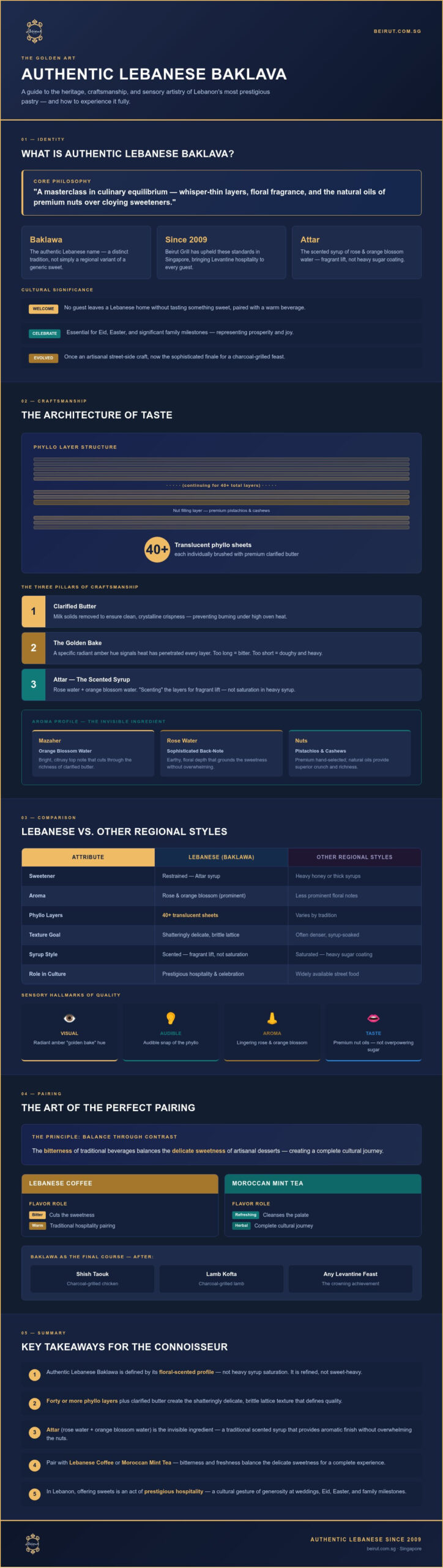
To understand the soul of Lebanese confectionery, one must first recognize its true name: Baklawa. While the global palate often groups these sweets under a single umbrella, the Lebanese variation stands as a distinct testament to culinary refinement. It is a philosophy of balance. Unlike versions that lean heavily on honey or thick syrups, the authentic Lebanese approach prioritizes the integrity of the ingredients. Every bite is a deliberate dialogue between the crunch of hand-selected nuts and the ethereal lightness of pastry. This dedication to quality has been a hallmark of Beirut Grill since 2009, ensuring that every guest experiences the same hospitality found in the heart of the Levant.
A Heritage of Flakiness and Floral Notes
The architecture of this dessert relies on dozens of translucent layers of phyllo dough, brushed with clarified butter to achieve a golden, brittle finish. While baklava’s rich history and regional variations span across the former Ottoman territories, the Lebanese style is uniquely characterized by “Attar.” This scented simple syrup, infused with rose and orange blossom waters, provides a fragrant lift rather than a heavy sugar coating. Lebanese baklava is a masterclass in culinary equilibrium, defined by its whisper-thin layers of pastry and a sophisticated infusion of orange blossom and rose water. This floral essence transforms the pastry into something more than a sweet; it becomes an evocative journey through a blooming Mediterranean garden.
The Cultural Significance of the Lebanese Sweet
In Lebanon, offering sweets is an act of prestigious hospitality. It’s a gesture of generosity that transcends simple feeding, acting as a bridge between the host and the guest. Whether it’s a religious holiday, a wedding, or a casual afternoon visit, a tray of assorted Baklawa is the centerpiece of the table. In Singapore, we continue this tradition by positioning these delicacies not just as food, but as a cultural signature of our heritage.
- A symbol of welcome: No guest leaves a Lebanese home without tasting something sweet, paired with a warm beverage.
- Celebratory staple: These pastries are essential for Eid, Easter, and significant family milestones, representing prosperity and joy.
- Culinary evolution: Once an artisanal street-side craft, it has evolved into a sophisticated finale for a charcoal-grilled feast of shish taouk or lamb kofta.
The transition of lebanese baklava from a simple treat to a fine-dining masterpiece reflects the Lebanese people’s pride in their culinary arts. It is a reward for the senses, designed to be savored slowly while the world outside fades away. It is not merely a dessert; it is the crowning achievement of a meal that honors centuries of tradition.
The Architecture of Taste: Ingredients and Craftsmanship
The structural integrity of authentic lebanese baklava begins with the meticulous stacking of phyllo dough. While baklava’s definition and culinary heritage emphasizes the use of thin pastry sheets, the Lebanese tradition elevates this to an art form of sheer precision. A master pastry chef typically layers forty or more translucent sheets to create the signature lightness. Each sheet is carefully brushed with premium clarified butter. This clarifying process is vital; by removing milk solids, we ensure the pastry achieves a clean, crystalline crispness that won’t burn under the high heat of the oven, resulting in a shatteringly delicate texture.
Achieving the perfect bake is a test of patience and seasoned expertise. The pastry must reach a specific, radiant amber hue often referred to as the “golden bake.” This color signals that the heat has penetrated every individual layer, transforming the butter-brushed dough into a brittle lattice. It’s a delicate balance where timing is everything. One minute too long results in an unappealing bitterness, while one minute too short leaves the internal layers doughy and heavy. This exacting standard is what we’ve upheld in Singapore since 2009, ensuring every piece meets the expectations of a true connoisseur.
The Secret of Orange Blossom and Rose Water
Aroma is the invisible ingredient that defines the Lebanese palate. We use Mazaher, or orange blossom water, to provide a bright, citrusy top note that cuts through the richness of the clarified butter. Rose water follows as a sophisticated back-note, grounding the sweetness with its earthy, floral depth. Unlike other regional styles that might saturate the pastry in heavy syrup, the Lebanese method involves “scenting” the layers. This technique ensures the fragrance lingers on the tongue and enhances the natural oils of the nuts without masking their quality.
Mastering the Crunch: Nut Varieties and Preparation
The heart of the pastry lies in its filling, where nut selection is paramount. While walnuts are common in other traditions, the Lebanese palate favors the vibrant green of premium pistachios and the creamy profile of cashews. These nuts aren’t merely crushed; they’re prepared using a specific coarse-grind technique. This method preserves the nut’s integrity, providing a substantial crunch that contrasts beautifully with the flaky exterior. After enjoying a main course of charcoal-grilled shish taouk or lamb kofta, this architectural marvel serves as the ultimate sensory reward for our guests.
- Regional Pistachios: Selected for their deep green color and high oil content, providing a robust flavor.
- Creamy Cashews: Used to provide a softer, buttery internal texture that complements the crispy phyllo.
- Textural Integrity: The coarse grind ensures the nuts don’t turn into a paste, maintaining a distinct “bite” within the layers.
Lebanese vs. Turkish Baklava: Key Differences for the Connoisseur
For the discerning diner, the distinction between regional styles is a matter of elegance versus intensity. While Turkish varieties are celebrated for their rich, buttery pools of syrup, authentic lebanese baklava offers a more disciplined, aromatic experience. The Lebanese approach relies on “Attar,” a delicate infusion of rose and orange blossom water that perfumes the pastry without compromising its structural integrity. This refined profile has been a cornerstone of the experience at Beirut Grill since we opened our doors in 2009, catering to those who seek a sophisticated balance of flavors.
The visual presentation also differs significantly. Lebanese artisans favor smaller, bite-sized geometries such as daintily rolled “fingers” or sharp diamonds. This allows for a higher ratio of crispy exterior to soft interior. While the Turkish palate often leans toward the robust, earthy flavor of walnuts, the Lebanese tradition prioritizes the vibrant green of pistachios and the creamy, mild crunch of cashews. This choice of nuts, combined with a lighter syrup application, ensures that the pastry remains light enough to be enjoyed as a frequent indulgence rather than a heavy, once-a-year treat.
Sweetness Profiles and Sugar Content
Lebanese sweets feel remarkably lighter on the palate because the floral essences provide a sensory complexity that doesn’t require excessive sugar to achieve impact. The science behind this lies in the aromatic top notes of the floral waters; they stimulate the olfactory senses, creating a perception of richness that isn’t tied to caloric density. Where Turkish baklava is often saturated with a heavy, honey-like syrup that pools at the bottom of the tray, lebanese baklava is lightly drizzled with a floral infusion that allows the individual layers to remain distinct and brittle.
Texture and Pastry Density
The hallmark of Lebanese craftsmanship is the “dryness” of the pastry. It shouldn’t leave a sticky residue on the fingers, but rather a dusting of fine, crystalline crumbs. This airy density is achieved through a specific cooling process that allows the syrup to be absorbed into the heart of the nuts while the phyllo layers stay crisp. This unique texture makes it the ideal companion for traditional beverages. We often suggest pairing these pastries with our bitter Lebanese Coffee or a fragrant Moroccan Mint Tea to cleanse the palate between bites.
- Syrup Intensity: A “light touch” of floral Attar vs. heavy honey or sugar saturation.
- Aromatic Balance: Dominant notes of rose and orange blossom vs. a focus on cooked butter.
- Portioning: Elegant, bite-sized shapes designed for refined snacking.
- Nut Selection: A prestigious focus on premium cashews and Aleppo-style pistachios.
By understanding these nuances, you can better appreciate the artistry required to produce a dessert that is both indulgent and ethereal. It is this commitment to the refined Lebanese style that distinguishes a truly authentic Middle Eastern experience in Singapore.
The Art of the Pairing: Elevating Your Lebanese Dessert
A prestigious meal doesn’t simply end with the final bite of a main course; it concludes with a curated transition into the world of sweetness. To truly appreciate the intricate nuances of lebanese baklava, one must consider the beverage that accompanies it. This isn’t merely a tradition but a sensory necessity. The deliberate interplay between temperature, bitterness, and aroma ensures that each delicate layer of pastry is experienced with absolute clarity. Since 2009, we’ve guided our guests through these rituals, transforming a simple dessert into an evocative cultural finale that rewards the curious palate.
Traditional Coffee and Tea Accompaniments
Lebanese Coffee remains the most venerable partner for our artisanal sweets. Brewed with intensity and served in small, handleless cups, it frequently features a fragrant hint of cardamom. This spice provides a warm, resinous counterpoint to the floral “Attar” syrup we discussed in previous sections. The intense bitterness of the coffee resets the palate, allowing the natural oils of the pistachios to emerge without the interference of sugar fatigue. Moroccan Mint Tea offers a different but equally compelling perspective. Its natural tannins and cooling menthol notes cut through the richness of the clarified butter, providing a refreshing lift. Proper etiquette dictates that these beverages are served alongside the sweets on a shared tray, encouraging a slow, communal appreciation of the moment.
Unexpected Pairings: Lebanese Wine and Arak
For those seeking a more spirited conclusion to their feast, the Bekaa Valley offers world-class Lebanese Wine that pairs beautifully with pastry. A late-harvest dessert wine provides a honeyed weight that matches the creamy density of cashews. However, the most authentic and perhaps surprising pairing is Arak, the legendary “Lion’s Milk.” This unsweetened, anise-flavored spirit undergoes a magical transformation when diluted with water, turning a milky white. Its cooling aniseed notes provide a brilliant contrast to the orange blossom water used in the lebanese baklava. It creates a clean, bracing finish that leaves the mouth refreshed and ready for the next delicate bite. Creating a tasting flight of these varied beverages allows for a prestigious exploration of how different liquids interact with the crunch of the phyllo.
You can experience these exquisite combinations and find your own favorite pairing by exploring our full selection of traditional beverages and desserts at Beirut Grill.
- Lebanese Coffee: Best for those who enjoy a sharp contrast between bitter and sweet.
- Moroccan Mint Tea: Ideal for a refreshing, palate-cleansing experience.
- Arak: A sophisticated choice for highlighting the floral and aniseed notes of the Levant.
- Sweet Lebanese Wine: Perfect for guests who prefer a rich, indulgent, and harmonious finish.
Savouring Authentic Heritage at Beirut Grill
To step through our doors is to leave the bustle of the city behind and enter a sanctuary of Middle Eastern refinement. Since 2009, we’ve dedicated ourselves to the art of hospitality, ensuring that every guest experiences the true soul of Lebanon. While many seek us out for our charcoal-grilled specialties, the journey is only complete when it culminates in our signature lebanese baklava. This golden pastry isn’t just a dessert; it’s the crowning achievement of a celebratory Mixed Grill feast, designed to linger on the palate long after the meal has ended.
Our kitchen operates under a strictly pork-free mandate, allowing us to focus entirely on the purity of traditional flavors and the integrity of our ingredients. This commitment ensures that the delicate floral waters and premium nut oils in our sweets remain untainted, preserving the heritage of the Levant in every bite. It’s a standard that reflects our role as curators of authentic culture, offering a safe and prestigious environment for all who wish to explore the depths of Lebanese cuisine.
A Legacy of Excellence in Singapore
For over 15 years, we’ve served as a premier destination for those seeking an authentic cultural journey. Our longevity is a hallmark of credibility, reflecting a refusal to compromise on the quality of our culinary offerings. We believe that true luxury lies in the details, which is why we prioritize imported ingredients from prestigious regional labels. From the hand-picked pistachios in our pastries to the specific grains used in our mezze, every element is chosen to reflect the highest standards of Mediterranean Food in Singapore. This dedication transforms a simple evening into a prestigious event that rewards your curiosity with every sensory detail.
Completing the Lebanese Culinary Journey
The transition from the savory heat of lamb kofta to the cool, floral notes of dessert is a carefully choreographed ritual. As the embers of the charcoal grill fade, the table is cleared to make way for a curated selection of sweets that define our heritage. Alongside our lebanese baklava, we invite you to experience the indulgent, cheese-filled warmth of our Kunafa, a dish that captures the heart of Middle Eastern street culture elevated for a sophisticated setting. To finish, allow us to pour a glass of Bekaa Valley wine or a refreshing serve of Arak, the “Lion’s Milk.” It’s an invitation to slow down, immerse yourself in the surroundings, and savor the golden art of a culture that has mastered the balance of life’s finest pleasures.
Embark on Your Own Lebanese Culinary Journey
The artistry of the Levant is found in the restraint of its flavors and the architectural precision of its layers. You’ve discovered how authentic lebanese baklava prioritizes the aromatic lift of orange blossom and rose water over heavy sugar saturation, creating a dessert that is both sophisticated and light. Since 2009, we’ve upheld these prestigious traditions in Singapore, offering a destination where heritage is served on every plate. Our strictly pork-free kitchen and authentic charcoal-grilling techniques provide the perfect prelude to these golden, floral-scented treasures.
Whether you’re concluding a feast of shish taouk or seeking a refined afternoon pairing with bitter Lebanese Coffee or a glass of Arak, the experience at Beirut Grill is designed to transport you. We invite you to celebrate over 15 years of culinary excellence with us, where every bite serves as a testament to the enduring beauty of Lebanese hospitality. The crunch of the phyllo and the fragrance of the Bekaa Valley await your discovery.
Reserve Your Table at Beirut Grill to Experience Authentic Lebanese Baklava and discover the true meaning of a golden finish.
Frequently Asked Questions
What is the main difference between Lebanese baklava and Turkish baklava?
Authentic lebanese baklava distinguishes itself through the use of “Attar,” a light simple syrup infused with rose and orange blossom water. This contrasts with the heavier honey or thick sugar syrups favored in Turkish traditions. The result is a pastry that feels lighter on the palate and emphasizes the natural oils of the nuts. Additionally, Lebanese varieties are often smaller and more delicate, favoring cashews and pistachios over walnut dominance.
Is Lebanese baklava vegan or vegetarian?
While our pastries are entirely vegetarian, they’re typically not vegan due to the traditional use of clarified butter or ghee. These fats are essential for achieving the shatteringly crisp texture of the forty plus phyllo layers. Every piece is crafted without any animal fats beyond dairy, ensuring a clean and indulgent experience. We maintain these standards across our entire dessert selection to honor the authentic preparation methods used in the Levant for generations.
What nuts are traditionally used in authentic Lebanese baklava?
Authentic versions rely on a prestigious selection of premium nuts, with pistachios and cashews taking center stage. We choose these for their vibrant color and creamy textures which complement the floral notes of the syrup. While walnuts are sometimes included, they’re rarely the primary focus in a professional Lebanese kitchen. The nuts are coarsely ground rather than pulverized, ensuring each bite provides a substantial and rewarding crunch that defines our artisanal heritage.
How long can Lebanese baklava be stored without losing its crunch?
You can enjoy the optimal crunch of this pastry for up to three weeks when stored correctly. Because the Lebanese style uses a lighter application of syrup compared to other regional varieties, the phyllo layers don’t become soggy as quickly. It’s best to keep them in an airtight container at room temperature in a cool, dry place. Avoid refrigeration, as the moisture can soften the delicate dough and dull the vibrant aromas of the floral waters.
Why is Lebanese baklava often called “Baklawa”?
The term “Baklawa” is the traditional Arabic transliteration and serves as a hallmark of cultural identity. Using this nomenclature highlights the specific Levantine heritage of the recipe, distinguishing it from the Turkish or Greek “Baklava.” For the connoisseur, this name signals a refined preparation style that emphasizes floral infusions and a lighter touch of sweetness. It reflects our pride in maintaining the linguistic and culinary roots of our ancestors since we established ourselves in 2009.
Does Lebanese baklava contain honey or sugar syrup?
Authentic versions utilize a scented simple syrup known as Attar rather than honey. This syrup is a precise blend of sugar and water boiled with lemon juice and generously infused with orange blossom and rose waters. This choice is deliberate; honey can often overpower the subtle flavors of the premium nuts and delicate pastry. By using Attar, we ensure the floral fragrance remains the dominant aromatic profile, providing a sophisticated and refreshing finish to your meal.
What is the best beverage to drink with Lebanese sweets?
The ideal accompaniment depends on your desired sensory outcome. A bitter Lebanese Coffee infused with cardamom provides a sharp, bracing contrast to the pastry’s sweetness, acting as a palate cleanser. Alternatively, a warm Moroccan Mint Tea offers refreshing menthol notes that cut through the richness of the clarified butter. For a more spirited conclusion, we recommend a glass of Lebanese Wine or a serving of Arak to highlight the aniseed and floral complexities of the dessert.
Is the baklava at Beirut Grill suitable for those seeking a pork-free diet?
Every dish served at our establishment is strictly pork-free, including our entire range of traditional desserts. We’ve upheld this commitment across our national operations in Singapore since 2009, providing a reliable destination for those with specific dietary requirements. Our kitchen focuses on the purity of ingredients and traditional charcoal-grilling techniques, ensuring that your transition from a savory Mixed Grill to a plate of lebanese baklava is both authentic and inclusive of your lifestyle choices.