
Could a single, golden-hued orb of fried legumes spark a centuries-old debate that spans the vibrant streets of Cairo to the sun-drenched hills of Beirut? For many culinary enthusiasts, the question, is falafel lebanese or egyptian, remains one of the most delicious mysteries in the world of heritage cooking. You’ve likely encountered conflicting stories online or felt a sense of confusion while browsing regional menus across Singapore. It’s frustrating when you’re seeking the truth behind a dish that feels so deeply rooted in history and place.
We understand that finding authentic, heritage-based explanations is rare in an age of fast-food imitations. This guide promises to transport you through the fascinating historical origins and sensory differences between Egyptian ta’ameya and Lebanese falafel. We’ll examine why Egypt provided the ancient spark while Lebanon perfected the global standard. From the earthy depth of fava beans to the light, nutty crunch of chickpeas, we’ll reveal how these regional recipes differ. By the end, you’ll have a clear understanding of this culinary icon’s journey and know exactly where to experience the prestigious flavors of Lebanon right here in Singapore.
Key Takeaways
- Uncover the fascinating history of this culinary icon, tracing its roots from ancient Egyptian traditions to the prestigious tables of the Levant.
- Resolve the long-standing debate over whether is falafel lebanese or egyptian by identifying the specific regional ingredients that define each version.
- Learn to distinguish between the light, herb-forward Egyptian ta’ameya and the golden, nutty crunch of an authentic Lebanese chickpea falafel.
- Discover how to curate a complete Lebanese dining experience by pairing these savory fritters with traditional mezze and imported regional wines.
- Identify a refined destination in Singapore that has been preserving these sacred culinary techniques and heritage flavors since 2009.
The Great Falafel Debate: A Matter of Middle Eastern Pride
Imagine the bustling morning markets of Cairo or the elegant, sun-drenched dining rooms of Beirut. In both settings, the intoxicating aroma of deep-fried legumes and fresh, aromatic herbs fills the air. Falafel is more than just a dish; it’s the rhythmic heartbeat of Middle Eastern street food and a prestigious cornerstone of the traditional mezze spread. Yet, beneath its crunchy, golden exterior lies a spirited rivalry that has simmered for generations. For decades, food historians and proud locals have debated whether the true origin of falafel rests in the ancient land of the Pharaohs or the cedar-lined mountains of the Levant.
The question of whether is falafel lebanese or egyptian isn’t merely a matter of geography. It’s a sophisticated debate about culinary evolution and cultural heritage. One nation claims the initial spark of invention, while the other claims to have refined the recipe into the global icon we recognize today. Determining whether is falafel lebanese or egyptian requires us to look past the crispy shell and into the very soul of the ingredients used, setting the stage for a journey through time and across borders.
Why the Origin Story Matters
In the Mediterranean and the Middle East, a recipe is a sacred inheritance. Food serves as a powerful marker of national pride, acting as a tangible link to ancestors who prepared the same meals under different skies. The so-called ‘Falafel Map’ stretches from the busy, historic corners of Cairo to the cosmopolitan, refined streets of Beirut, and even to our own vibrant food scene in Singapore. Within Lebanese culture, falafel holds a specialized place of honor. It isn’t just a quick snack; it’s an essential component of a grand mezze feast, designed to be shared slowly among friends alongside smooth hummus and a glass of chilled Lebanese Wine.
Defining the Two Contenders
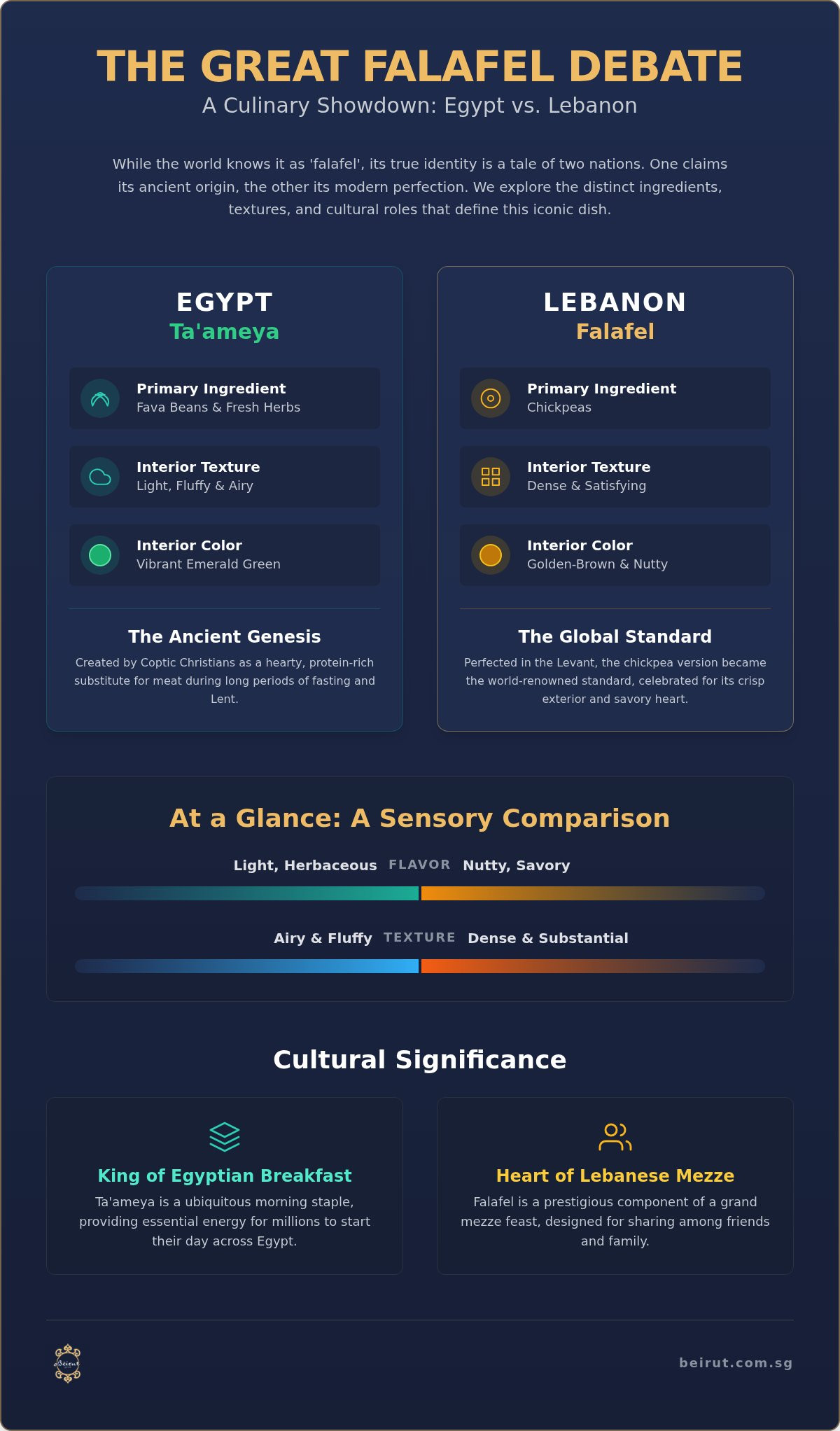
While the world often uses the umbrella term ‘falafel’, the preparation varies significantly depending on the regional geographic markers. In Egypt, you’ll find Ta’ameya, a vibrant green fritter characterized by its use of crushed fava beans and a generous handful of fresh leeks. Travel north to the Levant, and you’ll encounter the classic Lebanese version. This recipe favors the chickpea, resulting in a nuttier profile and a more substantial, savory heart.
- Egyptian Ta’ameya: Primarily fava beans; known for a lighter, fluffier interior and a bright herb profile.
- Lebanese Falafel: Primarily chickpeas; celebrated for its golden-brown, crisp exterior and dense, satisfying texture.
This heritage dish bridges ancient history and modern dining, proving that a simple recipe can carry the weight and allure of a thousand years of culture.
The Egyptian Genesis: The Story of Ta’ameya
To understand the roots of this global icon, one must look toward the fertile banks of the Nile. The most widely accepted theory in the history of falafel suggests that the dish was born in Egypt, where it’s known as Ta’ameya. Long before it became a staple of cosmopolitan dining, it served a specific spiritual and practical purpose. Historians often link its creation to Egypt’s Coptic Christians, who sought a satisfying, protein-rich meat substitute during the long periods of fasting and Lent. This ancient heritage imbues the dish with a sense of cultural weight that transcends simple street food.
The primary difference in the debate over whether is falafel lebanese or egyptian begins with the choice of legume. In Egypt, the foundation is the fava bean (Vicia faba). This choice creates a sensory experience quite distinct from other regional versions. Because the beans are soaked and ground with a generous abundance of fresh leeks, parsley, and coriander, the resulting fritter is remarkably light and airy. When you break open a freshly fried Ta’ameya, you’re greeted by a vibrant, emerald-green interior and a delicate, almost soufflé-like texture that contrasts beautifully with its crisp outer shell.
The Ancient Roots of the Fava Bean
The Nile Delta’s rich, silty soil provided the perfect environment for fava beans to flourish, cementing their place in the local diet for millennia. Today, Ta’ameya remains the undisputed king of the Egyptian breakfast table, often enjoyed by millions as they start their day. The linguistic journey is equally evocative. While the locals call it Ta’ameya, meaning “a small morsel of food,” the term falafel eventually emerged as a broader descriptor, likely derived from the Arabic word filfil, referring to the warm spices that season the mix.
How Ta’ameya Traveled North
As trade flourished along the Mediterranean coast, this ingenious recipe traveled north through ancient maritime and desert routes. As the dish reached the shores of the Levant, it underwent a fascinating transformation. While the core concept of a fried legume patty remained, the local ingredients of Lebanon and its neighbors began to reshape the dish’s identity. This migration is where the tension in the question is falafel lebanese or egyptian truly takes hold, as the Levant swapped the fava bean for the chickpea. If you’re curious to taste how these traditions evolved into a refined art form, you can experience the prestigious flavors of Lebanese mezze at our sanctuary of heritage.
The Lebanese Legacy: How the Levant Perfected the Chickpea
While the Nile Delta provided the initial spark, it was the sun-drenched hills of the Levant that truly refined the recipe into the version most recognized by global gourmets. The transition from the Egyptian fava bean to the chickpea (Cicer arietinum) wasn’t a mere accident of history. It was a calculated evolution that allowed the dish to take on a more robust, nutty character. This shift often fuels the modern falafel battle between purists who prefer the light Egyptian style and those who champion the Levantine standard. When diners ask, is falafel lebanese or egyptian, they’re often comparing two entirely different sensory experiences.
The Lebanese falafel is defined by its architectural perfection. It boasts a deep golden, remarkably crisp exterior that yields to a dense, savory heart. Understanding whether is falafel lebanese or egyptian requires appreciating the Levant’s specific mastery over the chickpea. This texture is achieved through a precise, time-honored technique: the chickpeas are never cooked, but rather soaked for hours until they reach the ideal consistency for grinding. This ensures the fritter maintains its structural integrity during the frying process, avoiding the oiliness sometimes found in lesser preparations.
The Chickpea Revolution
In Lebanon and Syria, chickpeas became the preferred base because they offered a more neutral canvas for a sophisticated blend of spices. A traditional Lebanese mix relies heavily on high-quality cumin and coriander, which provide an earthy warmth that complements the legume’s natural sweetness. This version isn’t just a snack; it’s a nutritional powerhouse. It’s packed with plant-based protein and fiber, making it a cornerstone of the Mediterranean diet. The secret to that iconic crunch lies in the balance of the grind. It must be coarse enough to provide texture, yet fine enough to hold together without the need for excessive binders.
A Staple of the Lebanese Mezze Table
Within a prestigious Lebanese feast, falafel is never served in isolation. It’s an essential player in a symphony of flavors, often positioned alongside a creamy bowl of Hummus and fresh, zesty Tabbouleh. The presentation is an art form in itself. Each plate is adorned with vibrant pickled turnips, fresh sprigs of parsley, and a generous drizzle of nutty tahini sauce. This combination creates a deliberate contrast between the hot, crunchy fritter and the cool, acidic garnishes. Truly, Lebanese falafel represents the ultimate balance of humble, earth-grown ingredients and the complex, disciplined techniques of a seasoned host.
Ta’ameya vs. Falafel: A Sensory Comparison
The moment a guest breaks open a freshly fried fritter, the debate over whether is falafel lebanese or egyptian shifts from historical theory to pure sensory reality. While both versions share a common lineage, the mouthfeel and aromatic profile offer distinct experiences for the discerning palate. Understanding these nuances is essential for anyone who views dining as a cultural journey rather than just a meal.
The primary bean remains the most significant divider. Egypt’s ta’ameya relies on the fava bean, which yields a moist, almost creamy interior. This moisture is balanced by an incredible airiness, a result of the beans being whipped into a fine paste before hitting the oil. In contrast, the Lebanese version uses the chickpea to create a nutty, substantial heart. It’s a denser bite, offering a satisfying resistance that celebrates the legume’s natural texture and structural integrity.
Aromatic profiles further distinguish these regional icons. Egyptian ta’ameya is unapologetically herb-forward. It’s often so packed with fresh leeks, parsley, and coriander that it feels like a garden in a bite. The Lebanese approach is more spice-forward, emphasizing the warm, earthy depths of premium cumin and coriander seeds. This creates a sophisticated flavor profile that lingers on the tongue, inviting another bite. When diners ask is falafel lebanese or egyptian, they’re often choosing between the bright freshness of the Nile and the spiced warmth of the Levant.
The Visual and Textural Contrast
Visually, the two are worlds apart. Crack open a ta’ameya and you’ll find a striking, bright emerald green. The Lebanese falafel reveals a soft, pale gold interior, mirroring the sun-bleached landscapes of the Levant. This structural difference isn’t just aesthetic. The chickpea-based Lebanese version is notably more durable. Its firm exterior provides the perfect vessel for being tucked into warm pita bread, maintaining its crunch even when layered with sauces. Achieving that perfect golden crust is a science, requiring precise oil temperatures to ensure the outside is shatteringly crisp while the inside remains tender.
Serving Traditions and Pairings
In Egypt, ta’ameya is the soul of the morning, often served simply with aish baladi and a crisp salad. In the Levant, it’s an elevated component of a grand meal. For those seeking the most authentic Middle Eastern food in Singapore, the Lebanese presentation is a curated experience. It’s served as part of a wider mezze selection, where the hot fritter meets the cool acidity of pickled turnips and fresh parsley. The universal constant, however, is the tahini drizzle. A high-quality, velvet-smooth tahini is non-negotiable, bridging the gap between the two styles with its rich, nutty finish.
Experience this sensory journey for yourself and decide where your loyalty lies. Book your heritage dining experience and taste the perfection of Lebanese falafel today.
Experiencing Heritage: Falafel at the Heart of Singapore
While the question of whether is falafel lebanese or egyptian may spark spirited debates among historians, for the diner in Singapore, the answer is found in the first golden, crunchy bite. Since our establishment in 2009, Beirut Grill has stood as a guardian of Levantine culinary traditions. We don’t just serve food; we curate a sensory journey that honors the meticulous techniques of our ancestors. Every fritter we serve is a testament to the Lebanese legacy of the chickpea, prepared with a reverence that respects the dish’s ancient roots while elevating it for a sophisticated modern palate.
The difference lies in the commitment to authenticity. Many versions found in local casual settings may lose the nuance of the original recipe, but our kitchen remains dedicated to the heritage-rooted methods that define true Lebanese falafel. It’s about the patience required for the perfect soak and the precise blend of imported spices that provide that unmistakable aromatic warmth. This dedication ensures that when you wonder whether is falafel lebanese or egyptian, you’re experiencing the definitive Lebanese expression of the craft.
From Beirut to the Dining Table
Our atmosphere is designed to transport you far from the city’s humidity to a refined Mediterranean sanctuary. The scent of charcoal-grilled meats and fresh herbs sets a scenic stage for your meal. We source prestigious regional spices to ensure the flavor profile remains uncompromised and deeply evocative of our heritage. After indulging in the savory depths of our mezze, we invite you to explore the full spectrum of Kunafa and other desserts. It’s the perfect conclusion to a meal that celebrates the enduring allure of Middle Eastern hospitality.
The Perfect Mezze Pairing
To truly appreciate the falafel, one must see it as part of a larger, harmonious spread. We suggest beginning your journey with a selection of our signature dips, such as silky Hummus and smoky Baba Ghanoush, paired with the zesty brightness of Tabbouleh. Adding a plate of Grilled Halloumi creates a delightful contrast of textures that rewards your curiosity. This style of dining, rooted in sharing and indulgence, is the hallmark of our service. Our knowledgeable hosts are proud to guide you through these cultural stories. We encourage you to reserve your table in advance to ensure your place at our table for your next cultural culinary journey.
Savoring the Legacy of the Levant
The journey from the fava bean fields of the Nile to the chickpea-rich hills of Lebanon reveals a culinary evolution that spans centuries. While Egypt holds the title for the dish’s inception, the Levant has undoubtedly elevated it to a prestigious global standard. Understanding whether is falafel lebanese or egyptian allows you to appreciate the subtle textures and aromatic profiles that distinguish these two cultural icons. Whether you prefer the airy, herb-forward ta’ameya or the golden, nutty crunch of the Lebanese version, you’re participating in a living history that connects ancient traditions to modern tables.
We invite you to immerse yourself in this heritage at our sanctuary of flavor. Since 2009, we’ve remained committed to preserving authentic Lebanese traditions through time-honored techniques. Our pork-free and halal-friendly menu features exquisite mezze prepared with traditional charcoal-grilling methods, ensuring every bite carries the weight of culture and pride. Book Your Heritage Dining Experience at Beirut Grill and discover why we’re the trusted guardian of Lebanese cuisine in Singapore. We look forward to hosting your next journey through the senses.
Frequently Asked Questions
Is falafel originally from Egypt or Lebanon?
Historical evidence suggests that falafel most likely originated in Egypt. It was initially known as ta’ameya and was crafted by Coptic Christians as a protein-rich meat substitute during periods of fasting such as Lent. Over centuries, the recipe migrated through ancient trade routes to the Levant. Once it reached Lebanon and its neighbors, the ingredients were adapted to local tastes, sparking the regional evolution we celebrate today.
What is the difference between Egyptian ta’ameya and Lebanese falafel?
The primary distinction lies in the base legume used for the mixture. Egyptian ta’ameya is crafted from crushed fava beans, resulting in a lighter, fluffier texture and a vibrant green interior. Lebanese falafel favors the chickpea, which provides a nuttier flavor and a denser, more substantial heart. Determining the difference is central to the question of whether is falafel lebanese or egyptian, as each version offers a unique sensory journey.
Why do Lebanese people use chickpeas instead of fava beans?
Chickpeas became the preferred foundation in the Levant because they were more abundant in the local landscape. Beyond availability, chickpeas offer a sturdy structure that achieves a superior crunch when deep-fried. This legume also provides a neutral canvas that allows the sophisticated Lebanese spice profile, featuring earthy cumin and coriander seeds, to truly shine. This transition represents the Levant’s specific refinement of the original Egyptian concept into a global standard.
Is falafel always vegan and gluten-free?
Authentic falafel is naturally vegan as it consists of legumes, fresh herbs, and spices. It is a cornerstone of the plant-based Mediterranean diet. However, it is not always gluten-free. While the core ingredients are free from wheat, some traditional recipes or modern adaptations include a small amount of flour or breadcrumbs as a binder. Guests with specific dietary requirements should always consult their host to ensure a safe and indulgent experience.
What is the best way to serve authentic falafel?
To enjoy falafel as a true connoisseur, it should be served as part of a prestigious mezze spread. It pairs beautifully with creamy hummus, smoky baba ghanoush, and the zesty acidity of tabbouleh. The experience is incomplete without a velvet-smooth tahini sauce and a selection of pickled vegetables. This combination of hot, crunchy fritters and cool, refreshing sides creates the balanced harmony that defines traditional Lebanese hospitality at the table.
How did falafel become so popular globally?
Its global rise is driven by the increasing demand for nutritious, plant-based dining. The global falafel market was valued at approximately S$24.6 billion in 2025 and is projected to reach S$39.8 billion by 2033. This growth reflects a 6.8 percent compound annual growth rate. Social media influence and a 12 percent year-over-year increase in the plant-based food market have further cemented its status as a versatile, healthy, and culturally rich culinary icon.
Can I find authentic Egyptian ta’ameya in Singapore?
While the debate over whether is falafel lebanese or egyptian continues, the chickpea-based Lebanese version is far more prevalent in Singapore’s refined dining scene. Specialty Egyptian outlets do exist in local neighborhoods, offering the fava-bean ta’ameya. However, for those seeking a sophisticated atmosphere and a deep connection to heritage, the Lebanese falafel remains the most sought-after choice for a curated mezze feast that transports the guest to the Mediterranean.
What makes the falafel at Beirut Grill unique?
Since 2009, we’ve stood as the guardian of Lebanese culinary heritage in Singapore. Our falafel is unique because we strictly adhere to traditional soak-and-grind techniques that avoid the oiliness of casual preparations. We use a proprietary blend of premium imported spices to ensure an evocative, aromatic warmth. Served within a prestigious, pork-free menu, our falafel acts as an entry point to a wider feast that rewards the visitor’s curiosity through authentic heritage.