
What if Lebanon’s most emblematic dish is less a single recipe than a family of traditions? Ask what is the national dish of lebanon, and kibbeh is the answer most often given, though different sources may point to other beloved Lebanese foods. Its place in the country’s food culture comes from its versatility and its presence at family gatherings and celebrations, rather than an official national designation.
At its heart, kibbeh brings together finely ground meat, bulgur wheat, onion, and spices, shaped and prepared in distinct ways. You might encounter crisp fried kibbeh, a layered baked version, or kibbeh nayyeh, served raw. Each style offers a different taste and texture, and knowing the names makes a Lebanese menu easier to navigate. In this guide, learn why kibbeh is widely regarded as Lebanon’s national dish, how its main preparations differ, and how to enjoy it among the shared plates of a Lebanese meal. Beirut Grill’s Fried Kibbeh offers one cooked way to experience this storied dish alongside mezze and other Lebanese favourites.
Key Takeaways
- For readers asking “what is the national dish of lebanon,” kibbeh is widely regarded as Lebanon’s emblematic dish, though it has no official national designation.
- Kibbeh’s familiar ingredients are bulgur wheat, meat, and seasonings, but recipes differ between households and preparations.
- Raw, baked, and fried kibbeh have distinct textures and presentations, shaped by their cooking methods.
- Kibbeh can be enjoyed as part of a shared Lebanese meal, alongside mezze and other complementary dishes.
- Beirut Grill’s Fried Kibbeh is one cooked way to encounter this versatile Lebanese favourite.
Lebanon’s National Dish: Why Kibbeh Is the Leading Answer
If you’re asking what is the national dish of lebanon, kibbeh is widely regarded as the country’s national or emblematic dish. That description reflects its cultural importance and enduring place in Lebanese cooking, not an official government designation. Lebanon’s food traditions are diverse, so no single dish represents every family or table. Still, kibbeh stands out as a powerful culinary symbol.
Kibbeh is a Lebanese dish made from finely prepared bulgur wheat and ground meat, seasoned and shaped in a variety of forms. Its adaptable preparations and associations with shared meals help explain why it resonates across generations. The Kibbeh overview traces the dish’s name and history and illustrates its many preparations, from fried and baked versions to raw kibbeh.
Is kibbeh officially Lebanon’s national dish?
Kibbeh is commonly called Lebanon’s national dish, but it’s more accurate to understand that phrase as a reflection of cultural recognition than as a formal title bestowed by the government. A national dish can express a country’s culinary identity without having one legally designated answer. Lebanese cuisine is rich with regional and family traditions, and beloved dishes vary from one table to another. Kibbeh is the leading answer, not an uncontested one.
What makes kibbeh distinct from other Lebanese favourites?
Its versatility gives kibbeh a place beyond that of a small accompaniment. Depending on its preparation, it may be served as part of a mezze spread or take a more substantial role in a meal. Hummus and tabbouleh are also celebrated Lebanese favourites, often enjoyed among shared plates, but they aren’t official alternatives to kibbeh’s emblematic status. It’s less about ranking dishes than appreciating the different character each brings to the table.
Kibbeh’s defining mixture can be shaped and cooked in different ways, making it adaptable to the occasion and the cook’s tradition. That flexibility connects it to both everyday meals and gatherings where food is shared. For a wider view of the region’s culinary traditions, explore this guide to Middle Eastern food.
What Is Kibbeh Made Of? The Ingredients Behind Lebanon’s Signature Dish
For anyone wondering what is the national dish of lebanon made from, kibbeh’s familiar foundation is finely prepared bulgur wheat, ground meat, and seasonings. The exact ingredients and proportions vary. Kibbeh belongs to a rich tradition of household and regional recipes, not one fixed formula.
Bulgur is cracked wheat prepared to blend with other ingredients. In some versions, it combines with meat to create a seasoned outer mixture shaped around a filling. The result has distinct layers: a savoury centre enclosed by a grain-and-meat casing. Other preparations handle the ingredients differently, changing the balance and texture from one style to the next.
How do bulgur and meat shape kibbeh?
Bulgur gives the mixture body and a gently textured character, while meat contributes savoury depth. Depending on the preparation, meat may be worked into the outer mixture, used as a filling, or appear in both. A filled form contrasts an outer shell with a more concentrated centre. In other styles, the seasoned mixture itself takes the lead. These are broad patterns, not rules shared by every recipe.
How is kibbeh seasoned and prepared?
Seasoning varies too. Aromatics and spices reflect personal preferences and local traditions rather than a universal blend. The mixture is shaped for the intended preparation, and form, thickness, and cooking method all affect the finished bite. The result might have a crisp exterior or a softer, more yielding texture.
That flexibility is part of the pleasure of understanding the dish. One recipe might shape the mixture around a filling, while another uses a different structure. Ingredients, proportions, and seasoning can all shift, so a description of kibbeh’s core components is a guide, not a definitive recipe.
In brief, kibbeh is built around bulgur wheat, meat, and seasonings, combined and shaped in ways that vary by recipe and preparation. This foundation leaves room for cooks to create distinct textures and expressions of the dish. To try one cooked preparation, enjoy Beirut Grill’s Fried Kibbeh as part of a wider exploration of Lebanese dishes.
Kibbeh Nayyeh, Baked, or Fried: How Lebanese Kibbeh Styles Differ
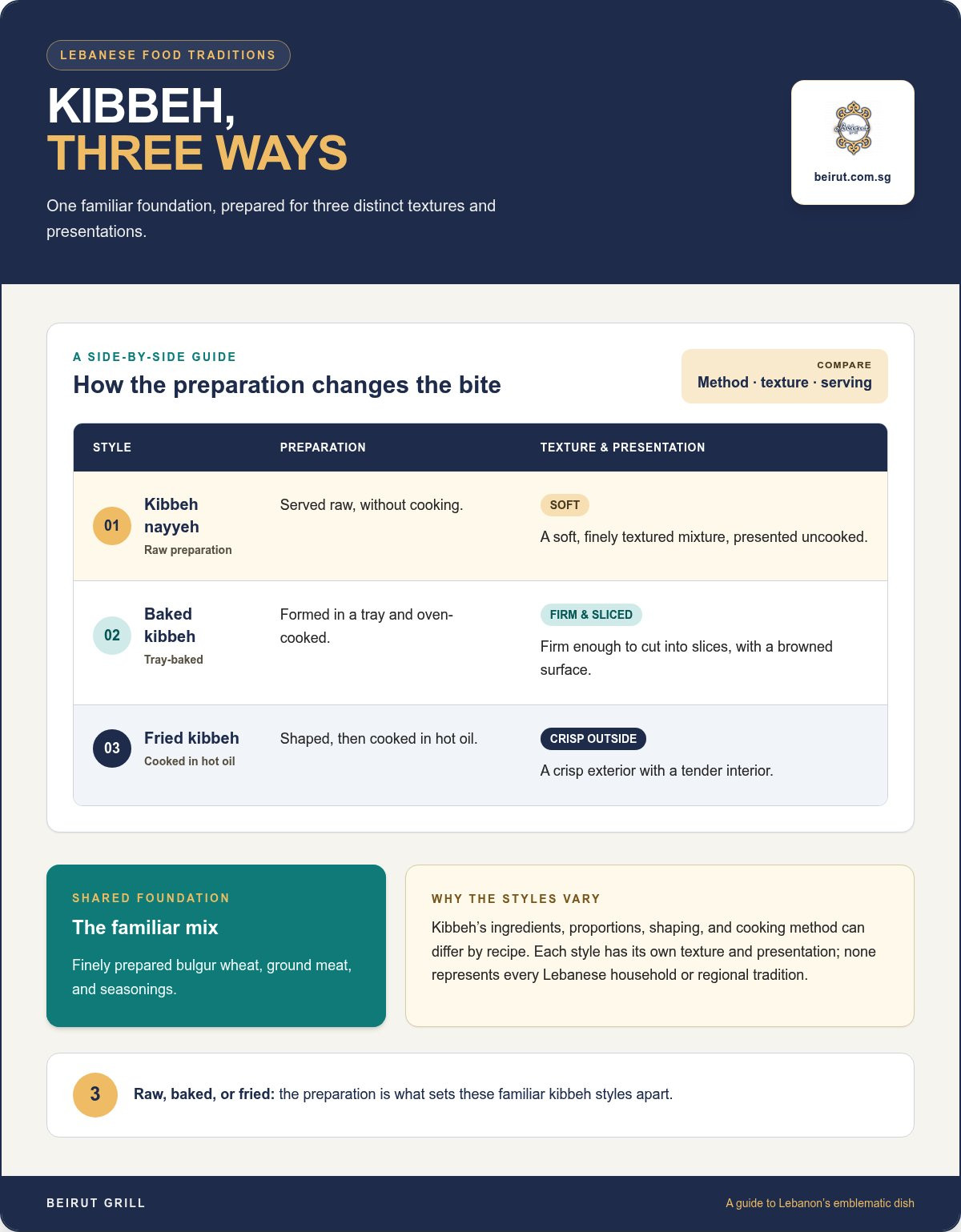
One reason the answer to what is the national dish of lebanon can’t be reduced to a single recipe is the range of ways kibbeh is prepared. The same culinary tradition can be served uncooked, baked in a tray, or fried into crisp pieces. Each style offers a distinct texture and presentation, and none represents every Lebanese household or regional tradition.
| Style | Preparation | Texture and presentation |
|---|---|---|
| Kibbeh nayyeh | Served raw | Soft, finely textured mixture, presented without cooking |
| Baked kibbeh | Formed in a tray and oven-cooked | Firm enough to cut into slices, with a browned surface |
| Fried kibbeh | Shaped and cooked in hot oil | Crisp outside, with a tender interior |
What is kibbeh nayyeh?
Kibbeh nayyeh is a raw preparation, distinct from baked or fried versions because it isn’t cooked. Its place in Lebanese food culture reflects a particular tradition and taste; it isn’t the form everyone prefers or the only way to enjoy the dish. For a first-time diner, the name signals the main difference: this kibbeh is served raw, while the other familiar styles are cooked.
How do baked and fried kibbeh compare?
Baked kibbeh is formed in a tray, cooked in the oven, and cut into portions for serving. Its broad, sliceable shape feels different from individual fried pieces. Fried kibbeh is shaped into smaller forms and cooked until the outside turns crisp, creating a contrast with the softer centre. Fillings and shaping can vary, so neither style has one universal appearance.
To choose between them, consider the texture and serving style you prefer: baked kibbeh comes in slices, while fried kibbeh is served as crisp pieces. Beirut Grill’s Fried Kibbeh is one cooked example, not a template for every version. It offers a crisp introduction to a tradition whose forms vary across kitchens, occasions, and family preferences.
How to Enjoy Kibbeh in a Lebanese Meal: Pairings, Sharing, and Context
Kibbeh can be the centrepiece of a meal or one distinctive plate among several. In Lebanese dining, mezze brings different flavours and textures to the table for everyone to sample, making it a natural setting for kibbeh. There’s no single serving order followed by every household, so use these ideas as a guide rather than strict rules.
A simple approach is to choose the preparation that appeals to you, share it if you’re dining with others, then add complementary dishes for variety. Crisp fried kibbeh, for example, contrasts with cool, creamy hummus or the fresh, herbaceous character of tabbouleh. A salad can bring another bright note. These are separate dishes, not ingredients in kibbeh.
What dishes are commonly enjoyed alongside kibbeh?
Mezze is an invitation to taste several dishes together rather than focus on one plate. Hummus and tabbouleh are familiar choices, while other Lebanese mezze add different flavours and textures. Pairings vary with the occasion and personal preference; the pleasure lies in balancing dishes and sharing them at an unhurried pace. For a broader look at the region’s culinary traditions, read this guide to Mediterranean food and heritage.
How can a first-time diner choose a kibbeh style?
Start with texture and presentation. Choose fried kibbeh if a crisp exterior sounds appealing, or baked kibbeh for a tray-baked preparation served in slices. Kibbeh nayyeh is a traditional raw preparation, distinct from cooked styles. If you’re new to kibbeh, consider whether you’d prefer one dish to explore or a shared mezze spread that lets you sample several plates. Each style offers a different experience, but no one version captures the dish’s full range.
From there, enjoy kibbeh alongside a few complementary dishes and share impressions as you go. To bring this Lebanese meal experience to your table, explore Fried Kibbeh and Lebanese mezze at Beirut Grill.
Explore Lebanon’s National Dish Through Beirut Grill’s Fried Kibbeh
So, what is the national dish of lebanon? Kibbeh is widely regarded as the country’s emblematic dish, but its cultural significance lives in its many expressions rather than one recipe presented as the only authentic version. Each preparation offers a different way to encounter a tradition shaped by family cooking, shared meals, and regional variation.
What can Fried Kibbeh show about the wider tradition?
Beirut Grill’s Fried Kibbeh is one cooked example of this adaptable dish. Its crisp exterior contrasts with softer preparations, making texture an inviting first clue to the variety kibbeh encompasses. It isn’t a universal standard, but one expression among many and a practical way to experience how preparation shapes a familiar culinary tradition.
A single plate can introduce kibbeh, but it can’t stand in for every household’s recipe or every form found across Lebanese food culture. Rather than searching for one definitive version, consider each preparation a different interpretation of a shared culinary idea.
Where does kibbeh fit in a Lebanese food journey?
Kibbeh can be enjoyed on its own or as part of a broader meal, where mezze and other traditional dishes bring contrasting tastes and textures to the table. At Beirut Grill, Fried Kibbeh sits within a wider Lebanese menu that includes mezze such as hummus, tabbouleh, baba ghanoush, and labneh, alongside charcoal-grilled dishes. Exploring several plates shows how a meal can unfold through variety and sharing, while recognising that one dining experience cannot represent every region or family tradition.
For a first encounter, begin with the preparation that appeals to you, then let the surrounding dishes add context. Crisp cooked kibbeh alongside a selection of mezze offers a welcoming introduction to Lebanese food, while each additional plate reveals another facet of the table. The pleasure is in discovering connections, not expecting one meal to tell the whole story.
Explore the tradition through a shared Lebanese meal, and explore Beirut Grill to discover its Fried Kibbeh, mezze, and other Lebanese dishes.
Discover Kibbeh One Plate at a Time
If you’ve wondered what is the national dish of lebanon, kibbeh is widely regarded as the country’s emblematic answer, though it isn’t an official designation or a single fixed recipe. Its familiar foundation of bulgur, meat, and seasonings takes different forms, from crisp fried pieces to baked and raw preparations. That variety is part of what gives the dish its lasting place in Lebanese food traditions.
Kibbeh also belongs naturally in a meal meant to be shared. Enjoyed alongside mezze and other traditional dishes, it offers one flavourful entry point into a broader culinary heritage without claiming to represent every Lebanese table. At Beirut Grill, Fried Kibbeh is one way to experience a cooked version alongside Lebanese mezze and traditional favourites.
Let curiosity guide your next meal. Explore Beirut Grill’s Lebanese menu and discover the dishes that make a shared table memorable. Your Lebanese food journey can begin with one crisp, inviting bite.
Frequently Asked Questions
What is the national dish of Lebanon?
Kibbeh is widely regarded as Lebanon’s national or emblematic dish. For those asking what is the national dish of lebanon, kibbeh is the leading answer because of its place in Lebanese food traditions and its many preparations. Its familiar foundation of bulgur wheat, meat, and seasonings can be shaped and served in different ways. No single recipe, however, represents every Lebanese household or table.
Is kibbeh officially recognized as Lebanon’s national dish?
Kibbeh is commonly described as Lebanon’s national dish, but that’s a cultural expression of its importance, not a claim of formal government designation. Lebanese cuisine includes a rich range of regional and family traditions, and people may name other beloved dishes when describing the country’s food. Kibbeh remains a widely recognized emblem, though its status doesn’t mean there is one uncontested answer for every Lebanese person.
What is kibbeh made of?
Kibbeh’s familiar foundation is finely prepared bulgur wheat, ground meat, and seasonings. In some preparations, these ingredients form a mixture shaped around a filling; other styles use them differently. Recipes vary in proportions, seasoning, and preparation, so there isn’t one universal formula. Depending on the style, kibbeh may be served raw, baked, or fried, with each method creating a distinct texture and presentation.
What is the difference between kibbeh nayyeh and fried kibbeh?
Kibbeh nayyeh is a raw preparation, while fried kibbeh is cooked in hot oil and typically has a crisp exterior. They offer distinctly different experiences: nayyeh is served uncooked, while fried kibbeh contrasts a crisp outside with a softer centre. These are two forms within a varied tradition, not the only ways kibbeh is prepared. Fillings and shaping can differ across recipes.
Is kibbeh the same as falafel?
No. Kibbeh and falafel are distinct dishes, though both may appear among Lebanese mezze. Kibbeh is commonly based on bulgur wheat and meat, with preparations that can be raw, baked, or fried. Falafel is a separate savoury dish, often formed into pieces and fried. Their shapes and cooking methods may seem similar at a glance, but their ingredients and culinary identities are different.
What do Lebanese people eat with kibbeh?
Kibbeh may be served as part of a larger meal alongside mezze and other Lebanese dishes. Hummus and tabbouleh are familiar examples that add creamy and fresh, herbaceous notes to a shared spread. Pairings and serving order vary by household and occasion, so there’s no single prescribed combination. The pleasure is in tasting kibbeh alongside complementary dishes and sharing the table.
Can kibbeh be vegetarian?
Yes, vegetarian versions of kibbeh can be made, though traditional recipes commonly use meat. Plant-based adaptations may use ingredients such as pumpkin, potatoes, or lentils in place of meat, giving the dish a different flavour and texture while drawing on the familiar idea of a shaped kibbeh mixture. Recipes vary, so “vegetarian kibbeh” can describe several interpretations rather than one standard preparation.