
Grapes are the quiet beginning of Lebanese arak’s distinctive anise finish. If you’re asking “what is arak made of?”, the answer is fermented grapes and aniseed. The grape base is distilled, distilled again with anise, then traditionally aged in clay for at least one year. This process helps explain why bottles can differ in character, and why alcohol strength alone doesn’t tell you whether an arak is well made.
It’s natural to look for a simple way to distinguish good arak from bad, especially when the clear spirit turns cloudy with water and its aroma opens into anise. More revealing clues are its ingredients and how they’re handled, from the grapes used to the distillation and ageing. This guide follows Lebanese arak from fruit to glass, explains how regional styles and other anise-flavoured spirits differ, and describes what to notice when it’s served with food. You’ll come away with a clearer sense of how its heritage and production shape its taste.
Key Takeaways
- Traditional Middle Eastern arak gets its grape base and signature aroma from two key ingredients: grapes and aniseed.
- Lebanese arak’s production stages, including repeated distillation and ageing in clay, help shape its character.
- Learn how anise-flavoured spirits differ, and why their shared aroma doesn’t make them interchangeable.
- Regional ingredients matter: Lebanese arak is grape-based, while Balinese styles can begin with fermented palm sap.
- Adding water turns Lebanese and Syrian arak cloudy, revealing a classic serving ritual to recognise at the table.
Comparison with other anise-flavoured spirits
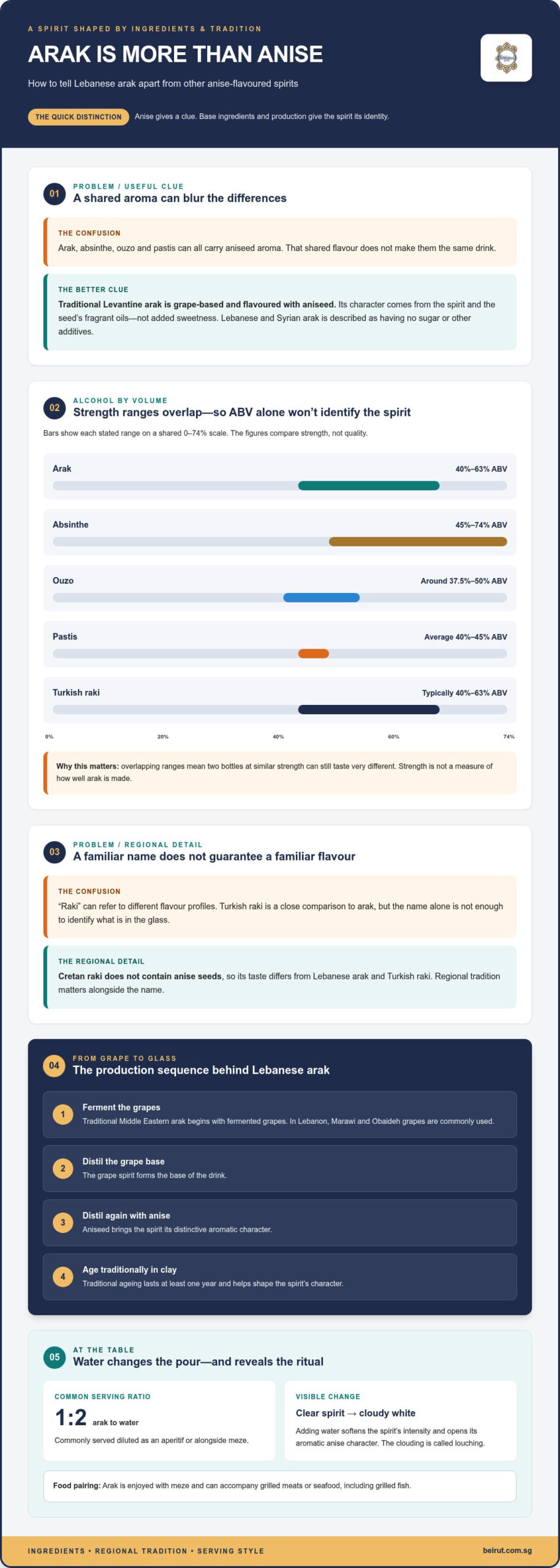
Aniseed gives several spirits a recognisable, aromatic character, but that flavour alone doesn’t make them the same drink. Lebanese and Syrian arak gets its flavour from aniseed, without sugar or other additives. Its character comes from the relationship between the spirit and the seed’s fragrant oils, rather than added sweetness. For readers asking what arak is made of, the distinction matters: the traditional Levantine style is defined by its grape base and aniseed, while other drinks use different methods or ingredients.
Alcohol strength offers one point of comparison, though it isn’t a measure of quality. The ranges below show how each drink can vary:
- Arak: typically 40% to 63% alcohol by volume.
- Absinthe: typically 45% to 74% alcohol by volume.
- Ouzo: generally around 37.5% to 50% alcohol by volume.
- Pastis: averages 40% to 45% alcohol by volume.
These ranges overlap, so strength alone can’t identify a spirit in the glass. Aniseed is a more useful flavour clue, while the drink’s regional name and production tradition help explain its identity. Two bottles at the same strength might taste very different, depending on their base spirit and how the aniseed is used.
Turkish raki is the closest comparison in this group: it shares aniseed character with arak and has a similar alcohol-strength range, typically 40% to 63% ABV. The name “raki,” however, doesn’t always point to the same flavour profile. Cretan raki does not contain anise seeds, so its taste differs from both Lebanese arak and Turkish raki. The island and regional tradition matter as much as the name.
Aniseed can shape a spirit’s aroma without making every drink taste identical. In arak, it gives the grape-based spirit a distinctive, fragrant edge. Absinthe, ouzo and pastis have their own profiles, shaped by different production traditions. Copper stills and regional knowledge also play a part in spirit-making, but a copper vessel alone doesn’t make a drink arak. Look for the combination of its Levantine identity, aniseed character and customary serving style.
At the table, arak is commonly mixed with water at a 1:2 ratio, then enjoyed as an aperitif or alongside meze. It can also accompany grilled meats or seafood, including grilled fish fillet. These pairings show how its aromatic profile works with dishes, rather than treating arak as interchangeable with every spirit that carries aniseed.
Arak’s origins and characteristics
Across Lebanon and Syria, arak is a clear spirit with a distinctive aniseed aroma that turns cloudy when water is added. Its history, strength and serving ritual help explain the cultural importance of this alcoholic beverage across the Levant.
Origins of Arak
Arak’s history is associated with the Levant, where it became a traditional drink served in Iraq, Lebanon, Jordan and Syria. The name comes from the Arabic word ʿaraq, meaning “perspiration” or “sweat,” possibly referring to condensation during distillation. These roots matter because arak is more than an anise-flavoured spirit: its regional identity connects the drink with local ingredients, hospitality and shared meals.
Production and consumption became more standardised under the Ottoman Empire, which controlled much of the Levant from the 16th to the early 20th century. That long history helps explain why arak is often considered part of cultural food traditions, rather than simply one of many drinks flavoured with anise. Its name and customs also distinguish Levantine arak from similarly named spirits made elsewhere.
Alcohol Content and Taste
Arak’s alcohol content varies by style, with the general range typically around 40% to 60% alcohol by volume and some examples reaching 70%. The strength matters when serving it: a small amount of water softens the spirit’s intensity and releases its aromatic anise character. Added water also turns the liquid milky white, a visible change called louching.
Arak tastes aromatic and strongly of aniseed, with the grape spirit providing its base. It’s usually served with water, commonly at a 1:2 ratio, and enjoyed as an aperitif or alongside meze. That diluted pour suits a meal better than treating the undiluted spirit as an ordinary drink.
Is arak made or sold in Singapore, and what are the local rules for buying it? Arak is available as an alcoholic beverage in Singapore, but availability for sale doesn’t mean it was made locally. Buying and selling alcohol are subject to applicable Singapore controls, which depend on the transaction and setting. Choose a legitimate retail or dining setting and follow its stated purchasing requirements.
What are the health risks of drinking arak? Like other alcoholic drinks, arak can cause intoxication and impair judgement and coordination. Drinking more, or drinking quickly, increases these immediate effects. Its strong anise flavour can make the spirit seem gentler than its alcohol content; adding water changes the taste and appearance, not the alcohol already poured.
At the table, arak’s aniseed notes can be enjoyed with meze, grilled meat or seafood. In Singapore, a meal featuring grilled fish offers one way to pair the spirit’s aromatic profile with savoury food. For a broader taste of Lebanese dining, explore Lebanese dishes in Singapore.
How Lebanese arak is made
Lebanese arak begins with grapes, then gains its signature aroma through distillation with aniseed. The sequence, from fermentation to clay ageing, shapes the spirit’s character.
Traditional Ingredients in Arak
Traditional Middle Eastern arak combines fermented grapes with aniseed, making both ingredients central to its identity. In Lebanon, Marawi and Obaideh grapes are commonly used. Wild yeast ferments crushed fresh grapes and must, creating the alcohol that will later be distilled. This base matters because the spirit’s character develops from the fruit before aniseed enters the process.
Lebanese arak is triple-distilled in a pot still, traditionally a regional alembic called a karkeh. The first distillation raises the spirit to 40% alcohol by volume. In a later distillation, the alcohol is mixed with aniseed, which infuses it with its defining fragrance. The second distillation also removes remaining undesirable compounds from fermentation and purifies the spirit.
Fruit Sources for Arak
Lebanese arak is made from grapes, not dates, as its traditional fruit base. Marawi and Obaideh grapes are particularly associated with Lebanese production. Dates, figs and other fruits may be added to some arak styles, but they don’t replace the grape foundation of the classic Lebanese spirit. Knowing the fruit source helps distinguish this Levantine tradition from regional drinks made with other raw materials.
The grape fermentation sets the process in motion: crushed fresh grapes and must ferment with wild yeast before distillation. The resulting alcohol is distilled, then redistilled with aniseed. Lebanese arak’s triple-distillation tradition uses pot stills, with the final distillation typically reaching 53% alcohol by volume. The still and the order of ingredients matter: aniseed joins the spirit during distillation, rather than serving as a late flavouring added after production.
After distillation, Lebanese arak is diluted to around 53% alcohol by volume before ageing. It rests in clay for a minimum of one year, allowing the spirit to mature before bottling. Some arak is also rested in clay amphoras. These stages explain why the production method matters as much as the ingredient list: the grape base, aniseed infusion, repeated distillation and clay ageing each contribute to the finished drink.
The timing of the aniseed is a defining part of the process. Alcohol from arak’s first distillation undergoes another distillation with aniseed, bringing the ingredient into a later production stage. The process follows a clear progression: an initial distillation, then another in which the spirit and aniseed come together. The order matters to the method, not just the choice of ingredients. It distinguishes this step from adding aniseed separately after distillation is complete.
The next part of the process is a period of rest in clay. Lebanese arak is aged in clay for at least one year and sometimes rested in clay amphoras before bottling. This stage has a clear duration and is associated with a specific vessel. Ageing follows distillation, closing the production sequence before bottling. Together, the later distillation and clay rest show how Lebanese arak’s character depends on aniseed’s place in the process and the final period of ageing.
Regional variations and added ingredients
Arak doesn’t have one recipe across every region. Lebanese arak is associated with grapes, while Balinese arak begins with fermented palm sap. These differences reflect local crops and production traditions, so the name alone doesn’t tell you which ingredients shape a particular beverage.
In Lebanon, the Bekaa Valley is a centre of arak production, where the grape-based tradition is part of the region’s heritage. Marawi and Obaideh grapes are associated with Lebanese arak, while aniseed gives the spirit its characteristic aroma. This combination makes the Levantine style recognisable, but it shouldn’t be assumed to represent every drink called arak. The fruit base is a useful first clue when comparing regional styles.
Balinese arak follows a different path. It is made from fermented palm-tree sap and may also include grains or fruit. In one traditional production method, collected coconut-palm sap is mixed with coconut fibre and fermented for 2-3 days before further processing. This differs from grape-based arak in both its starting ingredient and fermentation method. Local ingredients help explain why regional arak can vary in aroma and taste, even when the drinks share a name.
Other variations introduce additional ingredients into the flavour profile:
- Fruit additions: Dates, figs and other fruits are sometimes added to arak, creating styles beyond the classic grape-and-anise combination.
- Arakbica: This variation is made with a 3% infusion of Arabica coffee, bringing coffee character into the spirit.
- Karu arak: Yams are included in this regional style, setting it apart from grape-based Lebanese arak.
These examples show why ingredient lists matter. An added fruit or coffee infusion changes the flavour, while a different base ingredient changes the production story from the start. A grape spirit infused with aniseed and a palm-sap spirit may both be called arak, yet they express distinct agricultural and culinary traditions.
Distillation also contributes to regional variation. Arak can be distilled using pot stills or column stills, and the chosen method influences how the spirit is produced. The ingredient base, fermentation, distillation and any later additions all help define a style. When comparing bottles, identifying the region and principal ingredients is a more meaningful starting point than relying on the word “arak” alone.
What ingredients are used in traditional Middle Eastern arak?
Traditional Middle Eastern arak depends on two defining ingredients: grapes and aniseed. Their roles differ: grapes provide the fermentable base, while aniseed contributes the spirit’s signature aroma during distillation. Understanding when each enters production helps distinguish classic Levantine arak from regional variations with other bases or additions.
Grapes are more than a flavouring. In the traditional method, crushed fresh grapes and must ferment with wild yeast, producing the alcohol later distilled into the spirit. Must, the juice and pulp from crushed grapes, carries the fruit’s character into fermentation. In Lebanon, Marawi and Obaideh are grape varieties associated with arak production. Their importance is as the base, not as a replacement for aniseed’s aromatic role.
Aniseed is introduced during a later distillation, when the first distilled alcohol is combined with the seeds. This order matters: the anise flavour develops as the spirit is distilled with the ingredient, rather than through a simple late addition. The resulting aroma is central to the drink’s identity. A traditional 1936 account described an arak-making method using grapes and anise seeds learned in the Galilee region, showing how those ingredients are rooted in regional practice.
Traditional Lebanese arak is defined by grape spirit and aniseed, without sugar or other additives. That distinction helps explain why a sweetened anise drink may taste familiar but doesn’t follow the same ingredient tradition. Added flavours can create other styles, but the classic combination keeps the grape base and aniseed at its heart.
The ingredients also explain the production sequence. First, grapes are crushed and fermented with wild yeast. The resulting alcohol is distilled, then distilled again with aniseed. In Lebanese production, the spirit is triple-distilled in a pot still. Clay ageing follows distillation, giving the spirit time to mature without changing its core grape-and-anise foundation.
For a practical comparison, consider what each ingredient contributes. Grape must is the source material for fermentation; aniseed supplies the defining fragrance. Neither dates nor figs replace grapes in the traditional Lebanese recipe, though those fruits are sometimes added to other arak styles. This distinction can help you understand a bottle’s regional identity and flavour.
At the table, the same Lebanese culinary heritage extends beyond spirits. Explore Lebanese wine as another expression of the region’s grape-growing tradition, served with a meal rather than distilled with aniseed.
Beirut Grill: Mixed Grill
Beirut Grill serves a Mixed Grill for readers ready to enjoy Lebanese cuisine alongside their new knowledge of arak. Its selection of grilled flavours makes a fitting centrepiece for exploring how regional food traditions shape the table. Add Hummus or choose the Vegetarian Kebab for another taste of the menu, with Lebanese Wine as an alternative beverage pairing.
This is a natural next step if you want to bring the article’s ingredients and heritage into a meal, rather than simply compare spirits. Consider the flavours on the table and how they complement the dishes you choose.
Visit Beirut Grill online to explore the dining experience.
Let Curiosity Lead to the Table
Understanding what arak is made of is only the beginning; the more rewarding next step is noticing how its character sits alongside a meal. Bring that curiosity to the table, where aroma, texture and conversation can make a regional tradition feel immediate. A thoughtful pairing is less about mastering rules than paying attention to what you enjoy.
At Beirut Grill, build your meal around a Mixed Grill, share Hummus, or explore Lebanese Wine as another expression of the region’s table. Each offers a different way to savour Lebanese flavours and discover combinations that suit your palate. There’s no need to approach the meal as a tasting lesson. Start with an open mind, choose what appeals, and let the evening unfold at its own pace.
To continue exploring, contact Beirut Grill about arak. Bring your curiosity and enjoy discovering Lebanese traditions one memorable meal at a time.
Frequently Asked Questions
How Can You Tell Good Arak And Bad Arak Apart?
Start by distinguishing traditional arak from a different regional style, rather than treating every recipe variation as a flaw. A classic Lebanese or Syrian bottle should reflect a grape spirit and aniseed, without sugar or other additives. At a meal, notice whether its aroma is recognisably anise-led and how it changes when diluted. A fruit addition or different base may indicate another style, not automatically a bad spirit.
What is arak made of?
Traditional Middle Eastern arak is made from grapes and aniseed. Grapes provide the fermentable base, while aniseed gives the spirit its characteristic fragrance. In Lebanon, Marawi and Obaideh are grape varieties associated with production. Dates, figs and other fruits can appear in some variations, but they aren’t defining ingredients of the traditional grape-based style. Identifying the base ingredient helps distinguish it from palm-sap arak.
What is anise used for in arak?
Aniseed gives arak its characteristic aroma and flavour. In traditional production, it’s introduced during a later distillation, so its oils become part of the spirit’s aromatic profile. When water is added for serving, those oils disperse and the drink turns cloudy. That change is a normal visual effect, not evidence that another ingredient has been added. Aniseed provides flavour, not the alcohol in the spirit.
How is arak distilled and produced?
Production starts by fermenting crushed fresh grapes and must with wild yeast. The fermented liquid is distilled, then distilled again with aniseed; Lebanese arak is traditionally triple-distilled in a pot still. This process concentrates the alcohol and builds the anise aroma. In the Lebanese tradition, the spirit is then aged in clay for at least one year. Each stage contributes differently, from grape fermentation to the final aromatic character.
How does arak differ from ouzo, raki, and pastis?
They share aniseed notes, but their traditions and recipes differ. Lebanese and Syrian arak is grape-based and traditionally has no sugar or other additives. Ouzo and pastis have their own regional identities and production approaches, so similar aromas don’t make them the same spirit. Turkish raki is a close comparison; Cretan raki differs because it doesn’t contain anise seeds. Check the region and base ingredients to tell the styles apart.