
If you believe the only thing separating an Athenian taverna from a bustling Beirut eatery is a few hundred miles of turquoise water, you are overlooking the soul of the Mediterranean. It is a common mistake to assume that these two culinary giants are interchangeable simply because they share a love for olive oil and sun-drenched produce. You aren’t alone if you’ve ever hesitated over a menu, wondering about the true difference between greek and lebanese food or why your palate prefers the earthy warmth of one over the bright acidity of the other.
We understand that the nuances of these legendary cuisines can feel elusive when dishes like Baklava or Moussaka appear on both tables. This guide promises to unveil the sophisticated tapestry of aromatic spices, specialized techniques, and social dining traditions that distinguish these two cultures. You will discover the signature flavor profiles and regional markers that define each heritage. This journey will provide you with a clear framework to navigate any authentic menu with the confidence of a seasoned connoisseur, ensuring your next cultural journey is as rewarding as it is delicious.
Key Takeaways
- Uncover how the ancient Mediterranean “Trinity” of olive oil, wheat, and grapes serves as the common foundation for both of these legendary culinary lineages.
- Discern the true difference between greek and lebanese food through their distinct flavor profiles, moving from the bright acidity of the Aegean to the warm, aromatic spices of the Levant.
- Appreciate the cultural artistry of the table by distinguishing the rustic simplicity of family-style Greek platters from the elaborate, sensory-rich ritual of the Lebanese mezze.
- Gain a connoisseur’s eye for technical details, such as the specific yogurt and tomato-based marinades that elevate Lebanese Shish Taouk above its Mediterranean counterparts.
- Build the confidence to navigate an authentic Lebanese menu with ease, recognizing the premium ingredients and heritage that define a truly prestigious dining experience.
The Shared Heritage: Where Greek and Lebanese Cuisines Converge
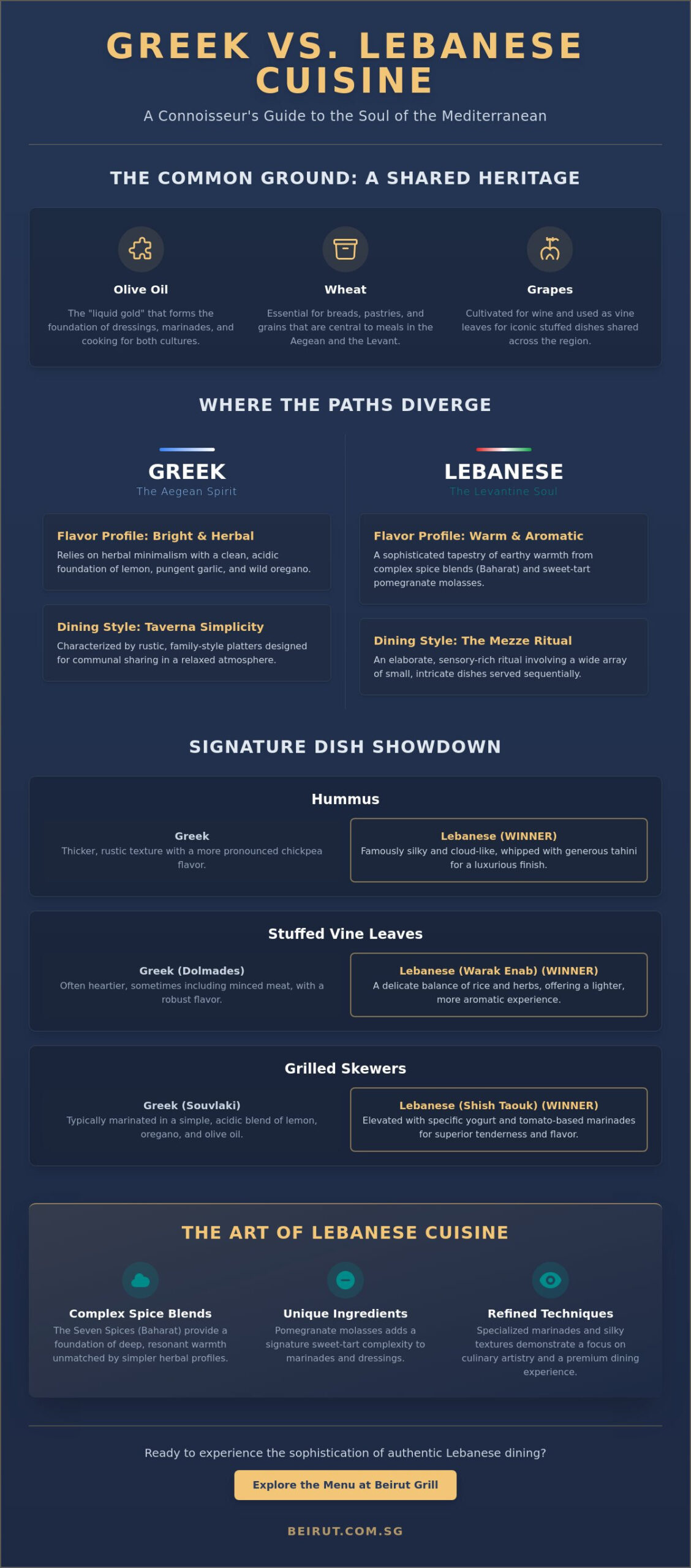
The Mediterranean basin is much more than a geographic coordinate; it is a shared cradle of civilization where the sun, soil, and sea have dictated the rhythm of the kitchen for millennia. Both Greek and Lebanese traditions are anchored by the venerable “Trinity” of ingredients: liquid gold olive oil, sun-ripened wheat, and the fermented juice of the grape. These foundational elements create a familiar baseline, yet they also highlight the nuanced difference between greek and lebanese food as each culture interprets these gifts through their own historical lens. Centuries of Ottoman rule further blurred these culinary borders, introducing a shared repertoire of slow-cooked stews and stuffed vegetables that remain beloved staples today. Whether it’s the smoky char of a perfectly grilled skewer or the vibrant colors of seasonal produce, both cuisines celebrate the absolute purity of ingredients.
The Concept of the Levant vs. the Aegean
While they share a coastline, their culinary spirits are shaped by different horizons. The Levantine cuisine of Lebanon, Syria, and Jordan represents the eastern heart of the Mediterranean, where fertile land and ancient trade routes brought a wealth of spices and grains. In contrast, the Aegean maritime influence of Greece is defined by rugged islands and salt-sprayed shores, where seafood and wild mountain herbs take center stage. Geography dictates that while a Greek chef might reach for octopus or lamb from the hills, a Lebanese kitchen excels in land-based proteins and intricate vegetable preparations. Understanding this geographic split is the first step in recognizing the difference between greek and lebanese food and how environment shapes flavor.
Shared Staples: Hummus, Halloumi, and Beyond
Shared staples often lead to friendly cultural debates, such as the rightful home of Grilled Halloumi. While both cultures embrace this salty, squeaky cheese, their approaches to common dishes differ in the fine details. Take Hummus as a prime example. In Greek kitchens, you’ll often find a thicker, more rustic texture that leans heavily on the pulse itself. The Lebanese version is famously silkier, whipped with precise amounts of tahini to achieve a luxurious, cloud-like consistency. Similarly, the Lebanese Warak Enab offers a sophisticated parallel to the Greek Dolmades. While both involve tender vine leaves, the Lebanese preparation often features a delicate balance of rice, herbs, and lemon that feels lighter and more aromatic on the palate.
The Flavour Palette: Oregano and Lemon vs. The Seven Spices
To truly understand the difference between greek and lebanese food, one must first inhale the aromas emanating from their respective kitchens. Greek cuisine is a masterclass in herbal minimalism. It relies on a bright, acidic foundation of lemon, pungent garlic, and wild oregano harvested from sun-scorched hillsides. This profile is clean, refreshing, and unapologetically herbal, often rounded out with the cooling presence of dill in yogurt-based sauces. Lebanese cooking, however, is a sophisticated tapestry of warmth and earthy complexity. It draws heavily from the Baharat, or Seven Spices, a traditional blend that often features allspice, cinnamon, and cumin. This aromatic palette transforms simple ingredients into deep, multi-layered masterpieces, offering a resonant warmth that contrasts with the sharp, fleeting citrus bite of the Aegean.
A secret weapon in the Lebanese arsenal is pomegranate molasses. This thick, dark reduction provides a unique sweet-tart depth that Greek cuisine rarely replicates. While a Greek chef might finish a dish with a splash of red wine vinegar to cut through richness, a Lebanese host uses this fruit-based syrup to add a luxurious, syrupy complexity to marinades and dressings. It is this intricate layering of dry spices like cinnamon with the tartness of fruit that defines the soul of the Levantine table. The result is a culinary experience that feels grounded in the earth yet elevated by exotic trade-route influences.
The Role of Aromatics and Floral Waters
The olfactory experience of a Lebanese meal often extends into the ethereal through the use of floral distillations. Rose water and orange blossom water are frequently used to infuse desserts and even certain beverages with a delicate, haunting perfume. This contrasts with the Greek preference for more robust, rustic sweets that lean heavily on golden honey and generous dustings of cinnamon. For those exploring the Customs & Cuisine of Lebanon, these floral notes are a hallmark of refined hospitality. Sumac is an essential Lebanese citrus substitute made from dried and crushed berries that provides a tart, ruby-red finish to almost any savory dish.
Acidity Profiles: Vinegar vs. Verjuice and Citrus
Acidity acts as the heartbeat of Mediterranean cooking, yet the source of that pulse varies significantly between the two regions. Greek recipes frequently employ red wine vinegar to provide a sharp, fermented tang to salads and slow-cooked meat marinades. In Lebanon, the focus remains on the immediate, vibrant brightness of fresh lemon juice combined with the dry acidity of sumac. There is no better way to witness this mastery than through a bowl of Tabbouleh, where the herbal acidity of flat-leaf parsley is elevated by a generous hand of citrus. To experience these nuances firsthand, we invite you to explore the authentic offerings at Beirut Grill, where every spice is curated to transport you to the Levant.
The Art of the Table: Taverna Simplicity vs. The Mezze Ritual
The physical environment of the meal reveals much about the cultural soul of these two regions. To dine at a traditional Greek taverna is to embrace a rustic, heartfelt simplicity where the table is often dominated by generous individual mains or expansive family-style platters. These dishes reflect the evolution of Greek cuisine from its humble agrarian origins into a celebration of the season’s best catch or harvest. In stark contrast, the Lebanese table is defined by the Mezze ritual. This is not merely a meal; it’s an elaborate social choreography involving a deliberate progression of 20 to 30 small cold and hot dishes. While both cultures value hospitality, the difference between greek and lebanese food is most evident in this structural pacing. The mezze is designed to slow time down, encouraging prolonged conversation as guests graze through a kaleidoscope of textures, from silky Moutabal to crisp Sambousek. This ritual even includes daring preparations like Kibbeh Nayyeh, a delicate lamb tartare that highlights the Lebanese commitment to the highest quality raw ingredients.
Arak vs. Ouzo: The Lion’s Milk Tradition
Central to these long, indulgent afternoons is the tradition of “Lion’s Milk.” Both Arak and Ouzo are anise-flavored spirits that transform into a captivating, cloudy white elixir when water is added. However, Arak is often distilled to a higher potency, serving as a formidable palate cleanser during a heavy meat feast. Its crisp finish cuts through the richness of charcoal-grilled proteins with more precision than its Greek counterpart, making it the essential spirit for a Levantine banquet. For the connoisseur, Arak isn’t just a drink; it’s a functional component of the dining experience that prepares the senses for the next wave of flavors.
Lebanese Wine and the Heritage of the Bekaa Valley
Lebanon holds a prestigious position as one of the world’s oldest wine-producing regions, with the Bekaa Valley serving as its ancient, sun-drenched heart. The wines produced here are often robust and influenced by French viticulture, offering a sophisticated depth that contrasts with the lighter, resinous Greek whites like Retsina. These high-status labels reward the visitor’s curiosity with complex notes of dark fruit and spice. A deep, oak-aged Lebanese red provides the perfect structural balance for the succulent, spice-crusted Beirut Lamb Chops. This pairing transforms a simple dinner into an immersive cultural journey, anchoring the meal in a legacy that spans centuries.
Signature Showdowns: Souvlaki vs. Shish Taouk and Beyond
When discerning the nuanced difference between greek and lebanese food, one must look closely at the marinades that define their grilled proteins. While a Greek Souvlaki relies on the bright, herbal simplicity of lemon and oregano, the Lebanese Shish Taouk is a more complex affair. It is bathed in a rich emulsion of garlic, yogurt, and tomato paste, which tenderizes the meat while creating a deeply savory crust over open flames. Even the iconic Moussaka reveals a cultural divide. The Greek version is a decadent, layered bake topped with a thick crown of béchamel sauce. Its Lebanese cousin, Maghmour, is often served as a hearty, vegan chickpea and eggplant stew, celebrating the vegetable’s integrity without the heavy dairy veil.
The dessert course offers another masterclass in subtle distinction. Greek Baklava is traditionally drenched in golden honey and packed with the earthy crunch of walnuts. Lebanese artisans, however, favor a lighter Attar simple syrup infused with floral essences, choosing the vibrant green of pistachios or the creamy texture of cashews to fill their delicate phyllo layers. This lightness extends to the bread. While Greek Pita is famously fluffy and thick, designed to be stuffed or dipped, the Lebanese Khubz is a large, paper-thin disc that acts as a functional utensil, expertly tearing away portions of hummus or grilled meats.
The Charcoal Grill Mastery
Lebanese charcoal grilling is a disciplined art form that prioritizes precise fat-to-meat ratios to ensure every bite of Lamb Kofta remains succulent. This differs from the Greek Gyro, which focuses on the vertical rotisserie method. The spice profiles also diverge sharply; Greek meats lean on garlic and herbs, while Lebanese Shawarma is defined by a warm, complex bouquet of spices like cardamom and cloves. The Mixed Grill serves as the ultimate showcase of this Lebanese meat artistry, bringing together diverse textures and flavors in one prestigious presentation.
Salad Philosophy: Horiatiki vs. Fattoush
A Greek Horiatiki salad is a rustic assembly of tomatoes, cucumbers, and massive blocks of feta, notably devoid of any leafy greens. Lebanese Fattoush, by contrast, is a celebration of mixed greens and garden vegetables, brought to life with the addition of crisp, toasted pita croutons. Tabbouleh stands alone as a Lebanese masterpiece, a parsley-based salad that has no true Greek equivalent in its herbal intensity. The secret to these Levantine dressings often lies in the cooling, aromatic addition of dried mint, which provides a refreshing finish to the palate. To experience these signature flavors prepared with uncompromising authenticity, we invite you to book your table at Beirut Grill today.
Experiencing the Sophistication of Beirut Grill
Since its founding in 2009, Beirut Grill has stood as a prestigious destination for those who seek the genuine culinary heritage of the Levant. Located in the historic heart of the city, our restaurant offers an immersive atmosphere that transports every guest to the vibrant, sun-drenched streets of Beirut. Here, the difference between greek and lebanese food is expressed through the technical mastery of our chefs and the uncompromising quality of our imported ingredients. We take immense pride in our commitment to traditional techniques, particularly our signature charcoal grill that imparts a smoky depth impossible to replicate. By offering a strictly pork-free menu, we provide an inclusive and refined environment where the purity of Mediterranean produce and seasoned expertise take center stage.
A Curated Journey Through the Mezze
The experience at our table begins with a deliberate progression of textures and temperatures, mirroring the actual experience of a guest arriving in a Lebanese home. We invite you to explore our cold mezze, where the smoky richness of Moutabal and the creamy, strained tang of Labneh awaken the palate. This flows naturally into the hot mezze selections, featuring the crisp, spice-laden perfection of our Fried Kibbeh. These dishes are more than mere appetizers; they are a social ritual designed for sharing and prolonged storytelling. To accompany this feast, we curate a selection of high-status Lebanese Wine from the ancient Bekaa Valley and the traditional clarity of Arak. The journey is made complete with the lingering fragrance of Moroccan Mint Tea or the bold, evocative strength of a traditional Lebanese Coffee.
The Mixed Grill: A Masterclass in Lebanese Meat
The Mixed Grill serves as the crowning achievement of our menu, showcasing the seasoned expertise that has defined our kitchen for over a decade. This platter features our signature Shish Taouk, succulent Beef Kebab, and aromatic Lamb Kofta, each benefiting from marinades that have been perfected since our founding in 2009. These preparations honor the warm, earthy profile of the Seven Spices, ensuring every skewer is a testament to the Levantine art of the flame. It is a sensory-rich experience that rewards the diner’s curiosity with every bite, providing a clear distinction from the simpler herbal profiles of other Mediterranean regions. Indulge in an authentic Lebanese feast at Beirut Grill today and immerse yourself in the sophisticated flavors of our heritage.
Embark on Your Own Levantine Cultural Journey
Understanding the nuanced difference between greek and lebanese food transforms a simple meal into a profound exploration of history, geography, and heritage. While the Aegean coast delights with its sun-drenched herbs and rustic taverna simplicity, the Levant offers a more intricate tapestry of aromatic spices and the sophisticated social ritual of the mezze. You’ve discovered how these two culinary legends diverged from their shared Mediterranean cradle, creating distinct identities through specialized marinades, floral aromatics, and technical mastery over the charcoal flame. These distinctions are the hallmarks of a true connoisseur who appreciates the subtle layers of flavor that define a culture.
Since our founding in 2009, Beirut Grill has served as a prestigious destination for those seeking the true soul of Lebanon. Our kitchen remains deeply committed to the authentic techniques of the charcoal grill, perfectly complemented by a curated selection of high-status Lebanese Wine and traditional Arak. We invite you to step into our atmospheric sanctuary, where every detail is designed to transport you to the heart of Beirut. Reserve Your Table at Beirut Grill for an Authentic Lebanese Experience and let your curiosity be rewarded with an indulgent feast. We look forward to hosting you for an unforgettable cultural journey at our table.
Frequently Asked Questions
Is Lebanese food spicier than Greek food?
Lebanese food is generally more aromatic rather than spicy in terms of chili heat. While Greek cuisine relies on fresh herbs like oregano and dill, Lebanese chefs use complex spice blends such as the Seven Spices to create earthy depth. You will find a warmer, more fragrant profile in Lebanese dishes, but they don’t typically feature the intense heat found in other global cuisines.
What is the main difference between Greek and Lebanese Baklava?
The primary distinction lies in the sweetener and the nut selection used in the pastry. Greek Baklava is famously rich, drenched in golden honey and packed with earthy walnuts and cinnamon. In contrast, the Lebanese version is lighter, using a floral-infused simple syrup and vibrant pistachios or cashews. This results in a cleaner, more delicate finish that highlights the crispness of the phyllo.
Do Lebanese and Greek cuisines use the same type of Hummus?
While the base ingredients are similar, the texture and tahini ratio define the difference between greek and lebanese food in this category. Lebanese Hummus is whipped into an exceptionally silky, cloud-like consistency with a generous amount of premium tahini. Greek versions tend to be more rustic and thick, often emphasizing the texture of the chickpeas themselves rather than the smooth emulsion favored in the Levant.
Is Lebanese food always Halal or pork-free?
Lebanese cuisine is deeply inclusive, and while it varies by community in the Middle East, prestigious Lebanese restaurants like Beirut Grill are strictly pork-free. This ensures a broad and welcoming dining experience suitable for all guests. Greek cuisine, conversely, frequently features pork as a primary protein in dishes like Souvlaki or Gyros, making the choice of meat a significant cultural marker between the two.
Which cuisine is healthier: Greek or Lebanese?
Both cuisines are world-renowned pillars of the heart-healthy Mediterranean diet and offer exceptional nutritional value. Greek food emphasizes fresh vegetables and monounsaturated fats from olive oil. Lebanese food adds a layer of nutritional density through its heavy use of pulses, ancient grains, and antioxidant-rich spices. Choosing between them is less about health and more about whether you prefer herbal brightness or aromatic complexity.
What is Arak, and how does it differ from Greek Ouzo?
Arak is a more potent, triple-distilled spirit that lacks the added sugars often found in Greek Ouzo. Both turn milky when water is added, but Arak serves as a more effective palate cleanser for rich, charcoal-grilled meats. Its higher alcohol content and drier finish make it a more sophisticated companion for a long, multi-course mezze ritual, rewarding the diner’s curiosity with its purity.
Can I find vegetarian options in both Greek and Lebanese cuisines?
Absolutely, both traditions offer a wealth of plant-based masterpieces that celebrate the bounty of the earth. You can enjoy Lebanese staples like Falafel, Spinach Fatayer, and Tabbouleh, which are naturally vegetarian and incredibly flavorful. Greek cuisine offers its own classics like Spanakopita and stuffed peppers. Both cultures prioritize seasonal produce, making them excellent choices for those seeking an authentic meat-free cultural journey.
What is the difference between a Gyro and a Shawarma?
A Gyro is defined by its herbal garlic marinade and is often served with cooling tzatziki. Shawarma, the Lebanese counterpart, is a more intricately spiced preparation featuring notes of cardamom, cloves, and cinnamon. While both are cooked on a vertical rotisserie, the difference between greek and lebanese food here is found in the warm, trade-route spices that give Shawarma its unmistakable Levantine soul and sophisticated aromatic profile.