
Most people have eaten baba ghanoush without ever truly tasting it. They’ve encountered a pale, watery scoop alongside a basket of pita, mild and forgettable, bearing almost no resemblance to the dish that has graced Lebanese tables for centuries. That version isn’t baba ghanoush. It’s an imitation, and the difference matters more than you might think.
If you’ve ever wondered why some eggplant dips carry that deep, almost haunting smokiness while others taste of nothing in particular, you already sense that something essential is being left out. That missing element isn’t a spice or a secret ingredient. It’s fire, patience, and an understanding of what this dish is actually meant to be: a labor-intensive ritual rooted in the heart of Lebanese hospitality.
This guide is here to set the record straight. You’ll discover the traditional Lebanese preparation behind authentic baba ghanoush, learn how to distinguish a genuinely crafted version from a generic substitute, and understand exactly how it fits within a proper mezze spread. From the eggplant’s first encounter with charcoal to its rightful place at the table, consider this your complete introduction to one of Lebanon’s most extraordinary culinary gifts.
Key Takeaways
- Authentic baba ghanoush is defined by its charcoal-grilling technique — without it, you’re eating an imitation that misses the dish’s entire soul.
- The name itself tells a story: understanding the etymology of “baba ghanoush” reveals centuries of Lebanese culinary culture and the spirit of indulgent hospitality behind every serving.
- Baba ghanoush and moutabal are not the same dish — knowing the key differences in ingredients and regional preparation will transform how you order and appreciate a Lebanese mezze spread.
- The mezze table is a ritual, not just a meal, and learning how to pair baba ghanoush with charcoal-grilled proteins like Lamb Kofta or Shish Taouk unlocks the full depth of the Lebanese dining experience.
- Beirut Grill has been preserving these traditional Levantine techniques in Singapore since 2009 — discover what over a decade of heritage tastes like on a single plate.
What is Baba Ghanoush? Exploring the “Spoiled Dad” of Lebanese Mezze
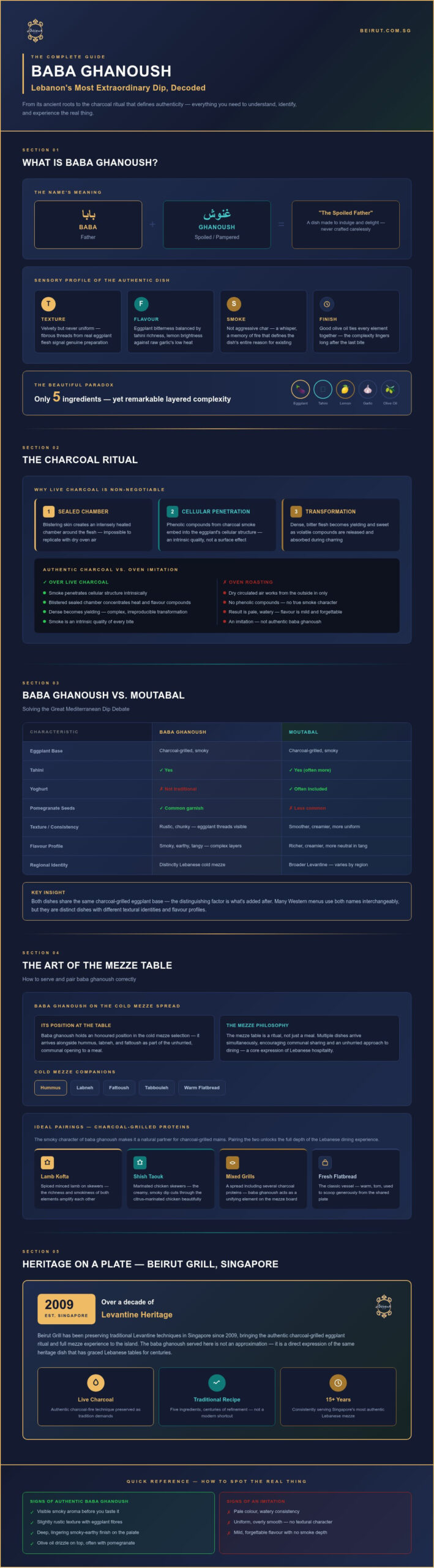
At its most elemental, baba ghanoush is a roasted eggplant dip, blended with tahini, lemon juice, garlic, and olive oil until it reaches a consistency that sits somewhere between silken and rustic. But that clinical description does it no justice whatsoever. What arrives at a properly set Lebanese table is something far more alive: a dish with depth, complexity, and a smokiness that lingers on the palate long after the last piece of flatbread has been torn.
The name itself is a small masterpiece of cultural storytelling. In Arabic, baba means father, while ghanoush translates loosely as spoiled or pampered. The “spoiled father” interpretation has charmed food historians for generations, though its precise origin remains delightfully contested. Some suggest it was named by a cook who prepared the dish to indulge a beloved patriarch. Others argue it reflects the eggplant’s own pampered nature, demanding careful attention and coaxing before it yields its finest qualities. Either way, the name announces something important: this is not a dish made carelessly.
Sensory profile matters enormously here. The texture is velvety but never uniform, carrying small fibrous threads from the eggplant flesh that remind you something real was cooked. The tahini introduces a nutty earthiness. The lemon lifts everything. And beneath all of it, if the preparation is honest, there’s smoke. Not an aggressive, overpowering char, but a whisper, a memory of fire that gives the dish its entire reason for existing.
In traditional Lebanese dining, it occupies an honoured position within the cold mezze selection, arriving at the table alongside dishes like hummus, labneh, and fattoush as part of that unhurried, communal opening to a meal.
The Cultural Significance of the Eggplant
Across the Levant, the eggplant has been cultivated and revered for well over a thousand years, earning its informal title as the “king of vegetables” in Middle Eastern culinary tradition. Its ability to absorb flavour, transform under heat, and carry the character of its cooking method makes it uniquely suited to a cuisine built on technique and patience. In Lebanon specifically, the eggplant became a vehicle for expressing hospitality, the idea that even a humble vegetable, treated with care and skill, could become something worthy of a guest’s highest praise.
A Symbol of Sophisticated Simplicity
Five ingredients. That’s the honest count. Yet those five ingredients, when handled with genuine expertise, produce a flavour profile of remarkable layered complexity. The contrast between the eggplant’s bitterness and the tahini’s richness, the brightness of lemon against the low heat of raw garlic, the finishing pour of good olive oil that ties everything together. None of it is accidental. For those seeking authentic Mediterranean food in Singapore, understanding this simplicity is the first step toward appreciating why the real thing tastes so profoundly different from any imitation.
The Culinary Alchemy: How Authentic Baba Ghanoush Achieves Its Signature Smoke
There’s a moment, somewhere between the first lick of flame and the final collapse of the eggplant’s charred skin, when something extraordinary happens. The flesh inside transforms from dense and bitter to yielding and sweet, absorbing the volatile compounds released by the burning exterior in a process that no oven, no matter how sophisticated, can replicate. This is the science behind the smoke, and it’s the reason authentic preparation demands fire.
The Importance of the Charcoal Grill
Whole eggplants placed directly over live charcoal aren’t simply being cooked. They’re being fundamentally restructured. As the skin blisters and blackens, it creates a sealed, intensely heated chamber around the flesh. Phenolic compounds from the charcoal smoke penetrate the outer layers, embedding themselves into the eggplant’s cellular structure in a way that oven roasting, which works from the outside in with dry, circulated air, simply cannot achieve. The result is a flesh that carries smoke as an intrinsic quality rather than a surface impression. That smoky infusion isn’t a flavour note; it’s the soul of the dish.
At Beirut Grill, this commitment to charcoal grilling isn’t a stylistic choice. It’s a non-negotiable standard rooted in over fifteen years of preserving Levantine technique in Singapore. The eggplants are grilled whole, turned patiently over the coals until the skin is uniformly charred and the interior has surrendered entirely to the heat, becoming buttery, almost liquid in its tenderness.
Once removed from the grill, the blackened skin is peeled away carefully, revealing flesh that carries the memory of fire in every fibre. What happens next is equally critical.
Balancing the Flavor Quadrant
Authentic baba ghanoush is never blended in a food processor. Hand-mashing preserves the delicate fibrous threads of the eggplant, producing that characteristic texture that sits between rustic and refined. A processor obliterates those threads, yielding something closer to a paste than a dip, and erasing the textural evidence of genuine craft.
The remaining ingredients each serve a precise structural role:
- Fresh lemon juice provides the acidity that cuts through the charred richness, lifting the smokiness rather than burying it beneath heaviness.
- Raw garlic must be used with restraint; its purpose is to add depth and a low, resonant heat without overwhelming the eggplant’s more delicate character.
- Premium tahini, made from hulled sesame seeds, introduces a luxurious, creamy mouthfeel that binds the dip together without making it dense.
- Extra virgin olive oil and pomegranate arils finish the dish, the oil adding fruitiness and gloss, the jewel-bright arils delivering a burst of sweet acidity that makes the entire composition sing.
None of these elements work in isolation. Together, they form a balance that rewards the cook’s patience, and the diner’s attention. For anyone curious to experience this technique executed with genuine fidelity, Beirut Grill’s mezze selection offers a compelling case for why the traditional method endures.
Baba Ghanoush vs. Moutabal: Solving the Great Mediterranean Dip Debate
Ask ten people at a Lebanese restaurant to explain the difference between baba ghanoush and moutabal, and you’ll likely receive ten different answers, most of them wrong. This confusion isn’t a personal failing; it’s a symptom of how carelessly these two dishes have been conflated in Western food culture, often presented interchangeably on menus that treat them as regional synonyms for the same thing. They are not the same thing. Understanding the distinction will permanently change how you navigate a mezze spread.
Both dishes begin with charcoal-roasted eggplant. That’s where the similarity ends.
Baba ghanoush, in its authentic Lebanese form, is fundamentally a vegetable-forward preparation. The eggplant carries the dish. Tahini plays a supporting role, present enough to add body and a quiet nuttiness, but never dominant. The result is a dip that tastes primarily of smoke, lemon, and the eggplant itself, bright and relatively light on the palate.
Moutabal inverts that hierarchy. Tahini moves to the foreground, lending the dish a richer, denser, more emulsified character. Some regional preparations also incorporate yogurt, which amplifies the creaminess further and introduces a gentle tang. The eggplant is still there, but it functions more as a base than a star. Certain Levantine traditions add pomegranate molasses for a bittersweet depth that distinguishes their version from Lebanese preparations entirely.
Identifying Traditional Moutabal
Texture is the most reliable diagnostic tool. Moutabal, when made properly, has a smoother, more emulsified consistency because the higher tahini content binds the mixture into something closer to a cream. Baba ghanoush retains its rustic, slightly fibrous character, the eggplant flesh never fully surrendering its identity. If your dip is silky-smooth and intensely nutty, you’re almost certainly eating moutabal. If it’s texturally varied and the smokiness dominates, that’s the real thing.
The Lebanese Standard
At Beirut Grill, both dishes exist on the menu as distinct preparations, not interchangeable placeholders. The Lebanese approach to baba ghanoush favors a garnish of fresh parsley and ripe tomato, a visual and flavour signal that the dish is meant to feel fresh and alive rather than heavy. This presentation isn’t decorative; it reflects the Lebanese conviction that a cold mezze should feel like the beginning of something, not the end.
For those new to this world, a useful starting point: if you enjoy hummus for its creamy, protein-rich richness, moutabal will feel familiar. If you’re drawn to dishes with more acidity and complexity, baba ghanoush is your natural territory. To taste the full spectrum of these distinctions prepared with genuine fidelity, explore the broader world of middle eastern food in Singapore and let the comparison speak for itself.
The Art of the Mezze Table: How to Serve and Pair Baba Ghanoush
The Lebanese mezze table isn’t a starter course. It’s a declaration of intent. When a spread of cold dishes arrives before the main event, the message is clear: this meal will not be rushed, and everyone at the table is equally important. Baba ghanoush occupies a central role in this ritual, not because it’s the most complex dish present, but because it anchors the spread with a depth that more delicate preparations can’t provide.
Temperature is the detail most often overlooked outside Lebanon. Serving baba ghanoush cold, straight from the refrigerator, mutes the smokiness almost entirely. The volatile aromatic compounds responsible for that characteristic char become sluggish at low temperatures, retreating behind the tahini and lemon. Room temperature is non-negotiable. Allow it to rest for at least twenty minutes before serving, and the full complexity of the charcoal grill reasserts itself on the palate.
Complementary Flavors and Textures
Pairing within the mezze spread follows an intuitive logic. Tabbouleh, with its sharp lemon dressing and the clean bitterness of fresh parsley, cuts beautifully through the richness of the eggplant, refreshing the palate between bites. Hot pita bread is the only vessel that does the dish full justice; its slight chew and warmth provide structural contrast while carrying the dip’s smoky creaminess without competing with it.
Where baba ghanoush truly reveals its range is alongside charcoal-grilled proteins. Dragged through the dip, a piece of Lamb Kofta becomes something greater than either component alone: the iron-rich char of the lamb meeting the smoky, yielding eggplant in a combination that feels entirely inevitable. Shish Taouk, with its bright citrus marinade, finds a grounding counterpart in the dip’s earthiness. At Beirut Grill, the Mixed Grill platter is designed with exactly this dynamic in mind, the charcoal-grilled meats and the mezze selection functioning as two halves of a complete sensory conversation.
Sophisticated Beverage Pairings
The traditional pairing is Arak, Lebanon’s anise-flavoured spirit, diluted with water and served over ice. Its liquorice notes create a fascinating counterpoint to the smoky eggplant, each amplifying the other’s character rather than competing. For those who prefer wine, a crisp Lebanese white from producers like Ksara or Kefraya works with equal elegance, its acidity slicing through the tahini’s richness and resetting the palate for the next bite.
The perfect mouthful, if one had to be defined, is this: a torn piece of hot pita loaded with velvety baba ghanoush, followed immediately by a bite of charred lamb from the grill, then a cold sip of Arak. It’s a sequence that has been refined across generations, and it remains unrepeatable by any shortcut.
To experience this pairing exactly as it was intended, explore Beirut Grill’s full mezze and Mixed Grill menu and let fifteen years of Levantine tradition guide the table.
Experience Authenticity: Why Beirut Grill’s Baba Ghanoush is a Heritage Staple
Some restaurants serve Lebanese food. Beirut Grill preserves Lebanese culture. That distinction, modest as it might sound, explains everything about why a table here feels fundamentally different from anywhere else in Singapore that claims the same culinary territory.
A Legacy of Flavor Since 2009
Sixteen years is a long time to hold a standard. Since opening in 2009, Beirut Grill has operated on a single conviction: that ancestral recipes deserve the same fidelity in Singapore as they receive in Beirut. That means sourcing premium imported ingredients rather than accepting local substitutes that compromise the final result. It means maintaining charcoal-grilling as the kitchen’s non-negotiable foundation, not as a marketing talking point, but as the only honest way to produce smoke-infused flavour that genuinely reflects the Levantine tradition. And it means employing a kitchen team whose understanding of Lebanese technique extends well beyond recipe cards.
The baba ghanoush served here carries that institutional memory in every mouthful. Guests who have eaten the dish across the Middle East consistently recognise something familiar in it: not an approximation, but the real thing, faithfully executed in a city far from the cedar forests of Lebanon.
Dining at Beirut Grill carries its own particular atmosphere. The environment is designed to slow you down, to encourage the kind of unhurried, generous table time that Lebanese hospitality has always demanded. You arrive as a guest. You leave feeling, as the name of the dish itself suggests, thoroughly spoiled.
Your Invitation to the Lebanese Feast
A full mezze experience here is the most complete introduction to Levantine dining that Singapore offers. Begin with the cold spread, let the baba ghanoush anchor the table alongside Hummus, Labneh, and Fattoush, then move through the charcoal-grilled proteins at whatever pace feels right. The meal doesn’t end with the last skewer. Baklava, with its layered pastry and honey-soaked richness, and Kunefe, warm and yielding with its cheese-filled interior, close the evening in the spirit it deserves: indulgent, generous, and entirely unhurried.
Pair it all with a glass from the Lebanese wine selection, or let Arak do what it has always done best at a Levantine table. Either way, the conversation will outlast the meal.
This is what fifteen years of dedication to a single culinary tradition actually tastes like. Reserve your table at Beirut Grill to taste the finest baba ghanoush in Singapore and discover why heritage, when it’s genuinely preserved, never goes out of style.
Your Table at the Lebanese Feast Awaits
Baba ghanoush is not a side dish. It’s a statement about what food can be when tradition, patience, and genuine craft converge on a single plate. Throughout this guide, you’ve seen why charcoal grilling is irreplaceable, how to distinguish it from moutabal with confidence, and how it anchors a mezze spread that rewards those who slow down long enough to truly taste it.
The difference between knowing this dish and experiencing it properly is a table at the right restaurant. Since 2009, Beirut Grill has held that standard in Singapore, pairing its charcoal-grilled mezze with expertly prepared Lamb Kofta, Shish Taouk, and a curated selection of prestigious Lebanese wines and Arak that complete the Levantine feast as it was always meant to be enjoyed.
Sixteen years of heritage doesn’t happen by accident. It happens one honest plate at a time. Indulge in an authentic Lebanese feast at Beirut Grill and discover exactly what that dedication tastes like.
Frequently Asked Questions About Baba Ghanoush
What is the main difference between Baba Ghanoush and Hummus?
The fundamental difference is the base ingredient. Hummus is built on chickpeas, producing a dense, protein-rich dip with a neutral, creamy character. Baba ghanoush starts with charcoal-roasted eggplant, which gives it an entirely different personality: lighter in body, with a smokiness and subtle bitterness that chickpeas simply can’t replicate. Both use tahini and lemon, but they arrive at completely different flavour destinations.
Think of hummus as the richer, more filling option and baba ghanoush as the more complex, aromatic one. On a properly assembled mezze spread, they complement rather than duplicate each other, serving different roles at the same table.
Is Baba Ghanoush traditionally vegan and gluten-free?
In its authentic Lebanese form, yes to both. The core ingredients, roasted eggplant, tahini, lemon juice, garlic, and olive oil, are entirely plant-based and naturally free of gluten. No dairy, no eggs, no wheat enters a traditional preparation. This makes it one of the more inclusive dishes on any mezze spread, suitable for guests with a range of dietary requirements without any modification needed.
The caveat worth checking is how it’s served. Hot pita bread, the traditional accompaniment, contains gluten. If you’re avoiding gluten entirely, ask for fresh vegetable crudités or gluten-free flatbread as an alternative vessel.
Why does some Baba Ghanoush taste bitter?
Bitterness in baba ghanoush almost always traces back to one of two causes: under-ripe eggplant or over-charring that allows burnt skin to contaminate the flesh during preparation. Eggplants that haven’t reached full maturity carry higher concentrations of solanine, a naturally bitter compound that cooking alone can’t fully neutralise. Careful selection of ripe, firm eggplants with taut, glossy skin is the first line of defence against this problem.
The second culprit is careless peeling. After charcoal grilling, the blackened skin must be removed thoroughly and promptly. Any charred residue left clinging to the flesh introduces an acrid, unpleasant bitterness that no amount of lemon or tahini can mask. Precision at this stage separates a skilled preparation from a careless one.
What is the best way to eat Baba Ghanoush at a restaurant?
Order it as part of a cold mezze selection rather than in isolation, and let it arrive before the grilled proteins. Tear warm pita bread into manageable pieces and use a scooping motion rather than spreading, which preserves the dip’s texture and ensures you capture the olive oil pooled on the surface. Eating it alongside charcoal-grilled meats like Lamb Kofta or Shish Taouk is the most rewarding approach, the smoky eggplant echoing and deepening the char of the grill.
Resist the urge to rush through the mezze course. Lebanese dining culture treats this opening spread as a meal in itself, and baba ghanoush rewards the diner who slows down enough to taste each layer properly.
How long does fresh Baba Ghanoush stay good for?
Fresh baba ghanoush keeps well in a sealed container in the refrigerator for three to four days. The smokiness tends to mellow slightly as it sits, and the garlic flavour intensifies over time, so the dish on day two often tastes noticeably different from day one. A thin layer of olive oil pressed directly onto the surface before sealing helps prevent oxidation and preserves the colour and freshness of the top layer.
One practical note: always bring it to room temperature before serving. Cold baba ghanoush straight from the refrigerator mutes the aromatic compounds responsible for its smokiness, and you’ll lose much of what makes the dish worth eating in the first place.
Can I substitute the eggplant with another vegetable?
No substitution produces anything that can honestly be called baba ghanoush. The eggplant’s unique cellular structure, its capacity to absorb smoke, collapse under heat, and yield a silky yet fibrous flesh, is specific to the vegetable and irreplaceable. Roasted zucchini, capsicum, or cauliflower blended with tahini produce their own worthy dips, but they belong to entirely different culinary categories.
The eggplant isn’t just an ingredient here; it’s the reason the dish exists. Swapping it out doesn’t create a variation of baba ghanoush. It creates something else entirely, and calling it by the same name does a disservice to both preparations.
What makes the Lebanese version of Baba Ghanoush unique?
The Lebanese approach keeps the eggplant firmly at the centre of the dish, using tahini as a supporting element rather than the dominant one. This restraint produces a dip that tastes primarily of smoke and the vegetable itself, bright with lemon and relatively light on the palate compared to richer regional variations. The traditional garnish of fresh parsley, ripe tomato, and a generous pour of extra virgin olive oil reflects the Lebanese conviction that cold mezze should feel alive and fresh rather than heavy.
Beirut Grill has maintained this Lebanese standard in Singapore since 2009, grilling eggplants whole over charcoal and finishing the dish with pomegranate arils that deliver a jewel-bright sweetness. It’s a detail that distinguishes an authentic preparation from the generic imitations that have diluted the dish’s reputation elsewhere.