
Have you ever wondered why the kofta served in the sun-drenched, historic courtyards of Beirut possesses a succulent, aromatic depth that seems impossible to replicate at home? It’s a common grievance for the curious cook; the meat often turns out rubbery or the spices feel uninspired and flat. Mastering a truly authentic lamb kofta marinade recipe requires more than just mixing ingredients; it is an act of culinary alchemy that honors a rich heritage of hospitality and sensory indulgence.
We believe that every meal should be a prestigious journey that rewards your senses. Lebanon exported over 18 million dollars worth of spices in 2024, a testament to the global demand for the high-end, sensory-rich ingredients that define our vibrant cuisine. In this guide, you’ll discover the professional techniques used to ensure your meat remains incredibly juicy and securely gripped to the skewer throughout the grilling process. We will explore the evocative spice secrets and the deep cultural context behind this Levantine masterpiece, giving you the confidence to create a result that is both aromatic and deeply indulgent.
Key Takeaways
- Uncover the cultural nuances of the Levant by understanding how Lebanese kofta distinguishes itself through the use of vibrant fresh herbs.
- Master the aromatic alchemy of an authentic lamb kofta marinade recipe, balancing the warmth of Baharat with the bright acidity of sumac.
- Learn the “Golden Ratio” of fat to meat to ensure your skewers remain succulent and securely attached to the grill without turning rubbery.
- Explore the professional techniques of charcoal grilling and high-heat searing required to achieve that elusive, smoky Beirut finish.
- Understand how heritage-driven preparation at Beirut Grill elevates traditional recipes into a prestigious and sensory-rich culinary journey.
Beyond the Skewer: Understanding the Heritage of Lebanese Lamb Kofta
To step into a traditional Lebanese kitchen is to be enveloped by a fragrant cloud of Baharat and the earthy scent of fresh parsley. While many cultures claim a version of the spiced meatball, the Lebanese tradition of kofta is a prestigious art form defined by its specific aromatic alchemy and historical depth. This isn’t merely a dish; it is a storied legacy of the Levant, where minced meat serves as a canvas for a complex heritage of spice trade and hospitality. Understanding the history and variations of kofta reveals a culinary evolution that spans centuries and continents.
The soul of this dish resides within the lamb kofta marinade recipe, which functions as both a tenderiser and a primary flavour profile. Unlike other regional variants that might rely on heavy binders, the Lebanese approach uses the marinade to enhance the natural richness of the lamb. When these seasoned skewers meet the intense heat of charcoal, a transformation occurs. The high temperature activates the essential oils within the spices, searing the exterior while the interior remains succulent and infused with the scent of the embers. It is this balance of smoke, spice, and silkiness that distinguishes our culinary offerings.
The Etymology of Flavour
The word “Kofta” finds its ancient roots in the Persian term koofteh, which literally translates to “to grind” or “to smash.” This technique of hand-mincing meat with aromatics allowed early cooks to transform humble cuts into a delicacy fit for a feast. As Lebanese communities migrated across the globe, they brought with them a specific preference for lamb heavy profiles, standardising the expectation for a rich, melt in the mouth texture. Today, the kofta remains a crowning jewel of the traditional Mixed Grill, representing a refined host’s pride in their cultural roots.
Beirut-Style vs. Regional Variants
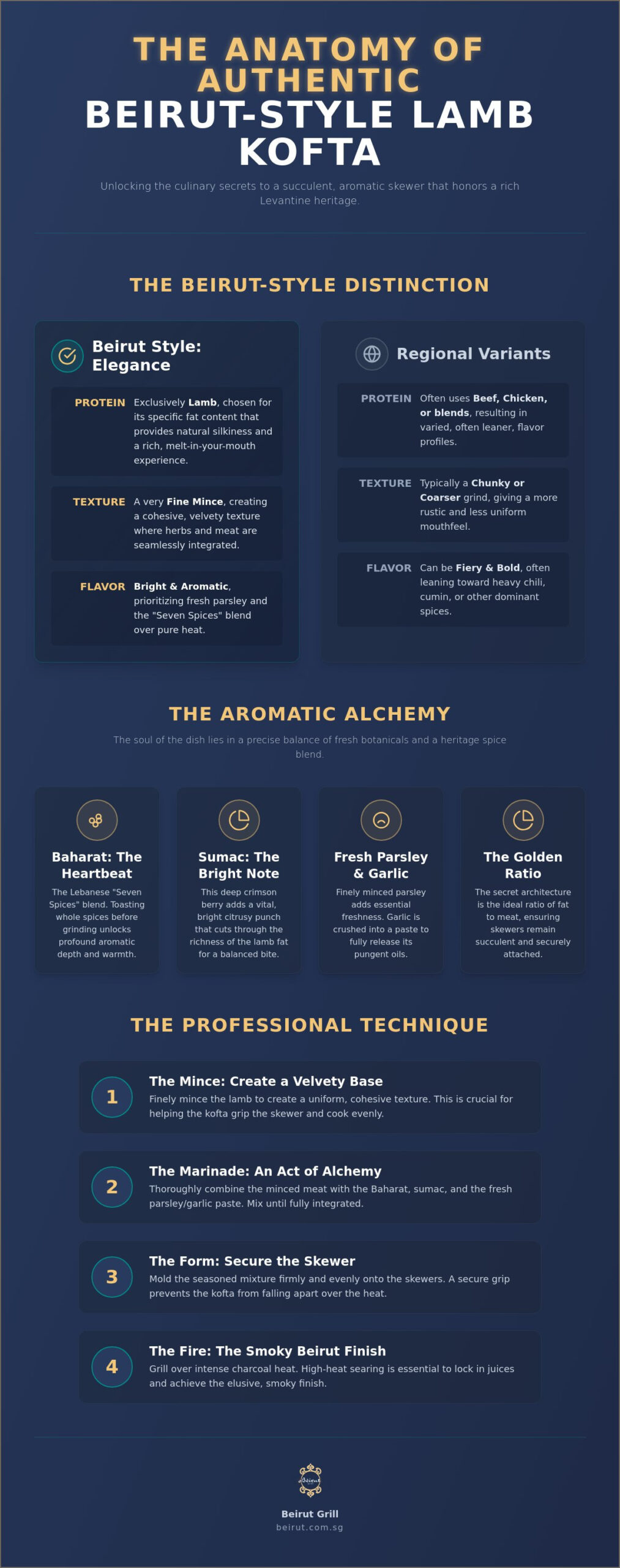
While Turkish or Indian variants often lean toward fiery heat or chunky textures, the Beirut style is celebrated for its elegance and precision. It prioritises a much finer mince, ensuring the herbs and meat are seamlessly integrated into a cohesive, velvety texture. Authenticity in this style demands lamb as the primary protein, as its specific fat content provides a natural silkiness that beef or poultry simply cannot replicate. The Lebanese lamb kofta marinade recipe focuses heavily on the “Seven Spices” blend and high ratios of fresh parsley, creating a profile that is bright and evocative rather than purely spicy. This deliberate composition ensures every bite is a sensory journey through the historic streets of Beirut.
The Aromatic Alchemy: Key Ingredients for an Authentic Marinade
The foundation of any prestigious Lebanese kitchen is the Baharat, a complex “Seven Spices” blend that serves as the aromatic heartbeat of our cuisine. Achieving the perfect balance in your lamb kofta marinade recipe requires an appreciation for the subtle interplay between dried spices and fresh botanicals. It is an act of alchemy. The warmth of black pepper and the sweetness of cloves must be tempered by the bright, citrusy punch of sumac. This deep crimson berry is vital; its astringency cuts through the opulent fat of the lamb, ensuring each bite remains indulgent yet balanced.
Freshness is a non-negotiable hallmark of the Beirut style. Flat-leaf parsley, finely minced until it resembles a verdant dust, provides a necessary brightness that dried herbs cannot replicate. To truly honor the tradition, one must look toward an authentic Lebanese lamb kofta recipe that prioritizes these sensory-rich elements. Garlic should never be merely chopped. Instead, crush the cloves with a pinch of sea salt until they form a pungent, emulsified paste. This technique ensures the garlic’s essential oils are fully released, creating a base that clings to the meat rather than falling away during the sear.
Mastering the Spice Ratios
Precision is your greatest ally when blending your lamb kofta marinade recipe. We recommend toasting whole spices in a dry pan before grinding them; this small act of patience coaxes out a depth of flavor that pre-ground alternatives lack. Balance is everything. The sweetness of cinnamon or allspice provides that evocative “Beirut” scent that transports the guest to a sun-drenched terrace. Use a light hand with these warmer notes to ensure they complement, rather than mask, the high-quality lamb.
The Role of Onion Juice
One of the most guarded secrets of the Lebanese grill master is the treatment of the onion. Adding whole onion chunks to a fine mince is a common mistake that leads to a crumbly texture. Instead, grate the onions and use a fine-mesh cloth to squeeze out the juice. This potent liquid acts as a natural enzymatic tenderiser, breaking down the lamb’s fibers without making the meat mushy. The result is a silky, cohesive kofta that holds its shape with professional integrity. If you wish to experience this mastery without the labor, join us for a Mixed Grill where every skewer tells a story of heritage.
Texture and Fat: The Secret Architecture of a Perfect Kofta
The architecture of a prestigious Lebanese kofta is built upon a foundation of fat. While many home cooks mistakenly select lean cuts in a misguided pursuit of health, a truly authentic result requires a minimum of 20% fat. This “Golden Ratio” is what separates a dry, rubbery skewer from the succulent, melt-in-the-mouth experience found in the heart of Beirut. To achieve this, the shoulder of the lamb is the discerning choice. It offers the perfect equilibrium of rich flavour and essential connective tissue. This structural complexity is deeply rooted in the cultural history of Lebanese cuisine, where the quality of the lamb reflects the host’s hospitality and status.
When executing your lamb kofta marinade recipe, temperature is your most critical variable. Both the meat and the marinade must remain chilled throughout the mixing process. If the fat begins to melt from the heat of your hands or the room, the texture will break. This leads to a greasy result that fails to grip the skewer properly. Professional integrity in the kitchen demands a cold environment to ensure the fat stays suspended within the protein matrix. It’s the only way to guarantee a result that is both juicy and structurally sound.
The Science of the “Tacky” Mix
Texture is not merely a matter of grinding; it’s a chemical reaction. When salt is introduced via your lamb kofta marinade recipe, it begins to dissolve a protein called myosin. This creates a natural, tacky binder that allows the meat to hold its shape without the need for unauthentic fillers like breadcrumbs or eggs. We recommend a gentle hand-kneading technique. You are looking for a specific visual cue: the meat should appear slightly fibrous and feel sticky to the touch. This tells you the proteins have bonded sufficiently to withstand the intense heat of the charcoal grill.
Fat as a Flavour Carrier
Fat is far more than a source of moisture; it is the primary vessel for your aromatics. The essential oils from the Baharat and the pungent garlic in the marinade are fat-soluble. As the kofta cooks, these spices dissolve into the intermuscular fat, basting the meat from within. This is why a lean kofta often tastes flat. Without that 20% fat threshold, the aromatic profile of your marinade simply evaporates into the air rather than being delivered to the palate. Using high-quality intermuscular fat creates a velvety finish that lingers, rewarding the visitor’s curiosity with every indulgent bite.
From Fire to Table: Grilling Techniques and Traditional Accompaniments
The final transformation of the lamb kofta marinade recipe occurs not in the mixing bowl, but over the glowing embers of a charcoal grill. To replicate the prestigious atmosphere of a Lebanese courtyard, one must abandon the convenience of gas for the soul of wood and coal. This is the only path to the authentic smoky “Beirut” finish. The initial searing phase is paramount. High, intense heat is required to instantly caramelise the sugars in the spices and the lamb’s natural fats, locking in the aromatic juices before they have a chance to escape.
Patience is the hallmark of a seasoned host. Once the meat has achieved a perfect, charred exterior, it must be removed from the flame and allowed to rest for exactly 3 minutes. This brief pause is frequently overlooked in generic guides, yet it’s essential for the redistribution of internal juices. Without this rest, the moisture simply pours out upon the first bite, leaving the texture dry. Serve the skewers atop a warm bed of flatbread; this acts as a culinary canvas, soaking up the spiced drippings to ensure no element of the marinade is wasted.
The Skewering Masterclass
Your choice of hardware defines the integrity of the cook. We advocate for flat metal skewers, as their broad surface area prevents the meat from rotating during the turn. Before placing them on the grill, employ the “Dimpling” technique. By using your fingers to create small ridges and valleys along the length of the kofta, you increase the surface area available for charring. This creates more of those coveted, crunchy bits where the lamb kofta marinade recipe has reached its peak caramelisation.
Authentic Lebanese Pairings
A truly indulgent meal is a symphony of contrasts. The rich, spiced profile of the lamb demands the sharp, creamy counterpoint of Toum or a velvety Hummus. To cleanse the palate between these opulent bites, introduce the bright, herbaceous notes of Tabbouleh or the crisp, sumac-dusted crunch of Fattoush. For the final flourish, a robust Lebanese Wine from the Bekaa Valley provides the structural depth needed to complement the complexity of the meat. If you find yourself yearning for this authentic sensory journey, we invite you to experience our signature Mixed Grill at Beirut Grill.
Indulging in the Extraordinary: The Lamb Kofta at Beirut Grill
Nestled in the historic heart of Kampong Glam, Beirut Grill stands as a prestigious destination where culinary heritage meets sophisticated hospitality. Since our inception, we’ve remained steadfast curators of authentic culture. We don’t merely serve food; we transport our guests to the sun-drenched terraces of the Levant. The Lamb Kofta is the crowning jewel of our Mixed Grill, a dish that embodies our philosophy of pride and indulgence. While you’ve learned the structural secrets of a lamb kofta marinade recipe, experiencing it prepared by seasoned experts over our signature charcoal grills is a different journey entirely.
Our grills are designed to replicate the atmospheric intensity of the streets of Beirut. The scent of the embers, combined with the searing meat, creates an allure that rewards the visitor’s curiosity. Every skewer is a testament to our reliability and culinary longevity. We take pride in the sensory details, from the architectural context of our dining room to the fluid service that mirrors a traditional Lebanese feast. This deliberate rhythm is designed to slow the guest down, encouraging an immersive exploration of our culinary offerings.
The Secret of Our Signature Marinade
The soul of our kitchen lies in our commitment to authenticity. We exclusively use high-end, imported spices from prestigious regional producers to ensure an unparalleled flavour profile. This dedication ensures that our lamb kofta marinade recipe remains deeply rooted in tradition and heritage. Every skewer is hand-prepared with meticulous care, ensuring the perfect “tacky” texture and fat distribution discussed previously. This level of professional Lebanese hospitality is what distinguishes us as a premier destination for connoisseurs seeking a specialized yet accessible cultural journey.
Plan Your Lebanese Journey
Whether you’re seeking an intimate dinner or hosting a corporate gathering, our heritage setting provides a rhythmic, storytelling backdrop for any occasion. We encourage you to immerse yourself in the surroundings. To elevate your experience, we offer a curated selection of Lebanese Wine and traditional Arak, chosen to complement the robust, spiced notes of our grilled meats. This progression from the atmospheric environment to the sensory detail of the cuisine defines the Beirut Grill experience. We invite you to join us and discover why our Lamb Kofta remains a cornerstone of Lebanese excellence in the city.
Master the Legacy of the Lebanese Grill
Mastering the perfect lamb kofta marinade recipe is an invitation to explore the sensory-rich traditions of the Levant. By respecting the “Golden Ratio” of fat and the enzymatic power of fresh onion juice, you elevate a simple minced meat dish into a prestigious culinary masterpiece. You now understand that the true soul of kofta lies in the balance of Baharat spices and the transformative power of a high-heat charcoal sear. These techniques, rooted in centuries of heritage, ensure a result that is both aromatic and deeply indulgent. It’s a craft that rewards patience and rewards the visitor’s curiosity.
Since 2009, Beirut Grill has served as a sanctuary for those seeking these authentic flavors in their purest form. Our kitchen remains strictly pork-free, adhering to traditional Lebanese standards while employing time-honored charcoal-grilling techniques to replicate the evocative atmosphere of Beirut. We invite you to step into our sophisticated heritage setting and experience the authentic taste of charcoal-grilled Lamb Kofta at Beirut Grill. Your journey into the heart of Lebanese hospitality awaits, promising a sensory experience that lingers long after the final bite.
Frequently Asked Questions
How long should I marinate lamb kofta for the best flavour?
For the most evocative and balanced result, marinate your meat for at least two hours but no more than four. While the spices need time to permeate the protein, the enzymatic action of the onion juice in your lamb kofta marinade recipe can break down the fibers too aggressively if left overnight. This specific window ensures the lamb remains succulent and firm rather than becoming mushy or losing its prestigious texture before it hits the charcoal.
Can I use beef instead of lamb for the kofta marinade?
You may certainly use beef, though lamb remains the soul of the traditional Lebanese experience due to its natural silkiness. If you choose to substitute, select a cut like brisket or chuck that maintains the “Golden Ratio” of 20% fat to ensure the result isn’t dry. The primary goal of any lamb kofta marinade recipe is to complement the richness of the meat, so ensure your beef selection is of high quality to uphold the sensory allure of the dish.
Why does my lamb kofta fall off the skewer when grilling?
Kofta typically falls from the skewer due to excess moisture or insufficient protein bonding. Ensure you have squeezed every drop of liquid from your grated onions and that your meat remains chilled during the hand-kneading process. If the fat melts before it hits the grill, the structural integrity is compromised. Using flat metal skewers also provides the necessary surface area to grip the meat securely during the intense searing phase.
What is the difference between Lebanese Kofta and Shish Kebab?
The distinction lies entirely in the preparation of the protein and the texture of the final dish. Kofta consists of finely minced meat kneaded with a complex array of herbs and spices to create a velvety, cohesive texture. In contrast, Shish Kebab features whole cubes of marinated meat, such as Shish Taouk or Beef Kebab, which offer a firmer bite. Both are cornerstones of a traditional Mixed Grill, yet kofta is uniquely celebrated for its aromatic depth.
Is it necessary to use a charcoal grill for authentic lamb kofta?
Authentic Lebanese kofta demands the intense heat and smoky essence that only charcoal can provide. While a gas grill or griddle pan can cook the meat, they cannot replicate the evocative “Beirut” finish that defines our culinary offerings. The charcoal embers activate the essential oils in the spices, creating a charred exterior that locks in the juices. It is this specific sensory detail that rewards the visitor’s curiosity and transports the guest to the Levant.
What are the essential spices in a Lebanese Seven Spice blend?
The Lebanese Seven Spice blend, or Baharat, is a prestigious alchemy of black pepper, allspice, cinnamon, cloves, nutmeg, ginger, and fenugreek. This specific combination provides the warm, sweet, and pungent notes that are the hallmark of our heritage. We recommend sourcing these from reputable regional producers to ensure your marinade possesses the high-end sensory profile that distinguishes true Levantine cuisine from generic supermarket imitations.
Can I prepare the lamb kofta marinade in advance?
You can prepare the dry spice components of the marinade weeks in advance, but the fresh aromatics should be added just before the chilling phase. Mixing the spices with the meat should occur no more than four hours before grilling. This ensures the parsley remains vibrant and the onion juice acts as a gentle tenderizer without compromising the structural architecture of the kofta. Professional integrity in the kitchen always prioritizes these precise windows of freshness.
What is the best sauce to serve with marinated lamb kofta?
Toum, a potent and airy garlic emulsion, is the quintessential accompaniment to spiced lamb. Its sharp, creamy profile provides a necessary contrast to the rich, smoky flavors of the grill. Alternatively, a velvety Hummus or a dollop of Labneh can offer a cooling balance. These pairings are designed to cleanse the palate, allowing the guest to fully indulge in the complex aromatic profile of each bite during their cultural journey.