
What if good table manners depend less on memorising rules and more on noticing the people around you? A spread of Lebanese mezze, from hummus and falafel to grilled halloumi, invites a generous, convivial rhythm, but the right way to share can vary with the company and occasion. That’s where social etiquette for sharing plates can feel uncertain: should you serve others first, reach for a communal utensil, or ask about someone’s preferences?
It’s natural to want to be considerate, especially when diners have different dietary needs or customs. A thoughtful question is often more gracious than an assumption. Start with a modest portion, keep serving utensils with their dishes, and leave enough room for others to join in.
This guide offers practical ways to approach shared dishes, use serving utensils with care and read the table’s cues without imposing a universal rulebook. You’ll also find simple ways to ask about preferences, so a meal built around sharing feels welcoming, relaxed and enjoyable for everyone.
Key Takeaways
- Let the setting and host’s lead guide your approach; shared-plate customs can differ from one table to another.
- Before serving, check whether dishes are communal and look for serving utensils. Keep personal cutlery out of shared dishes.
- Use social etiquette for sharing plates to make room for everyone: start with a considered portion and ask someone to pass a dish instead of reaching across the table.
- If you’re unsure about ingredients, preferences or how a dish is served, ask a simple, considerate question rather than making assumptions.
- Discover how Lebanese mezze brings a variety of dishes together in a relaxed meal at Beirut Grill.
What social etiquette for sharing plates really means
At a table of shared dishes, good manners are less about following a fixed sequence and more about making the meal comfortable for everyone. Notice how the group approaches the food, take a portion you expect to eat, and leave enough for others to try. If you’re hosting, make it easy for guests to say what works for them. If you’re a guest, let the host’s preferences and the group’s comfort guide your choices.
That flexibility matters because meals don’t all follow the same pattern. A family gathering, a restaurant dinner with colleagues and a relaxed meal among friends may each have different expectations. The principles behind general table manners also vary across cultures, so no single checklist can account for every custom. Considerate sharing means paying attention, not policing the table.
Lebanese mezze offers a vivid example of a meal that can bring different dishes to the centre of the table. Beirut Grill’s menu includes cold and hot mezze, with dishes such as hummus and falafel. Their presence can make a shared meal, but they don’t tell you exactly how the host or other diners prefer to serve them. Ask, observe, and adjust.
How shared plates differ from individually served meals
With shared plates, diners may choose from dishes placed in the centre, depending on how the meal is arranged. An individually served meal, by contrast, gives each person a plate of their own. Neither style is more polite. For hosts styling a table at home, pairing communal platters with stylish dining sets and glassware from chezmoi.ae can help establish a practical balance between shared food and individual settings. Hummus might be offered for the table, while falafel may be served to individuals. Check the arrangement rather than assuming, and let the meal’s format set the pace.
Why table cues matter more than memorised rules
Before reaching for a dish, take a moment to see how the host and other diners begin. Family habits, cultural practices and restaurant settings can all shape what feels comfortable, even among people sharing the same meal. If the arrangement isn’t clear, ask warmly: “How would you like us to share these?” It’s a simple way to show respect without making anyone explain or defend their customs.
That’s the heart of social etiquette for sharing plates: be attentive, take your cue from the table and leave room for others to enjoy the meal. Whether dining on Middle Eastern mezze or sharing generous traditional platters at restaurants like Nagy Fa-Tál Konyhája, a little curiosity can make unfamiliar dishes and different habits easier to navigate, while helping the whole group settle into a relaxed rhythm.
Before sharing plates arrive: agree on the table’s rhythm
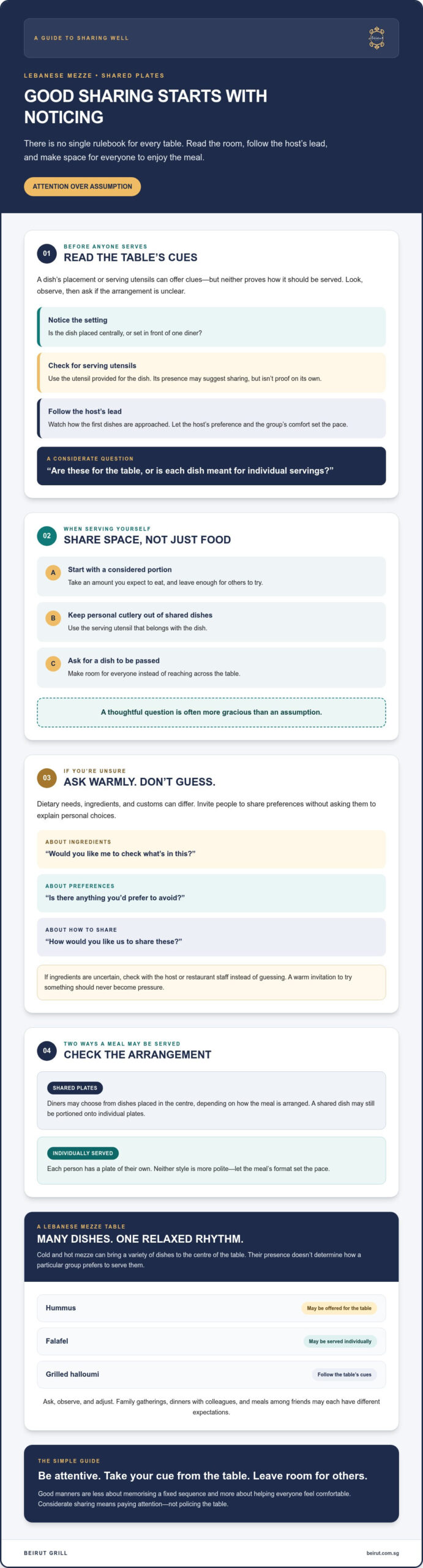
A few quiet cues can make the first moments of a shared meal feel easy. Notice the setting, check whether serving utensils are provided, then follow the host’s lead. If dishes arrive before anyone explains the plan, ask: “Are these for the table, or is each dish meant for individual servings?” Asking early is considerate, not awkward, and helps avoid reaching for a dish that someone considers their own.
Lebanese mezze may bring several cold and hot dishes to the table, but the way a particular group shares them can vary. For a wider sense of the food and traditions associated with Middle Eastern dining, explore this guide to Middle Eastern food and traditions. The philosophy behind shared plates also helps explain why agreeing on the table’s rhythm matters: eating together is as much about consideration and connection as it is about the food.
- Notice the setting. Is a dish placed centrally, or set in front of one diner?
- Check for serving utensils. Their presence may suggest a shared dish, but isn’t proof on its own.
- Follow the host’s lead. Watch how the first dishes are approached, and ask if you’re unsure.
How to tell whether a dish is meant for everyone
Placement, utensils and the way other diners begin can offer clues, but don’t treat them as strict rules. A dish in the centre may still be intended for one person, while a shared dish can be portioned onto individual plates. When in doubt, ask the host rather than reaching in or assuming. Their preference, and the group’s comfort, set the pace.
What to ask about allergies and dietary preferences
Make room for dietary needs without putting a guest on the spot. Try, “Would you like me to check what’s in this?” or “Is there anything you’d prefer to avoid?” No one needs to explain a personal choice. If ingredients are uncertain, check with the host or restaurant staff instead of guessing. A warm invitation to try something should never become pressure.
Once everyone knows what’s shared and what suits them, the meal can find its own easy cadence. To get familiar with Lebanese dishes before your next shared meal, explore Beirut Grill’s Lebanese menu.
How to serve yourself and share dishes politely
Once a dish is confirmed as communal, give everyone a moment to settle before serving. Take a modest first portion so others can taste it too, and choose an amount you expect to eat. For dips or other dishes served with a utensil, transfer a little to your plate rather than eating directly from the communal dish. If you’d like more later, wait until everyone has had a chance to serve themselves.
At a Lebanese mezze meal, several dishes may be set out for diners to enjoy together. The table might include hummus, falafel or grilled halloumi, each with a different texture and flavour. For more context on the region’s varied culinary heritage, read this guide to Mediterranean food and culinary heritage.
Serving from communal dishes without crowding the table
If someone is already serving from a dish, pause briefly rather than reaching around them. When passing a plate, offer it to the nearest diner or ask who would like it next. Don’t stretch across someone’s place setting. A dish can be shared without everyone taking food at once. Keep the movement easy, and let diners choose their own portions.
Using shared utensils with care
When a serving spoon, tongs or another utensil is provided, use it to transfer food to your own plate. Keep personal cutlery out of communal dishes. If there’s no serving utensil, pause and ask, “What would you prefer we use?” Practices differ between tables and cultures, so checking with the group is more considerate than insisting on one method.
Small courtesies make sharing feel natural. Before reaching for a dish just beyond your place, ask the diner beside it to pass it along. Once you’ve served yourself, return the utensil to its dish rather than leaving it on another person’s plate or in their space. If a serving dish is awkward to reach, invite someone closer to pass it instead of leaning over the table.
- Take a first taste-sized portion. Leave others a chance to try the dish before going back for more.
- Keep serving tools with their dishes. Use the utensil provided, and ask what the group prefers if none is available.
- Pass, don’t reach. A brief request keeps the table comfortable and avoids interrupting another diner.
These practical gestures are the heart of social etiquette for sharing plates: serve with care, give others room and stay responsive to the people around you.
What to do when sharing-plate etiquette feels uncertain
Even attentive diners can pause when a dish arrives with no clear serving cue, or when someone approaches it differently than expected. There isn’t one etiquette rule for every shared meal. Customs can vary between households, cultures and restaurant settings, so treat what you’ve seen before as a clue, not a rulebook. Stay observant, ask when it matters and adapt without making another diner feel scrutinised.
If a difference affects everyone, such as whether a dish is for the table or one person, ask the host quietly or wait for a natural pause. If it’s a harmless personal habit, there’s usually no need to correct it. One person’s family practice can be meaningful to them without representing an entire culture. If you’re corrected, a calm “Thanks for letting me know” keeps the meal moving more gracefully than a debate over the perfect technique.
If someone follows a different sharing custom
Perhaps another diner serves a dish in a way you didn’t expect, or prefers not to pass food around. Follow the group’s lead where you can, and avoid turning a small difference into a public lesson in manners. If the custom changes how everyone should proceed, ask the host discreetly: “Would you prefer we serve this another way?”
If you are unsure about a dish or ingredient
Curiosity is welcome, but no one needs to justify a dietary choice. Ask simply, “Do you know what’s in this?” or “Is it spicy?” If you’d rather not try something, a warm “Thank you, I’ll pass for now” is enough. For ingredient or preparation details the host may not know, check with restaurant staff rather than guessing.
These moments are where social etiquette for sharing plates becomes less about perfect technique and more about thoughtful communication. If a serving mistake happens, acknowledge it briefly and make room for others. If someone else slips, respond kindly. A relaxed table can absorb small missteps when nobody is pressured to explain, taste or follow a custom that doesn’t feel comfortable.
For a meal that invites discovery at your own pace, explore Lebanese mezze and shared dishes at Beirut Grill.
Enjoy a Lebanese mezze meal with confidence
A mezze table brings a variety of flavours into one relaxed meal. Cool dips, fresh salads and warm dishes can sit alongside one another, inviting diners to explore at an unhurried pace. Beirut Grill’s Lebanese menu includes hummus, tabbouleh, grilled halloumi and mixed grill, offering different textures and tastes to discover. The precise way a group serves each dish can vary, so follow the host’s preference and ask if anything is unclear.
The social etiquette for sharing plates doesn’t require you to try everything or know every custom. Begin with a small taste of the dishes that appeal to you, then leave room for others before returning for another serving. Sharing is an invitation to explore, not an obligation. A gracious meal makes space for curiosity as well as personal choice.
A simple way to approach a mezze table
Take a moment to see how the dishes are arranged and what the host suggests. Choose a modest first portion, and enjoy each flavour at your own pace. If a dish catches your eye later, wait until others have had a chance before serving yourself again. There’s no need to sample the entire spread; a few thoughtful tastes can be more enjoyable than trying to keep up with the table.
Keep the meal welcoming for everyone
People arrive with different appetites, dietary needs and levels of comfort around shared food. Let each diner decide what they’d like to try, and keep conversation open without testing anyone’s knowledge of Lebanese customs. You might ask what a dish tastes like or which flavours someone is enjoying, while accepting a simple “no, thank you” without comment. Warmth matters more than performance.
At Beirut Grill, guests can explore Lebanese dishes in a welcoming dining setting, with no need to assume that every table follows the same serving ritual. Discover Beirut Grill and its Lebanese menu, and let the company, the dishes and the moment shape a meal that feels generous to everyone.
Bring a little more ease to your next shared meal
Thoughtful sharing doesn’t depend on memorising strict rules. Notice how the host and other diners begin, take a considered portion, and make space for everyone to enjoy the dishes. If you’re unsure about serving customs, ingredients or preferences, a gentle question can put the whole table at ease. That’s the heart of social etiquette for sharing plates: attentiveness, generosity and respect for each person’s comfort.
Lebanese mezze makes a welcoming setting for practising that spirit. Beirut Grill serves a selection of cold and hot mezze, with Lebanese dishes such as hummus, falafel and grilled halloumi. Each brings its own flavour to a meal made more memorable by curiosity and good company.
Ready to explore? Explore Beirut Grill’s Lebanese menu and plan a welcoming shared meal. With a little consideration and an open mind, you can settle into the table’s rhythm and enjoy every moment together.
Frequently Asked Questions
What is the etiquette for sharing plates?
Good etiquette means following the table’s cues, taking a considerate portion and leaving enough for others. Check whether a dish is communal, use a serving utensil if one is provided, and ask someone to pass a dish rather than reaching across another diner. Customs vary between groups and settings, so there isn’t one strict rule for every meal. If you’re unsure, a brief, friendly question to the host can make the arrangement clear.
Should you use your own fork to serve food from shared plates?
Use the serving utensil provided rather than your personal fork. This keeps personal cutlery out of communal dishes and makes serving more comfortable for the group. If there’s no serving spoon, tongs or other utensil, pause and ask what the host prefers instead of assuming. Practices can differ from table to table, so follow the group’s comfort rather than insisting on one universal custom.
How much food should you take from a shared dish?
Start with a modest portion that you expect to eat, allowing everyone a chance to sample the dish. If you’d like more, wait until the others have served themselves or had an opportunity to do so. This is especially considerate when a dish is limited or particularly popular. There’s no need to take a little of everything; choose what appeals to you and enjoy it at your own pace.
Is it rude to ask how shared dishes should be served?
No. Asking courteously is often more considerate than guessing, particularly if you’re unfamiliar with the group’s preferences. You might say, “Would you like us to share this, or is it for one person?” Keep the question light and follow the host’s answer. The social etiquette for sharing plates is about making the meal comfortable for everyone, not demonstrating perfect knowledge of every dining custom.
Can you pass a shared dish across the table?
Yes, if you can pass it comfortably and without disrupting another diner. Offer it to the person nearest you or ask who would like it next. Avoid stretching across someone’s place setting or moving a hot or heavy dish over another person. If the plate is awkward to reach, ask someone closer to pass it along. A small pause and a polite request keep the table flowing smoothly.
What should you do if you have a dietary restriction at a shared meal?
Let the host know before the meal if you can, and ask about ingredients or preparation when something is unclear. You don’t need to explain more than you’re comfortable sharing. If the host doesn’t know what a dish contains, ask restaurant staff rather than relying on a guess. You can decline a dish with a simple “Thank you, I’ll pass,” without criticising the food or drawing attention to your choice.
Are Lebanese mezze dishes meant to be shared?
Lebanese mezze includes a selection of cold and hot dishes that can be enjoyed as part of a shared meal, but don’t assume every dish or table follows the same serving customs. Beirut Grill’s menu includes hummus, falafel and grilled halloumi, among other Lebanese dishes. Follow the host’s lead, ask how a particular dish is intended to be served, and take only what you’re comfortable trying.