
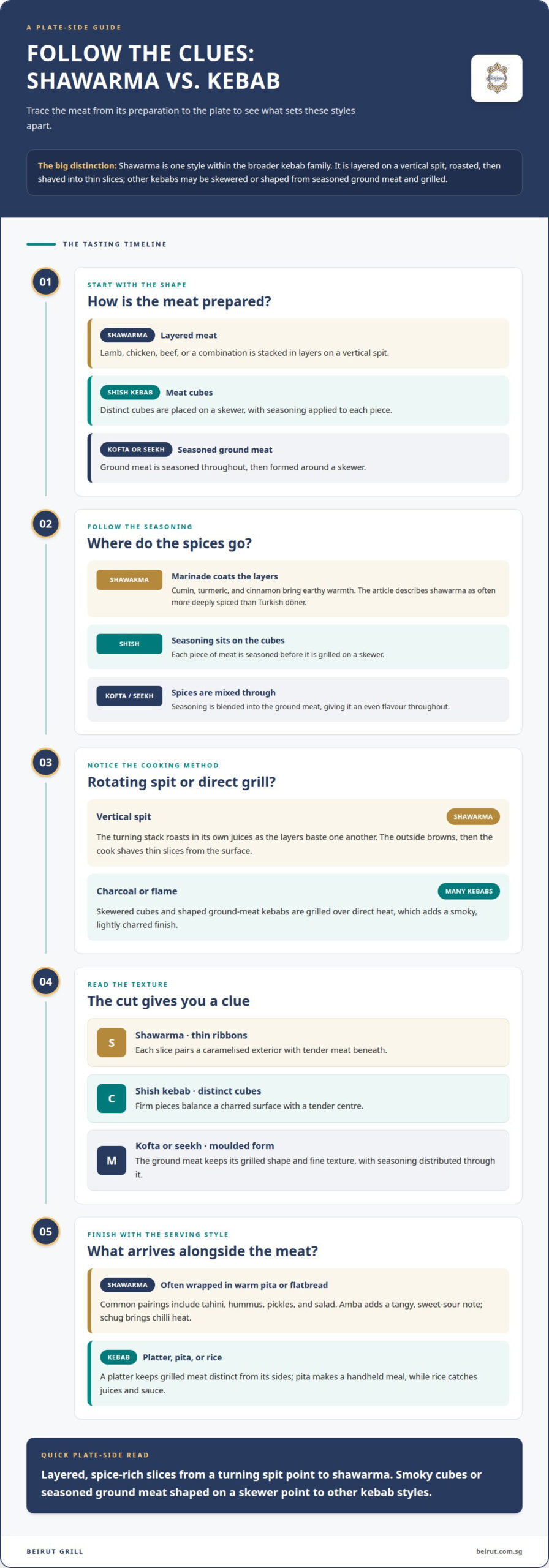
The difference between shawarma and kebab is less a strict divide than a distinction in style: shawarma is a type of kebab, but kebab covers a broader family of dishes. Shawarma is stacked on a vertical spit, roasted and shaved into thin slices; other kebabs may be skewered or shaped from seasoned ground meat and grilled over direct heat.
It’s easy to see why the names blur: both bring richly seasoned meat to the table, and shawarma shares its turning spit with dishes such as döner. The details make the difference. Discover how the meat is seasoned and cooked, which breads and sauces commonly accompany each style, and how their shared vertical-spit method produces a distinct result. By the end, you’ll have a clearer sense of what to order in Singapore, whether you’re drawn to shawarma’s tender, layered slices or the smoky character of a chargrilled kebab.
Key Takeaways
- Look at how the meat is prepared: kebabs can be skewered in cubes or shaped from seasoned ground meat, while shawarma is marinated and roasted in layers.
- Use the cooking method to tell styles apart: shawarma is shaved from a vertical spit, while many kebabs are chargrilled over direct heat.
- Expect different accompaniments: shawarma is often wrapped with tahini, hummus, pickles and salad, while kebab can arrive on a platter, in bread or over rice.
- Choose a Mixed Grill at Beirut Grill when you’d like to enjoy a selection of grilled flavours in one meal.
Differences in meat seasoning
The difference between shawarma and kebab starts with how the meat is seasoned and prepared. Shawarma commonly uses lamb, chicken, beef, or a combination, layered on a vertical spit. A warm-spice marinade coats the meat, while the rotating stack bastes itself with its juices as it roasts.
Its flavour profile is often more deeply spiced than Turkish döner. Cumin, turmeric, and cinnamon bring earthy warmth, while the rotating layers develop savoury, browned edges. Once roasted, the cook shaves thin slices from the outer surface. Each cut combines a caramelised exterior with tender meat beneath.
Kebab covers several preparations, so its seasoning and texture vary. Shish kebab uses cubes of meat on a skewer, with seasoning applied to each piece. Kofta and seekh kebabs can be made with seasoned ground meat formed around a skewer, with the seasoning mixed through the meat. Grilling over charcoal or flame adds a smoky, lightly charred finish.
| Meat style | Typical seasoning | Shape and texture | Cooking and carving |
|---|---|---|---|
| Shawarma | Cumin, turmeric, cinnamon | Layered meat; tender, browned slices | Roasted on a vertical spit; shaved thinly |
| Shish kebab | Seasoning on meat cubes | Distinct, firm pieces | Skewered and chargrilled |
| Kofta or seekh | Spices mixed through ground meat | Fine, moulded texture | Shaped on a skewer and grilled |
Choose by the texture and flavour you prefer: layered, spice-rich slices point to shawarma; distinct smoky cubes or evenly seasoned ground meat suggest kebab.
For a closer comparison, notice where the seasoning sits. Shawarma’s marinade flavours the stacked meat, and roasting lets the layers baste one another. In kofta, spices are mixed into the mince, creating an even taste throughout. Shish kebab cubes retain their shape, so each bite balances a charred surface with a tender centre.
Carving also changes the experience. Shawarma is shaved from the roasted stack in thin ribbons, while shish kebab is served as cubes and kofta keeps its grilled, shaped form. The cut, distribution of spices, and cooking method are useful clues when choosing between the styles.
Shawarma vs Kebab: What’s the Difference?
Shawarma is one style of kebab, while kebab is the broader family. It spans grilled-meat traditions across the Middle East, Mediterranean, and South and Central Asia. In everyday use, kebab often means meat cooked on skewers. Shawarma refers to a Levantine dish prepared on a turning spit, making it one member of a much wider culinary family.
Turkey is closely linked with döner, the Levant with shawarma, and Greece with gyro. All three names relate to turning, reflecting a shared rotating cooking method. Each belongs to its own food tradition and has distinct serving customs. Gyro, for example, is commonly served in Greek pita with tzatziki, tomato, and onion.
The vertical rotisserie associated with döner kebab traces to the Ottoman Empire in the 19th century. Bursa is often credited as its birthplace. Turkish döner may feature veal, beef, chicken, or lamb. In Germany, döner served in bread with salad and sauce became popular in the 1970s. That format made sliced rotisserie meat a familiar handheld meal.
Neither dish is inherently healthier; nutrition varies with the meat, portion, bread, sauce, and sides. A shawarma wrap with tahini differs from a kebab platter, so compare ingredients and serving sizes rather than dish names alone.
In Singapore, meal costs vary with the restaurant, meat selection, portion, and accompaniments. Bread, rice, and added sides can affect the total, so compare similar servings.
Traditionally, shawarma uses seasoned meat stacked on a vertical spit, where it roasts before being shaved into thin slices. It is commonly served in warm pita or flatbread, so the cooking style and presentation are useful clues.
To explore Lebanese flavours alongside these traditions, browse Lebanese dining in Singapore.
Bread and sauces used for each dish
Shawarma is often served in warm pita or flatbread, wrapped around shaved meat, fresh salad, and sauces. Tahini brings a creamy sesame note; hummus adds a smooth, savoury layer. Pickles cut through the richness with sharp acidity, while crisp salad adds freshness. Together, these fillings make a compact meal with meat, sauce, and crunch in every bite.
Condiments can change a wrap’s character. Amba, a tangy mango pickle sauce, contributes sweet-sour fruitiness. Schug, a chilli paste, brings heat. Choose amba for a bright, tart edge or schug for a sharper, spicy lift. Tahini and hummus, by comparison, soften the meat’s roasted savouriness.
Kebab has no single bread or sauce pairing because it includes different preparations. Skewered cubes or ground-meat kebabs may arrive on a platter, in pita, or over rice. A platter keeps the grilled meat distinct from its sides; pita makes it a handheld meal, while rice catches juices and sauce. The format can shape each mouthful as much as the seasoning.
Greek gyro offers a useful comparison. It is commonly tucked into thick, soft pita with tzatziki, tomato, and onion, and fries may go inside the wrap. Tzatziki’s cool, creamy character contrasts with the savoury meat; tomato and onion add freshness and bite. This combination differs from shawarma’s familiar pairing of tahini, hummus, and pickles.
- For a creamy shawarma wrap: pair tahini or hummus with pickles and salad.
- For more punch: choose amba for tang or schug for chilli heat.
- For kebab: select pita for a wrap, rice for a fuller base, or a platter to keep components separate.
In Singapore, these serving styles help distinguish the dishes on a menu. A warm flatbread wrap with tahini and pickles suggests shawarma; kebab may appear with rice or as grilled pieces on a platter. Compare the bread, sauce, and sides together, not just the meat’s name, to identify the style and choose the texture you want.
Shared vertical-spit cooking method
Shawarma, Turkish döner, and Greek gyro share a vertical-rotisserie method. Seasoned meat is stacked upright around a turning spit and roasted. As the stack rotates, its outer surface meets the heat and gradually browns. The cook shaves off thin, cooked layers while the meat inside continues roasting.
This method differs from kebabs cooked directly over charcoal or flame. A skewer of meat cubes sits close to the heat, while kofta is shaped from ground meat and grilled. With shawarma and döner, the turning stack creates a continuous outer surface for roasting and carving. The vertical spit rotates the meat rather than a hand-turned skewer.
The technique associated with döner kebab traces to the Ottoman Empire in the 19th century. Bursa is often credited as its birthplace. Shawarma developed through the Levant, while gyro belongs to Greek food tradition. Their shared spit method links these dishes, but their regional identities and accompaniments remain distinct.
Watch for these cues when a dish arrives:
- Stack: meat is layered upright on a rotating spit.
- Roast: the exposed surface browns as rotation continues.
- Carve: thin slices are shaved from the cooked exterior.
- Serve: the sliced meat goes into a wrap or onto a plate.
That sequence explains why spit-roasted meat often combines browned edges with softer slices beneath. It also clarifies why “kebab” can describe more than one cooking style: shish kebab is grilled on a skewer, while spit-roasted döner also belongs to the broader kebab family. The cooking method is the clearest clue.
For another way to savour Lebanese cooking in Singapore, explore Beirut Grill’s menu.
Beirut Grill: Mixed Grill
Beirut Grill’s Mixed Grill offers a natural next step after comparing shawarma and kebab: enjoy a selection of grilled flavours in one meal. It suits diners curious about Lebanese grilling but undecided on one style. Add Hummus for a creamy accompaniment, or choose Vegetarian Kebab for a meat-free option.
For diners in Singapore, Lebanese Wine offers a regional pairing alongside the meal. These choices let you shape the occasion around grilled flavours, whether sharing dishes or exploring Lebanese cuisine at your own pace.
Visit beirut.com.sg to explore Beirut Grill’s menu.
Let curiosity lead to your next meal
Understanding the difference between shawarma and kebab can make a menu feel less like a choice between unfamiliar names and more like an invitation to explore. Next time you dine, notice what draws you in first: the aroma of seasoned meat, the contrast of crisp and tender textures, or the way bread and sauces bring a dish together. That instinct can guide your order as surely as tradition does.
Food also offers a way to encounter the character of a place. In Singapore, a Lebanese meal can turn a new culinary curiosity into a relaxed occasion, whether you’re sharing dishes or simply taking time over the flavours. Let appetite, company, and the atmosphere you’re seeking shape the experience.
For your next meal, contact Beirut Grill today and take the next step toward discovering Lebanese hospitality. Find a table that suits your curiosity, and enjoy the pleasure of exploring at your own pace.
Frequently Asked Questions
What Is Döner Kebab?
Döner kebab is a Turkish style of kebab cooked on a rotating vertical spit. Its name relates to turning, describing the meat’s movement as it roasts. The cook shaves the browned outer layer for serving. Look for “döner” on a menu when you want spit-roasted meat; “kebab” alone may refer to several grilled preparations.
So which should I order?
Choose according to the texture and meal format you’re craving. Order shawarma for thin, layered slices in a wrap; choose shish kebab for distinct grilled cubes, or kofta for seasoned ground meat. If you’re deciding at a Singapore restaurant, consider whether you want a handheld meal or a plated dish, then select bread, rice, or sides to suit.
What is kebab and what are the main types of kebab?
Kebab is a broad family of meat dishes, rather than one fixed recipe. Shish kebab uses cubes threaded onto skewers; kofta or seekh kebab shapes seasoned ground meat around a skewer. The word can also describe spit-roasted styles such as döner and shawarma. Check the preparation name on the menu to understand the cut and cooking style.
What are the key differences between shawarma and kebab?
Shawarma is a specific Levantine style within the wider kebab family. The main distinction is preparation: shawarma is stacked and roasted on a vertical spit, while kebab may mean skewered cubes or grilled ground meat. For the clearest clue, look beyond the dish name to whether the menu describes carving, skewering, or shaping.
Which meats and seasonings are commonly used in shawarma versus kebab?
Shawarma is traditionally made with lamb, chicken, beef, or a combination, seasoned with warm spices such as cumin, turmeric, and cinnamon. Kebab varies by type: shish uses cubes, while kofta uses spiced ground meat. Döner seasoning commonly includes paprika, cumin, and garlic. These are typical styles, and recipes differ between kitchens.
How are shawarma and kebab typically served, including breads and toppings?
Shawarma commonly comes wrapped in warm pita or flatbread with salad, pickles, tahini, or hummus. Kebab can be served as a platter, placed in pita, or set over rice, depending on the preparation. For a Greek-style comparison, gyro is commonly paired with pita, tzatziki, tomato, and onion. Check the menu description for the accompaniments.