
Rosewater should whisper through a dessert, not announce itself with every bite. That measured touch is what makes rosewater in middle eastern desserts so intriguing: a few drops can bring softness and fragrance, while too much may taste soapy or overpowering. If you’ve wondered whether its floral aroma will overwhelm a sweet, your caution makes sense.
Used thoughtfully, rosewater lends a sweet, petal-like note that can sit beautifully alongside richer flavours. This guide explains what it tastes and smells like, how to use and store it carefully, and how it differs from the lighter, citrus-floral note of orange blossom water. You’ll also find examples of sweets where floral notes may appear, from baklava and kunafeh to ma’amoul and milk puddings. Beirut Grill’s menu includes baklava, kunefe and mouhalabieh, familiar Middle Eastern sweets, though recipes vary and their ingredients shouldn’t be assumed. With a little context, you can recognise rosewater’s role without expecting every dessert to taste of roses.
Key Takeaways
- Rosewater in middle eastern desserts is an aromatic accent that can add a delicate floral impression. Its effect varies by recipe and palate.
- Rosewater and orange blossom water have distinct aromas and flavour profiles, so don’t treat them as automatic substitutes.
- Follow the recipe’s guidance, measure carefully, then taste before making any adjustment.
- Baklava, kunefe and mouhalabieh are examples of Middle Eastern desserts to explore, but their ingredients and recipes can vary.
- Read dessert descriptions to learn how floral notes may balance sweetness, texture and richness.
What Is Rosewater in Middle Eastern Desserts?
Culinary rosewater is a fragrant, food-use ingredient that gives a recipe a rose-like aroma and flavour. In rosewater in middle eastern desserts, it works as a measured aromatic accent, complementing a sweet’s main flavours rather than replacing them. It isn’t the same as rose-scented perfume or cosmetics, or necessarily the same as rose-flavoured syrup, sweets or drinks.
The name describes an ingredient, not a guaranteed intensity or a fixed recipe. Products and recipes vary, so the result depends on what you use and how much the recipe calls for. A dessert may feature floral fragrance, or rely on other ingredients entirely.
What does rosewater taste and smell like?
Rosewater smells floral and rose-like, and its flavour can come across as delicate, sweet and fragrant. Some people notice a fresh, petal-like quality; others find the same note more pronounced. Concentration, quantity and personal preference all shape the impression.
Used with restraint, rosewater can lend a dessert a graceful aromatic lift. Too much may make the sweetness seem perfumed or soapy, drawing attention away from other flavours. Think of it as seasoning: the aim is balance, not a dominant floral taste.
How is rosewater used as a culinary ingredient?
Culinary rosewater is intended for food and drink. Depending on the recipe, it may be added to syrup, batter, filling or another dessert component to contribute fragrance. It doesn’t make every sweet taste alike; the other ingredients and preparation shape the result.
Before using a bottle, check that its label identifies it as food-grade or suitable for culinary use. Rosewater sold for perfume or cosmetic use isn’t automatically edible, and shouldn’t be used in food unless the label explicitly confirms that it’s intended for consumption. Follow the recipe’s directions, since products can differ in strength and a quantity suited to one recipe may not suit another.
For a first taste, choose a recipe that clearly calls for culinary rosewater and measure as directed rather than pouring by eye. This lets the aroma sit gently within the dessert, leaving room for its sweetness, texture and other flavours to shine.
How Rosewater Brings Fragrance to Middle Eastern Sweets
Fragrance can shape a dessert’s first impression before its sweetness or texture fully registers. In rosewater in middle eastern desserts, rosewater acts as an aromatic accent: it can lift a recipe with floral notes while sweetness, richness and texture remain central. The effect depends on the recipe, so floral fragrance is one possible expression of Middle Eastern sweets, not a feature to expect in every dessert.
Rosewater’s role also depends on where it enters the preparation. Some recipes incorporate floral water into syrup, while others add it to a cream or filling. The recipe determines where and when it goes in, which can influence how clearly its aroma comes through. Follow the specific instructions rather than assuming one method suits every sweet.
Rosewater in syrups, creams, and fillings
A fragrant syrup may carry rosewater across pastry layers or provide an aromatic finish, while a dairy-based preparation can offer a softer setting for floral notes. These are possible recipe roles, not fixed rules. A recipe may specify adding rosewater during preparation or at a later stage, so use its directions as your guide.
Why rosewater pairs with different dessert textures
Consider the contrast between crisp pastry, creamy pudding and a cheese-based dessert. Their textures and levels of richness create different settings for aroma: a floral note might brighten a rich mouthful or add another layer to a delicate one. The balance varies with the recipe and the diner’s palate.
Baklava, kunefe and mouhalabieh offer examples of distinct dessert styles. Baklava is associated with layered pastry, kunefe with a cheese-based style, and mouhalabieh with a creamy pudding style. These descriptions help set expectations for texture, but they don’t establish that any particular version contains rosewater. Beirut Grill’s menu includes all three desserts, though their ingredients shouldn’t be assumed. You can explore Beirut Grill’s dessert offerings as you learn how different sweets express their own character.
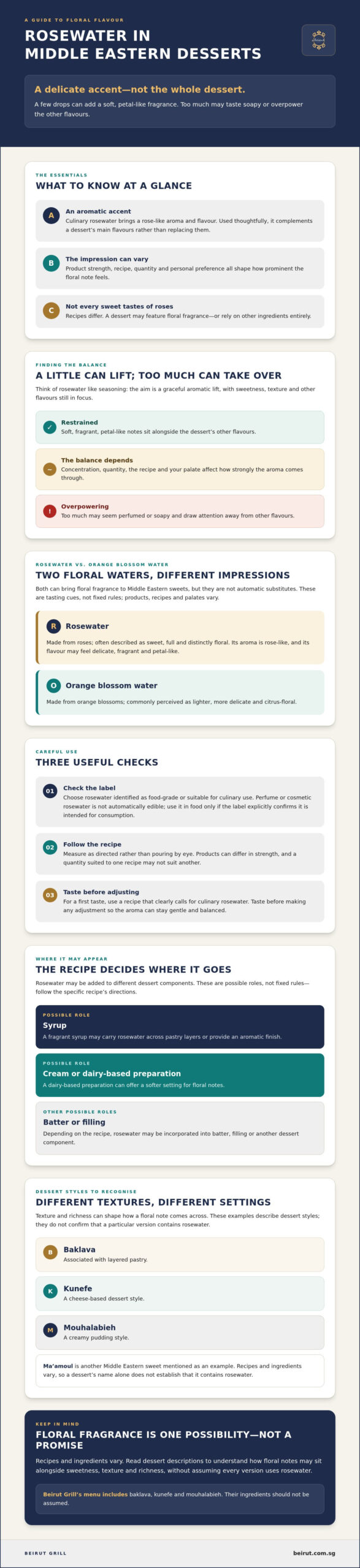
Rosewater vs. Orange Blossom Water: What Is the Difference?
Rosewater and orange blossom water both bring floral fragrance to Middle Eastern sweets, but they leave different impressions. Rosewater is made from roses and is often described as sweet, full and distinctly floral. Orange blossom water comes from orange blossoms and is commonly perceived as lighter, more delicate and citrus-floral. These are useful tasting cues, not fixed rules: products, recipes and individual palates vary.
In rosewater in middle eastern desserts, the ingredient is chosen for the particular aromatic note a recipe calls for. Orange blossom water offers a different expression, rather than a default replacement. A dessert’s sweetness, richness and other flavours also shape how either floral water comes through.
| Floral water | General aroma and flavour impression | How to approach it in a recipe |
|---|---|---|
| Rosewater | Often rose-like, sweet and floral | Use when the recipe names rosewater and its particular floral character is wanted. |
| Orange blossom water | Often lighter, delicate and citrus-floral | Use when the recipe calls for its distinct blossom aroma. |
How rosewater and orange blossom water differ
The simplest distinction is their source: rosewater is rose-derived, while orange blossom water is blossom-derived. Their aromas may suggest different directions in a sweet, from a recognisably rosy note to a more citrus-floral one. Follow the ingredient named in the original recipe to preserve its intended flavour balance; the two waters aren’t interchangeable by default.
Can you substitute one floral water for the other?
A recipe may allow room for experimentation, but a substitution can shift the dessert’s aromatic character. The result depends on the recipe and whether you want to move from a rose-like impression toward a citrus-floral one, or the reverse. There’s no universal conversion ratio that suits every product and preparation.
If the recipe permits a swap, proceed cautiously: use a small amount, taste where practical, and adjust only if the flavour remains balanced. For a first attempt, or a recipe where the named aroma is central, it’s safer to use the specified floral water. That helps preserve the character the recipe is designed to express.
How to Use Rosewater Without Overpowering a Dessert
The best approach to rosewater in middle eastern desserts is measured and guided by the recipe. Start with the recipe’s specified amount. Don’t assume one quantity will suit every dessert: recipes, products and concentrations can vary, and an amount that feels subtle in one preparation may dominate another.
Use this simple sequence:
- Check the recipe. Confirm it calls for culinary rosewater, then note the amount and when to add it.
- Measure carefully. Use a measuring spoon rather than pouring directly from the bottle.
- Taste where appropriate. If the preparation can be tasted safely before serving, check whether the floral note is balanced.
- Adjust only if the recipe allows. Add a little at a time, tasting between additions. Don’t try to correct a finished dessert by adding more without considering its effect on the overall balance.
Check the label before cooking. Culinary rosewater is intended for food use; perfume, cosmetic rosewater and concentrated rose extracts aren’t automatic substitutes. A product’s strength and intended use may differ, so follow its labelling as well as the recipe. If the label doesn’t clearly indicate that it’s suitable for food, don’t add it to a dessert.
When should rosewater be added?
Timing depends on the recipe and preparation method. A syrup, cream or batter may each call for rosewater at a different stage, so follow the specific instructions rather than adding it by habit. Heating can affect aroma, but the result depends on the preparation. Don’t assume heat will always preserve or remove the fragrance; let the recipe guide you.
How should rosewater be stored?
Follow the product label for storage directions and use-by guidance, since these can differ between products. Close the bottle securely after each use, and don’t rely on a guessed shelf life or storage rule. If the label is missing or unclear, check with the manufacturer before using the product.
Careful measuring is part of the pleasure: a restrained floral note can complement a sweet without obscuring its other flavours. To explore Middle Eastern desserts beyond your own kitchen, discover Beirut Grill’s dessert offerings, including Baklava, Kunefe and Mouhalabieh. Check their specific ingredients rather than assuming what they contain.
Where to Explore Rosewater and Middle Eastern Desserts
Rosewater can lend a dessert a distinctive floral aroma, but it’s one note within a much wider culinary landscape. Recipes, ingredients and preferences vary, so a sweet’s name alone won’t tell you whether it contains rosewater or how strongly its fragrance will come through. Reading recipe notes and dessert descriptions can offer useful clues, especially when they identify the floral water and explain how it fits with the other flavours.
For anyone curious about rosewater in middle eastern desserts, exploring different styles is a rewarding next step. Notice the aroma first, then consider how sweetness, richness and texture shape the whole experience. A floral note may be subtle or more pronounced; the recipe and your own palate both matter.
Explore desserts with different textures and flavours
Beirut Grill’s menu includes Baklava, Kunefe and Mouhalabieh, three distinct Middle Eastern dessert offerings. Their names are a starting point for discovery, not a guarantee of shared ingredients or rosewater in any particular preparation. Check the recipe or menu description for ingredient details, then pay attention to each dessert’s balance of aroma, sweetness and texture.
To explore Kunafa in greater depth, look for the guide The Ultimate Guide to Kunafa. It offers a focused path into a dessert that may also be written as Kunefe, while reminding readers that spellings and recipes can vary.
Turn ingredient curiosity into a dessert discovery
As you explore floral desserts, take a moment with each bite. Is the aroma immediately noticeable, or does it emerge after the sweetness? Does the texture feel crisp, creamy or something else? These observations help you appreciate how fragrance works with a dessert without assuming every version follows the same recipe.
For broader culinary context, continue with Middle Eastern Food: The Ultimate 2026 Connoisseur’s Guide. Exploring the wider food culture can help place individual sweets within a richer dining experience, while keeping in mind the variation found across recipes and kitchens.
If you’d like to continue your dessert discovery, explore Beirut Grill’s dessert offerings and check the current menu for details on Baklava, Kunefe and Mouhalabieh.
Discover the Subtle Art of Floral Desserts
Rosewater in middle eastern desserts is best understood as a measured aromatic accent, not a flavour that belongs in every sweet. Its rose-like fragrance can shape a dessert’s impression, while the recipe’s sweetness, richness and texture remain essential. Orange blossom water brings a different, often citrus-floral character, so follow the recipe’s choice rather than treating the two as automatic substitutes.
In the kitchen, choose rosewater labelled for culinary use, follow the recipe’s quantity and timing, and taste before making any adjustment. These small steps help keep its fragrance graceful rather than overpowering. Every recipe has its own balance, and the most rewarding discoveries come from noticing how aroma meets texture and sweetness.
Beirut Grill serves Lebanese and Middle Eastern cuisine, with Baklava, Kunefe and Mouhalabieh among its dessert offerings. Their specific ingredients can vary, so don’t assume they contain rosewater. Explore Beirut Grill’s Middle Eastern dessert offerings and let curiosity guide your next sweet discovery.
Frequently Asked Questions
What does rosewater do in Middle Eastern desserts?
Rosewater adds a floral aroma and flavour that can complement a dessert’s sweetness, richness and texture. In rosewater in middle eastern desserts, it’s best understood as an aromatic accent, not the main flavour in every recipe. Depending on the preparation, it may be incorporated into a syrup, cream or filling. The recipe determines how it’s used, and not all Middle Eastern sweets include rosewater.
Does rosewater make desserts taste like perfume?
Rosewater doesn’t have to make a dessert taste like perfume. Used in the amount specified by a recipe, culinary rosewater can provide a gentle, rose-like fragrance. The impression depends on the product, quantity and personal preference. Too much may make a sweet seem heavily perfumed or soapy, masking its other flavours. Measure carefully, and don’t add extra unless the recipe allows adjustment.
Can I substitute orange blossom water for rosewater?
Sometimes, but the substitution changes the dessert’s floral character. Rosewater is generally associated with a sweet, rose-like aroma, while orange blossom water is often lighter and citrus-floral. They’re distinct ingredients, not automatic substitutes. Follow the recipe’s specified choice when possible. If the recipe permits experimentation, add the alternative cautiously and taste where practical. There’s no universal conversion ratio that suits every preparation or product.
How much rosewater should I use in a dessert?
Use the quantity specified in your recipe, since the right amount depends on the dessert and the product’s strength. Measure with a spoon rather than pouring straight from the bottle. If the recipe allows adjustments, taste the preparation where practical before adding more, then proceed cautiously. Don’t assume that the quantity used in one dessert will work in another. A heavy hand can overpower other flavours.
Is culinary rosewater the same as rose essential oil?
No. Culinary rosewater and rose essential oil aren’t interchangeable. Rosewater labelled for culinary use is intended for food, while essential oil is a concentrated product that may have different directions and uses. Don’t add essential oil to a dessert unless its label explicitly confirms it’s suitable for food and the recipe gives appropriate instructions. For cooking, choose rosewater clearly labelled as food-grade or suitable for culinary use.
What happens if I add too much rosewater?
Too much rosewater can make a dessert taste overwhelmingly floral, perfumed or soapy, and may obscure its sweetness and other flavours. If you’re still preparing a mixture, pause and taste before adding anything else. Whether the flavour can be balanced depends on the recipe, so avoid relying on a universal fix. For next time, measure the recipe’s amount carefully and adjust only if its instructions permit.
Do all Middle Eastern desserts contain rosewater?
No. Middle Eastern desserts vary widely, and rosewater is only one possible aromatic ingredient. A dessert’s name or cultural association doesn’t confirm that its recipe contains rosewater; ingredients and methods can differ between recipes and kitchens. Check the recipe or menu description if you want to know whether a particular sweet includes it. Explore each dessert on its own terms rather than expecting the same floral flavour throughout.