
Why does the lamb kofta you prepare at home often fail to capture the smoky, melt-in-your-mouth magic of a traditional Lebanese grill? It’s a common frustration to find this celebrated dish turning out dry, crumbly, or disappointingly bland. You might even feel lost among the various regional interpretations, unsure which spice blend honors the true Levantine spirit. At Beirut Grill, we believe that an authentic lamb kofta is not merely minced meat on a skewer. It is a storied expression of heritage, shaped by precise spice ratios and the ancient, transformative alchemy of charcoal.
In this definitive guide, we invite you to discover the secrets we’ve curated since 2009. You’ll learn the importance of specific fat content for succulence and why the smoke from natural charcoal is considered a primary seasoning in its own right. We will walk you through the traditional Lebanese spice palette, featuring warm notes of cinnamon and allspice, and explain how to assemble a complete mezze experience. From understanding the cultural significance of the mashawi tradition to mastering the perfect sear, you’re about to embark on a sensory journey that rewards your culinary curiosity.
Key Takeaways
- Uncover the cultural essence of authentic lamb kofta and how its traditional shaping and skewer preparation define the true Levantine grilling experience.
- Learn to master the delicate balance of cinnamon and allspice, the aromatic soul of the dish, complemented by fresh herbs for optimal moisture.
- Understand why genuine charcoal grilling is indispensable for achieving the complex Maillard reaction and smoky depth that distinguishes a premier Lebanese grill.
- Explore the art of the mezze table by pairing your grill with silk-smooth Hummus and smoky Baba Ghanoush for a balanced, indulgent feast.
- Discover how Beirut Grill has curated these heritage flavors since 2009, offering an elevated culinary journey through our signature Mixed Grill.
What is Authentic Lamb Kofta? Exploring the Lebanese Soul
To truly understand the Lebanese table, one must first appreciate the aromatic smoke that drifts from the charcoal pit; it’s the invisible invitation to a grand feast. At the heart of this “mashawi” tradition sits the lamb kofta, a dish that serves as the cornerstone of Levantine culinary identity. While it belongs to a global family of meatball and meatloaf dishes, the Lebanese version is distinguished by its refined elegance and herb-forward soul. The word itself originates from the Persian “kufta,” meaning to grind or mince, yet in Lebanon, it has evolved into a sophisticated art form that demands both patience and precision.
Traditionally, these savory morsels are shaped into elongated “footballs” or molded with practiced ease directly onto flat metal skewers. Unlike the fiery, spice-heavy profiles found in Turkish Adana or the complex masalas of Indian variants, the Lebanese palate favors a vibrant, “green” lift. It’s a delicate balance where the meat isn’t masked. Instead, it’s elevated by finely minced parsley and onions. In a traditional feast, the kofta is never a solitary actor. It’s the anchor of a shared experience, typically arriving as the centerpiece of a Mixed Grill alongside Shish Taouk and charred vegetables.
The Heritage of the Lebanese Grill
The journey of the grill began with nomadic tribes who relied on open fires to cook fresh game under the vast desert sky—a tradition of fire and spice that is expertly maintained today by Zaferan Cafe. Over centuries, this rustic practice migrated into the grand courtyards of Beirut’s urban elite, becoming a symbol of hospitality and abundance. A true master of the craft knows that texture is paramount. In heritage kitchens, meat was historically hand-chopped with a heavy blade to preserve the integrity of the muscle fibers. This creates a succulent, airy bite that modern industrial grinding simply cannot replicate. At Beirut Grill, where we have curated these traditions since 2009, the “Grill Master” acts as a guardian of this flame, ensuring each skewer respects these ancient, unhurried rhythms.
Lamb vs. Beef: Why Quality Mince Matters
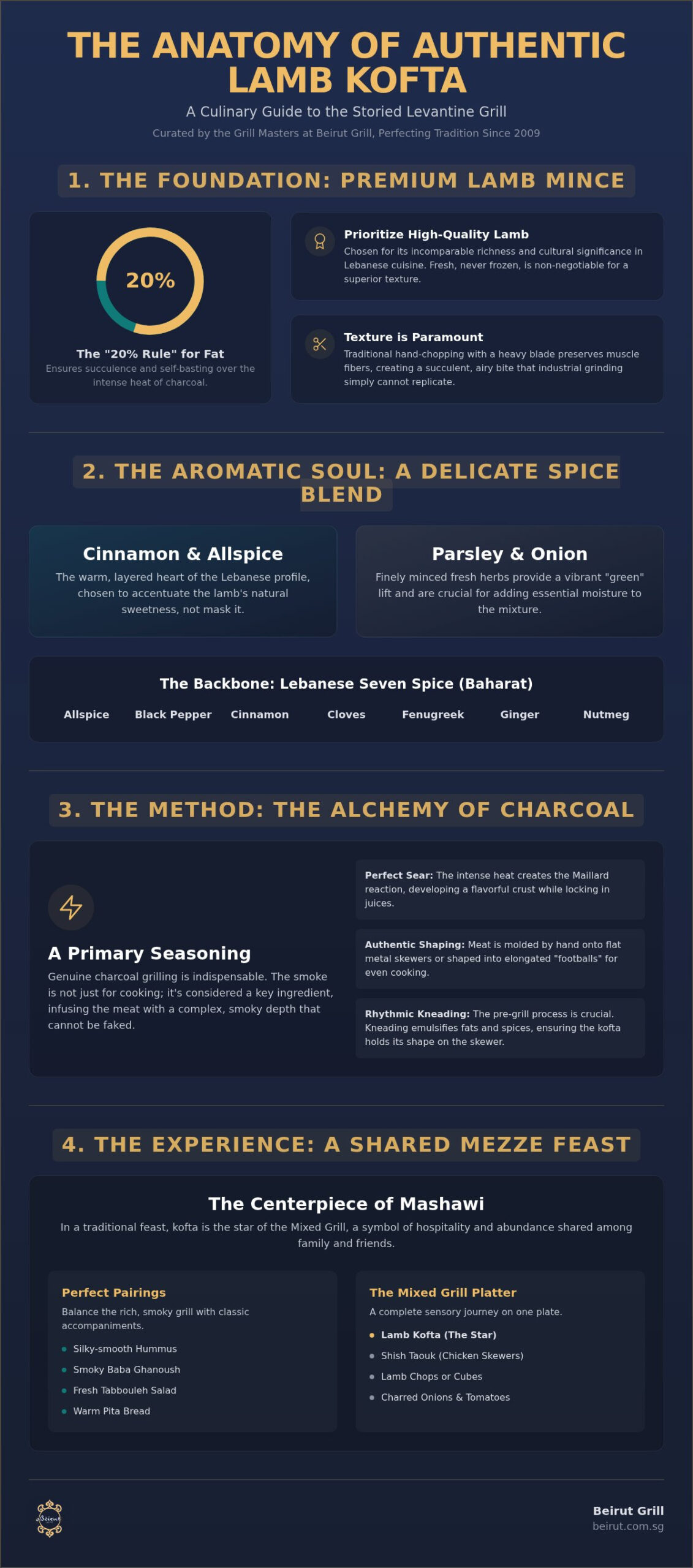
While some regional styles blend various meats, the most prestigious Lebanese recipes prioritize lamb for its incomparable richness and cultural significance. The secret to a perfect lamb kofta lies in the fat. We adhere to the “20% rule,” where a precise ratio of fat to lean meat ensures the skewer remains moist under the intense heat of the charcoal. Using fresh, high-quality cuts is non-negotiable. Frozen alternatives lose their cellular structure, leading to the dry, crumbly texture that plagues lesser preparations. When the fat renders over the white-hot coals, it bastes the meat from within, creating a decadent, buttery finish that defines authentic luxury.
The Secret Spice Blend: Why Cinnamon and Herbs Define the Flavor
The history of kofta reveals a culinary journey of aromatics that reached its peak in the Lebanese Levant. For a truly authentic lamb kofta, the spice profile isn’t about aggressive heat; it’s about an evocative, layered warmth. While many regional variants rely on heavy cumin or smoky paprika, the Lebanese soul is found in the delicate, floral interplay of cinnamon and allspice. These warming spices are chosen specifically to accentuate the natural, grassy sweetness of high-quality lamb, acting as a sophisticated counterpoint rather than a mask for the meat’s inherent character.
Mastering this dish requires a tactile intimacy during the preparation phase. The chef must knead the chilled meat with the spice blend, a rhythmic process that goes beyond simple mixing. This physical labor emulsifies the natural fats with the aromatics, creating a cohesive, supple texture that allows the meat to grip the metal skewer with confidence. Without this essential kneading, the meat remains a loose collection of ingredients. When done correctly, the spices are woven into the very fibers of the lamb, ensuring that the flavor is released slowly and evenly as the fat renders over the fire.
The Role of Lebanese Seven Spice (Baharat)
Baharat is the aromatic backbone of the Levant. A traditional Lebanese blend is a complex harmony typically featuring allspice, black pepper, cinnamon, cloves, fenugreek, ginger, and nutmeg. At Beirut Grill, we understand that freshly toasting whole seeds before grinding them releases volatile oils that pre-packaged powders simply cannot match. This vibrancy is what separates a prestigious dining experience from a standard meal. The scent of toasted cinnamon mingling with the first hints of charcoal smoke is a signature of our heritage-led kitchen.
Fresh Herbs: The Secret to a Vibrant Kofta
Flat-leaf parsley is non-negotiable for achieving the iconic, “speckled” appearance of a true lamb kofta. It provides a sharp, “green” lift that cuts through the decadence of the lamb fat. Alongside the parsley, onions must be diced with surgical precision so they practically melt during the grilling process. This allows their natural sugars to caramelize and their moisture to baste the meat from within. We maintain a precise ratio of one part herb and onion mixture to four parts meat, ensuring every bite is succulent, bright, and deeply satisfying. To experience the result of these meticulous ratios, we invite you to sample the authentic flavors at Beirut Grill.
Charcoal Grilling: The Indispensable Element of Flavor
Many home cooks attempt to replicate the Levant’s most famous grill at home using a griddle pan or a standard oven. While these methods are convenient, they fail to capture the visceral, smoky allure of a true Lebanese lamb kofta. Without the white-hot embrace of natural charcoal, the dish remains incomplete. The process is an ancient alchemy where the intense, dry heat of the coals triggers the Maillard reaction with a ferocity that gas flames cannot match. This chemical transformation between amino acids and reducing sugars creates a deeply complex, caramelized crust. This rugged exterior isn’t just for texture; it acts as a savory reservoir of concentrated flavor that provides a necessary counterpoint to the tender meat within.
Standing before a traditional grill, the experience is intensely sensory. The scent of rendering fat hitting the glowing embers creates a plume of aromatic smoke that seasons the meat as it cooks. Managing this heat requires a seasoned hand and a deep understanding of the fire’s temperament. A master of the grill creates distinct zones of intensity, moving the skewers between the searing heart of the fire and the gentler edges. This ensures the meat reaches its ideal internal temperature without scorching the delicate parsley and warming spices that define its heritage.
The Science of Smoke and Fat
As the fat renders from the lamb, it drips onto the wood charcoal, vaporizing into a signature smoke that acts as a physical ingredient. This is the fundamental difference between wood charcoal and gas heat. Gas is sterile and purely functional, while charcoal provides a transformative, earthy depth. The initial high-heat sear is critical. It creates a structural barrier that locks in the internal juices, preventing the meat from becoming the dry, leathery skewer so often found in lesser establishments. This interaction between the smoke and the fat is what creates the “charcoal-kissed” profile that diners have sought at Beirut Grill since 2009.
Mastering the Skewer Technique
Authenticity also resides in the tools of the trade. We utilize flat, wide metal skewers which serve a dual purpose. Beyond securing the meat, the metal acts as a conductor, drawing heat into the center of the lamb kofta to cook it from the inside out simultaneously. Once the meat reaches its peak, it must be allowed to rest. This brief pause permits the pressurized juices to redistribute through the fibers, ensuring the first bite is a revelation of succulence. A perfect kofta is a study in contrasts: a rugged, charred exterior that yields to a tender, blushing center.
Beyond the Meat: Perfect Pairings for a Lebanese Feast
In the vibrant tapestry of Mediterranean food Singapore, a single dish rarely stands alone. A true feast is a curated dialogue between textures and temperatures; it’s a social ritual that rewards the guest’s curiosity. While the lamb kofta is the undisputed star of the charcoal pit, its brilliance is amplified by the company it keeps. Creamy Hummus, whisked to a silken finish with premium tahini, provides a cool, earthy base for the warm meat. In contrast, the smoky depth of Baba Ghanoush mirrors the charred notes of the grill. To navigate the decadence of the lamb fat, one requires the sharp, citrusy bite of Tabbouleh. This abundance is best experienced through our signature Mixed Grill, a prestigious platter where the kofta joins succulent Shish Taouk and robust Beef Kebabs for a complete culinary journey.
Lebanese Wine and Arak: The Connoisseur’s Choice
For those seeking the ultimate high-status pairing, the beverage selection is as critical as the spice blend. Arak, the traditional Levantine spirit, is the quintessential companion for grilled meats. Its potent anise notes act as a sophisticated palate cleanser, cutting through the richness between every savory bite. If your preference leans toward the vine, the bold, sun-drenched reds from the Bekaa Valley offer enough structure to stand up to the warming spices of the meat. Alternatively, a crisp Lebanese Rosé serves as the secret summer pairing; its bright acidity and floral nose provide a refreshing counterpoint to the intense heat of the charcoal-grilled skewers.
Traditional Sides: From Batata Harra to Warm Pita
The architecture of a Lebanese meal is designed for indulgence. Warm, pillowy pita bread is more than a side; it’s a tool used to “catch” the spiced juices that escape the lamb kofta as it leaves the fire. For a textural contrast that satisfies the soul, Batata Harra is the ultimate companion. These cubed potatoes, sautéed with garlic, coriander, and chili, offer a crisp exterior and a fluffy center that complements the succulent meat. As the meal draws to a close, the unhurried pace of the evening is preserved with a pot of Moroccan Mint Tea. The refreshing, herbaceous finish of the tea settles the palate after the intensity of the grill. Experience this heritage first hand by booking your table at Beirut Grill.
Beirut Grill: A Masterclass in Traditional Lebanese Grilling
Since 2009, Beirut Grill has served as a sanctuary for those who seek the smoke-kissed reality of a true Lebanese kitchen. We don’t merely provide food; we act as curators of a heritage that stretches back through generations of master grillers. While home cooking offers a glimpse into these traditions, our establishment provides the definitive experience where the science of the fire meets the art of hospitality. Here, the lamb kofta is prepared with a devotion to detail that honors its nomadic roots while embracing the sophistication of modern urban dining. Every skewer is a testament to our longevity and our unwavering commitment to the authentic flavors of the Levant.
Our philosophy is built upon a foundation of purity and quality. We maintain a strictly pork-free menu, ensuring that every ingredient is sourced with the highest standards of integrity. This dedication allows the natural, buttery richness of our premium lamb to shine without compromise. For the discerning palate, visiting our tables marks the essential transition from culinary curiosity to a professional Middle Eastern food Singapore journey. It’s an invitation to experience the pinnacle of charcoal-grilled excellence in a setting that values tradition as much as taste.
The Signature Mixed Grill Experience
The Mixed Grill platter stands as our crowning achievement, a grand presentation designed for shared indulgence. Within this prestigious offering, the lamb kofta finds its perfect companions: the citrus-infused Shish Taouk and our succulent Beirut Lamb Chops. Our kitchen serves as a theatre of fire, where the visual spectacle of rising embers and the intoxicating aroma of rendering fat create an atmosphere of immediate allure. The balance of flavors on this platter is a deliberate composition, designed to showcase the diverse textures that only a master of the charcoal pit can achieve.
An Immersive Culinary Journey
Stepping into Beirut Grill is an immersion into an environment defined by heritage and refined luxury. The air is thick with the promise of a feast, complemented by a beverage selection that rivals the finest cellars of the Bekaa Valley. We offer a curated list of prestigious Lebanese wines and traditional Arak, providing the high-status markers that define a truly world-class dining experience. We invite you to join us at this prestigious destination, where our seasoned expertise and warm hospitality reward your curiosity with a journey through the very soul of Lebanese culture.
Experience the Heritage of the Lebanese Grill
From the delicate balance of warming cinnamon to the vigorous alchemy of the charcoal pit, you now hold the secrets to the Levant’s most celebrated skewer. True authenticity isn’t found in a pan, but in the unhurried rendering of fat over glowing embers and the vibrant lift of fresh herbs. It’s a sensory narrative that transforms a simple lamb kofta into a masterpiece of texture and heritage. You’ve explored how the Maillard reaction intensifies under the heat of wood charcoal and how the right beverage pairing can elevate a meal into a social ritual.
Since 2009, we’ve dedicated ourselves to this craft, ensuring every bite reflects our seasoned expertise and commitment to quality. We invite you to transition from theory to indulgence at our tables, where the smoke of the grill meets a prestigious atmosphere of hospitality. Pair your feast with a selection from our award-winning Lebanese wines or a traditional Arak to complete the journey. Book Your Table at Beirut Grill and Experience the Ultimate Mixed Grill. We look forward to being your host for an unforgettable evening of authentic culture.
Frequently Asked Questions
What is the difference between Lamb Kofta and a Kebab?
Lamb kofta is specifically defined by its preparation of minced or ground meat blended with finely chopped parsley, onions, and warming spices. While kebab is a broad umbrella term that refers to various grilled meats like cubed Shish Taouk, kofta is a refined emulsion of protein and aromatics. It’s this minced texture that allows the flavors to integrate deeply, creating a succulent, tender bite that distinguishes it from the whole-muscle structure of other traditional grilled offerings.
Why is my Lamb Kofta falling off the skewer?
The most common reason for meat separating from the skewer is insufficient kneading or using meat that is too warm. You must knead the chilled lamb kofta mixture vigorously to develop the proteins, which creates a tacky texture that grips the metal. Additionally, ensuring a 20% fat ratio provides the necessary glue. If the meat is too lean or hasn’t been rested in the refrigerator before grilling, it will lose its structural integrity over the fire.
What are the essential spices for Lebanese Lamb Kofta?
The soul of the Lebanese profile rests on the delicate use of cinnamon and allspice, rather than the heavy cumin found in other regional variants. These are often combined into a “Seven Spice” or Baharat blend. Freshness is paramount; we use finely minced flat-leaf parsley and onions to provide essential moisture and a vibrant, green lift. These ingredients should complement the meat’s natural sweetness, creating a sophisticated, layered aroma that defines our heritage-led kitchen.
Is Lamb Kofta always made with 100% lamb?
While authentic recipes often prioritize 100% lamb for its decadent fat content and rich flavor, some variations incorporate high-quality beef for added structure. At Beirut Grill, we focus on the premium nature of our lamb to ensure a buttery, melt-in-your-mouth experience. Regardless of the blend, the commitment to a pork-free preparation is absolute, preserving the cultural integrity and traditional standards that have defined our culinary philosophy since we were established in 2009.
What is the best way to serve Lamb Kofta for a crowd?
For a truly indulgent experience, serve the skewers as part of a grand Mixed Grill platter. This communal approach allows guests to sample the meat alongside traditional mezze like Hummus, Baba Ghanoush, and Tabbouleh. Presentation is key; arrange the grilled meats on a bed of warm pita bread to catch the savory juices. This creates a social, unhurried atmosphere where the abundance of the Lebanese table encourages a shared journey through our authentic heritage flavors.
Can Lamb Kofta be made gluten-free or dairy-free?
Authentic lamb kofta is naturally both gluten-free and dairy-free, as it consists entirely of meat, fresh herbs, and ground spices. It contains no breadcrumbs or fillers, relying instead on the quality of the mince and the skill of the kneading process for its texture. When dining with us, guests with these dietary preferences can enjoy the grill with confidence, though they should opt for fresh salads or rice instead of the traditional pita bread accompaniment.
What drinks pair best with charcoal-grilled lamb?
To elevate the richness of the meat, we recommend the traditional anise-flavored spirit, Arak, which acts as a sophisticated palate cleanser. For wine enthusiasts, a robust Lebanese Red from the Bekaa Valley offers the necessary structure to balance the warming spices. If you prefer a non-alcoholic finish, a pot of Moroccan Mint Tea provides a refreshing, herbaceous conclusion to the meal. These selections are curated to enhance the sensory allure of our signature charcoal-grilled specialties.