
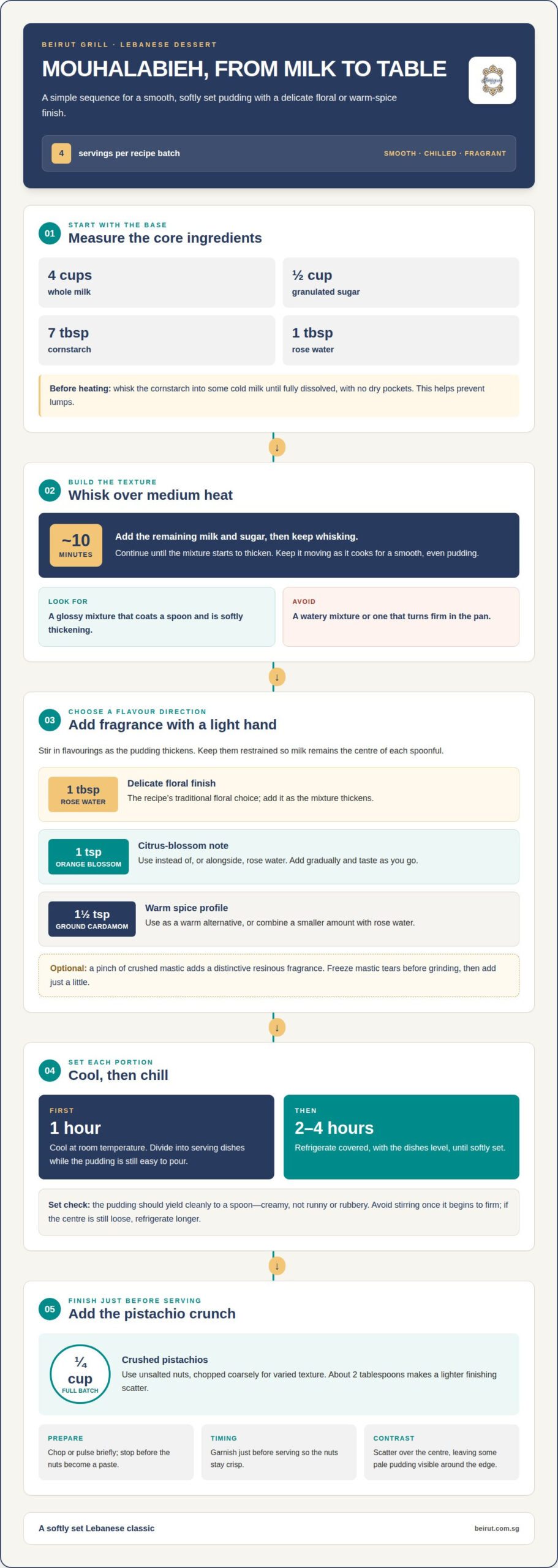
A softly set pudding can carry the fragrance of a whole Lebanese dessert tradition. For a Lebanese milk pudding recipe (mouhalabieh), whisk 4 cups of whole milk with ½ cup of granulated sugar and 7 tablespoons of cornstarch, then add 1 tablespoon of rose water for its delicate floral finish. This recipe makes 4 servings.
That simple combination is the heart of the dessert: milk turns silky and spoonable, while fragrant waters bring a gentle perfume that feels at home after a generous meal. The key is to keep whisking over medium heat for about 10 minutes, until the mixture begins to thicken, then let it cool and chill for 2-4 hours. In the steps ahead, you’ll learn how to avoid lumps, balance rose water with orange blossom water or cardamom, portion the pudding, and crown it with pistachios. The result is a cool, creamy finish with the quiet elegance of a Lebanese table.
Key Takeaways
- Choose a floral or warmly spiced flavour profile, and add fragrant ingredients with care so they complement rather than overwhelm the milk.
- Keep the mixture moving as it thickens to help achieve a smooth, even texture.
- Portion the pudding before chilling, then finish each serving with pistachios for a delicate crunch.
- Discover how this cherished Lebanese dessert fits into a wider meal, or enjoy Mouhalabieh at Beirut Grill.
Cardamom, rose water, and orange blossom water flavourings
Lebanese milk pudding, or mouhalabieh, pairs a softly set milk base with floral fragrance or gentle spice. These steps balance each flavour without overwhelming the dessert.
- Gather 4 cups of whole milk, ½ cup of granulated sugar, 7 tablespoons of cornstarch, and 1 tablespoon of rose water. These quantities make 4 servings. For a fragrant finish, prepare pistachios for topping, then choose cardamom, orange blossom water, or both sparingly.
- Whisk the cornstarch into some cold milk until fully dissolved, with no dry pockets. This helps prevent lumps before heating. Add the remaining milk and sugar, then keep whisking over medium heat for about 10 minutes, until the mixture starts to thicken. A smooth pudding should look glossy and coat a spoon, rather than remain watery or turn firm in the pan.
- Stir in the rose water as the pudding thickens. Its floral aroma is traditional in Lebanese versions, and 1 tablespoon gives this recipe a clear, delicate fragrance. For another floral note, use 1 teaspoon of orange blossom water; increase it only if you prefer a more pronounced citrus blossom character. Add it gradually, tasting as you go.
- For a warm spice profile, add 1½ teaspoons of ground cardamom. You can use orange blossom water instead, or combine a smaller amount of cardamom with rose water. A pinch of crushed mastic is another optional choice. Freeze mastic tears before grinding, then add just a little for their distinctive resinous fragrance.
- Keep the flavourings restrained so milk remains the centre of each spoonful. For a finishing variation, scatter crushed pistachios over the pudding; their nutty crunch contrasts with its smooth texture and adds polyunsaturated fat. Spoon the mixture into serving dishes, then refrigerate after cooling so the floral aroma and cardamom accompany a chilled, softly set dessert.
Rose water remains a fitting choice for the flavoring suggested for Lebanese versions of the pudding. The recipe uses 1 1/2 teaspoons of ground cardamom, offering a warm alternative to the floral notes. Mastic is a fragrant resin from an evergreen tree that grows primarily in Greece, and its distinctive aroma can complement the other restrained flavorings.
Chilling and serving
Cook the pudding over medium heat for about 10 minutes, then cool and refrigerate it for 2-4 hours. That gives the cornstarch time to set into a smooth, spoonable dessert.
-
Cool and Chill the Pudding
Let the cooked pudding cool at room temperature for 1 hour before refrigerating. Divide it among serving dishes while it’s still easy to pour, then cover them to keep the surface from drying out. Chilling for 2-4 hours after cooling helps the mixture set; look for a softly firm texture that yields cleanly to a spoon.
- Keep the dishes level as they chill so each portion sets evenly. Avoid stirring once the pudding begins to firm. If the centre still seems loose after chilling, return the dishes to the refrigerator and allow more time. The finished texture should be creamy, not runny or rubbery.
-
Serve and Store the Pudding
Serve each portion cold, adding the garnish just before it reaches the table. A clean spoon makes it easy to serve an even portion and appreciate the pudding’s delicate set. For a pleasing contrast, pair the chilled dessert with a crisp topping rather than mixing it into the smooth base.
- Prepare the pudding up to 2 days ahead, keep it covered in the refrigerator, and serve it chilled. The milk contributes calcium and a vitamin, while cornstarch and sugar provide carbohydrates; these ingredients make the dessert satisfying without needing extra richness. If the surface releases a little moisture during storage, gently blot it rather than whisking the set pudding, which can loosen its texture. Let each portion stay refrigerated until serving, especially in Singapore’s warm climate. For another way to enjoy a Lebanese dessert, explore Lebanese dessert dining.
The recipe recommends refrigerating the pudding for 2-3 hours before serving and suggests refrigerating it for at least an hour before serving. Divide Muhalabia into 4-8 individual cups before chilling; it should be refrigerated for about 2-3 hours or up to 2 days until set.
The recipe author recommends keeping mahalabia in the refrigerator for 2-3 days before its texture may become watery, and says the pudding can be kept in the fridge for up to a week. Keeping it covered and chilled helps protect the pudding while it waits to be served.
Pistachio garnish
Finish each chilled portion with a light scatter of pistachios. Their green colour, gentle nuttiness and crisp texture contrast with the pudding’s smooth surface.
- Choose unsalted pistachios and crush them coarsely for a garnish with varied texture. For the recipe’s full batch, use ¼ cup of ground or crushed pistachios; about 2 tablespoons makes a lighter finishing scatter. Keep some pieces larger, so each serving gets both fine nutty flecks and a satisfying crunch.
- Prepare the nuts separately from the pudding mixture. Chop them with a knife or pulse briefly, stopping before they become a paste. If the pistachios feel soft, spread them out and let them return to room temperature before chopping. Dry, distinct pieces are easier to scatter evenly than warm, clumped nuts.
- Add the garnish just before serving, not before chilling. A topping added too early can soften against the pudding’s moist surface. Sprinkle from a small bowl, aiming for the centre and leaving a little of the pale pudding visible around the edge. The contrast makes the pistachio colour stand out.
- For a traditional finish, keep pistachio as the main accent rather than combining every topping. A few almond slivers can add another crisp note, but use them sparingly so they don’t compete with the pistachio. If you made the pudding with almond milk, toasted almond pieces can echo that flavour without changing the base.
- Treat the garnish as a textural flourish, not a nutrition claim. The amount varies by serving, so don’t treat a spoonful as a measure of saturated fat or potassium. For a neat presentation, add the crushed nuts after the pudding has set, then carry each dish directly to the table.
Lebanese and Middle Eastern milk pudding
Lebanese mouhalabieh is distinguished by its softly set milk base and delicate floral fragrance, often from rose water or orange blossom water. Other Middle Eastern milk puddings may vary in flavour, thickener and garnish. The clearest distinction is the combination chosen for each regional style.
- Begin with the Lebanese balance of creamy milk and aromatic flavour. In a Lebanese milk pudding recipe (mouhalabieh), floral water perfumes the base without masking it. The result is a gently scented dessert, often finished with pistachios rather than a heavy topping.
- For this version, combine 4 cups of whole milk, ½ cup of sugar, and 7 tablespoons of cornstarch to make 4 servings. Whisk until the starch dissolves, then cook over medium heat for about 10 minutes, stirring as the mixture thickens. Add 1 tablespoon of rose water for a characteristic floral note.
- Keep stirring while the pudding cooks. A 10th-century Baghdadi cookbook cautions cooks not to stop stirring when making this dessert. Constant movement helps the mixture thicken evenly and prevents starch from settling at the bottom. Remove it from the heat when smooth and spoon-coating, rather than waiting for it to become firm in the pot.
- Cool the portions before refrigerating them for 2-4 hours. Chilling lets the starch create the final texture. Add crushed pistachios just before serving, preserving their crispness against the smooth pudding. This contrast is a useful hallmark of the classic presentation.
- Use the ingredients to shape flavour, not to imply a fixed nutrition profile. Calories and cholesterol vary with ingredients and portions; monounsaturated fat also depends on toppings. Almond milk changes the base’s taste and composition. A Lebanese milk pudding recipe (mouhalabieh) offers a graceful introduction to this wider dessert tradition. For a prepared taste of Lebanese cuisine, explore Lebanese dining.
Beirut Grill: Mouhalabieh
Beirut Grill serves Mouhalabieh for those who would rather enjoy this Lebanese milk pudding than make it at home. It’s a natural finish after a meal, with delicate, creamy sweetness that follows savoury dishes without overwhelming them.
For a fuller Lebanese table, pair the pudding with Hummus or a Mixed Grill, then let dessert bring the meal to a gentle close. Whether you’re exploring the cuisine or returning to a favourite, Mouhalabieh makes a fitting final course.
To enjoy this dessert as part of a Lebanese meal, contact Beirut Grill.
Bring Lebanese Flavours to Your Next Table
A homemade Lebanese milk pudding recipe for mouhalabieh can be more than a dessert. It can inspire a fuller appreciation of Lebanese flavours and dining traditions. Carry that curiosity into your next meal, whether you’re sharing familiar favourites or discovering how a sweet, fragrant finish complements a savoury table.
At Beirut Grill, Hummus and Mixed Grill make a satisfying savoury beginning, while Lebanese Wine brings another dimension to the meal. Let the occasion guide your choices, from a relaxed dinner to a meal centred on Lebanese cuisine. Enjoy each dish at its own pace and make room for a memorable finish.
Continue your exploration around the table and contact Beirut Grill to plan your next Lebanese dining experience. There’s always another flavour to discover.
Frequently Asked Questions
What are traditional toppings for mouhalabieh?
Crushed pistachios are a classic topping, adding colour and nutty contrast to the creamy pudding. Pine nuts are another option for a delicate crunch. For a simple presentation, choose one garnish and scatter it over each portion just before serving. This keeps the topping distinct and lets the rose water or orange blossom fragrance remain clear.
How do you make dairy-free or vegan mouhalabieh?
Replace the dairy milk with almond milk, then use cornstarch to thicken the mixture as usual. Keep rose water or orange blossom water for fragrance, and choose sugar suitable for a vegan diet. Stir steadily as the pudding heats so the plant milk blends smoothly with the starch. The flavour and creaminess may differ from a whole-milk version.
How should mouhalabieh be stored, and how long does it keep?
Cover the pudding and keep it refrigerated; it can be prepared up to 2 days ahead. Store portions in their serving dishes to avoid disturbing the set texture when serving. Add pistachios or other crunchy toppings at the table, rather than before storage, so they retain their texture. If the pudding becomes watery, serve it promptly rather than stirring it back together.
Can mouhalabieh be made with cornstarch, rice flour, or other thickeners?
Yes. The recipe uses cornstarch, but rice flour can be used instead. Stir it into cold milk before heating to help prevent lumps.