
The secret to mastering how to get crispy falafel isn’t adding heavy flour or cranking up the stove; it begins by completely abandoning the convenience of canned chickpeas. If you’ve ever watched hand-shaped patties disintegrate into bubbling oil, or bitten into a dense, gummy paste beneath a crust that turns soggy within minutes, you aren’t alone. Achieving that iconic Levantine texture often feels impossible when modern shortcuts compromise the integrity of the dish.
At Beirut Grill, our culinary philosophy has celebrated authentic Levantine scratch cooking since 2009, perfecting the delicate textures of traditional mezze. You don’t have to settle for heavy, oil-logged patties. In this guide, you will discover the culinary secrets to achieving shatteringly crisp, golden falafel with an airy, vibrant green interior that holds its shape without heavy binders. We’ll explore the crucial role of raw soaked starch, proper herb balance, and the precise frying techniques needed for lasting crunch.
Key Takeaways
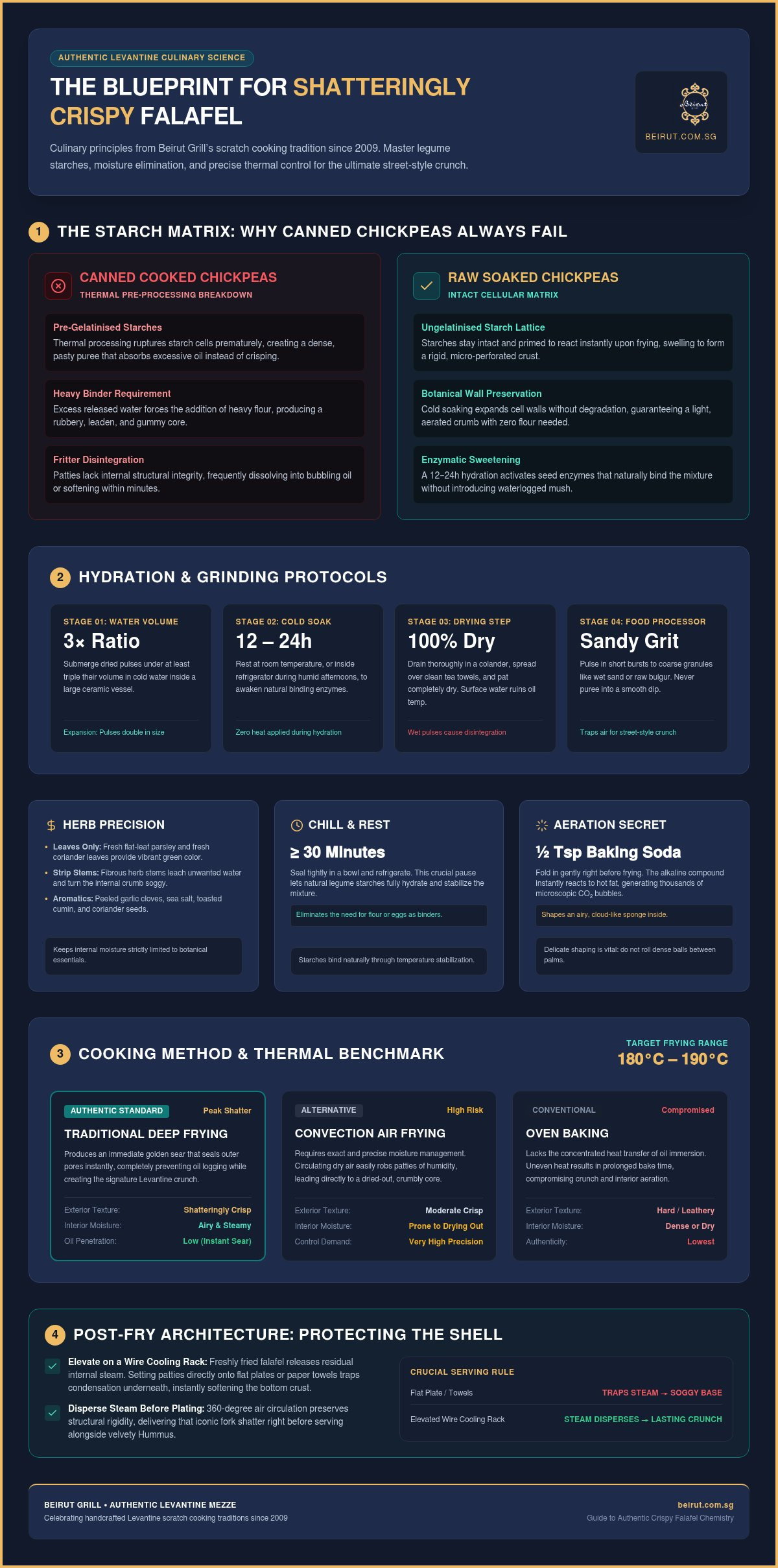
- Raw, soaked dried chickpeas provide the intact starches necessary for structural integrity; precooked or canned pulses release excess moisture that ruins your texture.
- Discover the secret of how to get crispy falafel by pulsing soaked pulses into coarse, sandy granules rather than pureeing them into a dense paste.
- Maintain precise frying oil temperatures between 180°C and 190°C to guarantee an immediate golden sear that prevents oil logging.
- Traditional deep frying creates the quintessential Levantine shatter, whereas air frying requires precise moisture control to avoid a dried-out interior.
- Preserve maximum crunch by elevating freshly fried patties on a wire cooling rack to let steam disperse before serving them with velvety Hummus.
The Secret to Crispy Falafel: Why Canned Chickpeas Always Fail
Every culinary tradition carries non-negotiable rules. In Levantine kitchens, the primary rule of how to get crispy falafel is absolute: step away from the can opener. Home cooks often turn to canned pulses seeking convenience, only to produce soft, leaden fritters that dissolve in hot fat. Canned legumes have already undergone intensive thermal processing, fundamentally breaking their internal structure long before they reach your kitchen.
Cooked beans release excessive moisture and ruptured starches when ground. This creates a pasty puree that requires heavy flour binders to hold together, which guarantees a dense, gummy interior. Raw dried pulses behave entirely differently. When hydrated through a long, cool soak, their cellular walls expand without degrading, keeping their starches intact. These ungelatinised starches remain primed to react violently with boiling oil, swelling instantly to form a rigid, micro-perforated crust while keeping the core light.
The Science of Legume Starch and Moisture Control
As documented throughout the centuries-old history of falafel, traditional preparations rely on raw legume starch behaving as an active structural matrix. Understanding this pulse chemistry reveals why cooked chickpeas fail:
- Starch Gelatinisation: Canned chickpeas contain pre-gelatinised starches that turn pasty, absorbing oil rather than crisping. Raw pulses hold tight, ungelatinised starch granules that fry into a delicate lattice.
- Cellular Wall Preservation: Soaking dried pulses preserves the botanical cell walls. This ensures a coarse, aerated texture rather than a homogenous, heavy paste.
- Enzymatic Activation: A gentle 12-to-24-hour cold soak awakens natural seed enzymes, sweetening the legume and releasing natural binders without introducing waterlogged mush.
How to Properly Soak and Dry Your Chickpeas
Achieving artisan perfection requires patience during the hydration phase. Place dried chickpeas in a large ceramic vessel, submerging them under at least triple their volume of cold water; they will easily double in size. Allow them to rest between 12 and 24 hours at room temperature, or inside the refrigerator during humid afternoons.
Surface moisture is the ultimate enemy of the fryer. Wet legumes instantly lower oil temperature, causing the mixture to steam and disintegrate rather than sear. Drain your soaked pulses thoroughly in a colander, spread them across clean tea towels, and pat them completely dry. Taking the time to eliminate this exterior moisture is the foundational step in learning how to get crispy falafel that shatters under the fork rather than turning soggy.
Step-by-Step Technique: How to Get Crispy Falafel at Home
Creating authentic mezze at home is an art of restraint. Many home cooks rush the grinding phase or panic when the mixture appears loose, tossing in handfuls of all-purpose flour that yield rubbery fritters. The true path of how to get crispy falafel lies in respecting the structural integrity of your ingredients through measured processing, careful chilling, and delicate shaping.
Mastering Grind Texture and Herb Ratios
Texture determines your crunch. Add your soaked, dried legumes to a food processor alongside fresh flat-leaf parsley, fresh coriander leaves, peeled garlic cloves, sea salt, toasted cumin, and coriander seeds. Pulse in short, deliberate bursts. You want a coarse, gritty consistency resembling wet sand or raw bulgur, not a creamy dip. Strip away fibrous herb stems, which leach unwanted water and turn the mixture soggy.
The Crucial Role of Rest Time and Leavening
Patience separates good cooking from genuine culinary mastery. Once your mixture achieves a fine gravel texture, transfer it to a bowl, seal it tightly, and rest it in the refrigerator for at least 30 minutes. This pause allows natural starches to hydrate fully, stabilizing the dough without eggs or flour. Just before frying, fold in half a teaspoon of baking soda. This alkaline addition reacts instantly to the frying heat, generating thousands of microscopic carbon dioxide bubbles that lift the interior crumb into an airy, cloud-like sponge.
Gentle Shaping Methods That Preserve Air Pockets
How you form the patties directly dictates their final crunch. Avoid rolling the mixture into dense balls between your palms, which compresses the starch and creates a heavy, doughy core:
- Use the Right Tools: Shape the mixture using an authentic brass falafel tool (aleb falafel) or two warmed dessert spoons.
- Form Flattened Discs: Craft compact discs about two centimetres thick. Flat surfaces ensure swift heat penetration so the interior steams through before the outside burns.
- Keep Pressure Light: Press just firmly enough for the granules to adhere. Loose, airy edges fry into jagged, shatteringly crisp ridges.
If you prefer to experience these artisanal textures prepared by seasoned hands, you can always visit Beirut Grill to savour our scratch-made mezze fried fresh to golden perfection.
Frying Masterclass: Oil Temperature, Timing, and Equipment
Thermal control is where technique meets transformation. Even the most impeccably coarse pulse mixture will falter if your frying environment lacks heat stability. Understanding the mechanics of thermal transference is essential when learning how to get crispy falafel that develops an audible crunch while remaining vivid green and tender within.
Selecting the Best Frying Medium and Cookware
Deep-frying demands an oil that tolerates prolonged heat without scorching or infusing bitter off-flavours into the delicate aromatics. Choose high-smoke-point, neutral oils such as sunflower, canola, or refined peanut oil. Avoid extra virgin olive oil; its lower smoke threshold and pronounced character make it unsuitable for high-heat immersion, even if it remains a staple for drizzling over finished mezze.
Pair your oil with a heavy-gauge Dutch oven, deep cast-iron skillet, or thick stainless-steel pot. Thin aluminium pans lose thermal energy the second chilled food hits the surface. Heavy cookware acts as a heat reservoir, buffering against wild temperature fluctuations and providing sufficient depth so each patty floats freely without touching the bottom.
Managing Oil Temperature and Batch Sizes
Consistency requires measurement rather than intuition. Fastidious home cooks often look to The best falafel recipe references for baseline temperatures, but real success hinges on dynamic management throughout the cooking cycle:
- Target 180°C to 190°C: Use a clip-on digital culinary probe. If the oil drops below 175°C, the legume starches absorb grease instead of blistering, yielding an oily, sodden crumb. If it spikes past 195°C, the exterior burns before the interior steam cooks the raw legume granules.
- Fry in Modest Batches: Submerge no more than four or five patties at a time. Overcrowding instantly chills the bath, precipitating the thermal collapse that causes patties to break apart.
- Respect the Rebound: After retrieving a batch with a spider skimmer, pause. Let the flame bring your oil back to 185°C before dropping the next set.
Expect each batch to take approximately three to four minutes. When the bubbling subsides and the crust turns an alluring shade of deep, burnished mahogany, lift the patties promptly. That precise golden coloration signals that the starch has fully set, securing the essential texture of how to get crispy falafel without drying out its fragrant, herbaceous core.
Baking vs. Air Frying vs. Deep Frying: Crunch Comparison
Modern culinary media frequently champions baking or air frying as effortless substitutes for the fryer. Yet, legume physics tells an entirely different story. When evaluating how to get crispy falafel that boasts a delicate, crackling exterior and a moist, verdant interior, your choice of cooking medium dictates your ultimate success.
The Thermodynamics of Traditional Immersion Frying
Immersion frying relies on swift, unforgiving thermodynamics. The moment an uncooked patty enters heated fat, surface moisture vaporises immediately, forcing internal water outward as high-velocity steam. This outward pressure acts as a natural barrier, repelling excessive oil ingress while the outer starch granules rapidly caramelise.
Within sixty seconds, this reaction creates an impermeable, micro-thin golden crust. That delicate shell traps residual steam within the patty, allowing the raw, coarse-ground chickpeas and tender herb leaves to cook thoroughly without turning dry. Done properly, deep frying leaves the fritter delightfully light rather than greasy, delivering the definitive texture celebrated across Levantine dining rooms since antiquity.
Adapting Falafel for Modern Air Fryers
Air fryers have established a firm presence in modern homes as a convenient alternative, but hot circulating air behaves fundamentally differently than liquid fat. Without immediate heat conduction across every millimetre of the surface, moisture evaporates slowly. This produces a thicker, stiffer shell while sapping hydration from the fragile green interior.
If you choose to use an air fryer, you can mitigate these pitfalls with specific adjustments:
- Apply Oil Generously: Mist each shaped disc thoroughly on both sides with high-smoke cooking oil spray. Without this surface layer, the starches cannot blister and will turn chalky.
- Intense Heat and Turning: Set the appliance to 200°C. Air-fry for ten minutes, turning the patties gently halfway through to ensure balanced browning.
- Skip Conventional Baking: Avoid standard oven baking entirely. Baking sheet pans lack the airflow of air fryers and the direct heat of immersion oil, producing leathery discs with dense, tough centres.
While an air fryer offers everyday convenience, nothing rivals the golden majesty of genuine immersion cooking. To experience authentic texture perfected through time-honoured technique, reserve a table at Beirut Grill and indulge in scratch-made mezze fried to crisp, fragrant perfection.
How to Serve and Preserve That Signature Falafel Crunch
The culinary journey does not end when your fritters exit the hot fat. Understanding how to get crispy falafel requires equal vigilance during the resting and plating stages. Even an impeccably blistered exterior can soften within minutes if moisture becomes trapped against the crust, undoing all your careful prep work.
Post-Fry Handling: Preventing Moisture Condensation
Avoid the common mistake of draining freshly fried patties on paper towels. Flat paper traps escaping interior steam against the bottom surface, creating a humid microclimate that steams the underside soggy. Instead, transfer your fritters onto an elevated stainless-steel wire cooling rack set over a rimmed baking sheet.
This elevation encourages 360-degree air circulation, allowing steam to disperse freely into the room while excess oil drips away. Season the patties immediately; a delicate dusting of flaky sea salt or tangy, burgundy sumac adheres best while the surface oil still glistens.
Authentic Mezze Accompaniments and Pairing
In Levantine hospitality, crisp fried foods find their counterbalance in refreshing, cool dips and vibrant salads. Present your hot patties alongside nutty tahini sauce laced with lemon and garlic, crunchy ruby-pink pickled turnips, and sprigs of fresh wild mint. The textural interplay between warm crunch and cool smoothness defines the classic table:
- Velvety Foundations: Swirl a generous spoonful of silky, scratch-made Hummus across your serving plate to provide a rich, creamy contrast to the shatteringly crisp exterior.
- Smoky and Tart Contrasts: Pair hot fritters with roasted Baba Ghanoush and citrusy Tabbouleh to cut through the richness of the frying oil.
- Assembly Precision: If crafting pita pockets, tuck the fritters into warm flatbread at the final possible second. Drizzle tahini right before serving so the bread never turns limp.
For an authentic dining experience that captures these traditional mezze textures without the home kitchen cleanup, join us at Beirut Grill, where our kitchen has honoured classic Levantine methods since 2009.
Reheating Instructions for Day-Two Crispness
Never place leftover falafel in a microwave. Microwave radiation heats water molecules rapidly, causing internal steam to burst through cell walls and collapsing the delicate starch lattice into a wet, spongy mush. To revive true crispness the following day, preheat your oven to 190°C. Arrange the chilled patties on a bare baking sheet and warm them for seven to eight minutes until the surface sizzles. Alternatively, toss them into an air fryer at 180°C for three minutes to regenerate that irresistible, brittle crunch.
Bring the Crackle of Authentic Levantine Heritage to Your Table
Achieving artisan texture at home is an art of patience and technique. Mastering how to get crispy falafel comes down to respecting the starch chemistry of raw soaked chickpeas, preserving a coarse grind, and managing oil temperature with exacting precision. When these elements align, you’re rewarded with that unforgettable contrast of a shatteringly crisp exterior and an aromatic, herbaceous centre.
Yet, nothing compares to tasting this culinary heritage crafted by seasoned artisans. Since 2009, Beirut Grill has welcomed guests to experience authentic Lebanese mezze and grills prepared through time-honoured recipes. Our strictly pork-free gourmet kitchen serves nationwide connoisseurs, using imported spices and premium ingredients to honour the true spirit of Levantine hospitality. When you crave an exquisite crunch without the stovetop cleanup, indulge in our signature scratch-made Falafel at Beirut Grill. Embrace these classic techniques in your kitchen, and celebrate the timeless flavours of the Levant.
Frequently Asked Questions
Why is my homemade falafel falling apart when it hits hot oil?
Patties disintegrate primarily because of excess moisture or cold oil. Using precooked beans or leaving wet herbs in the mixture weakens the natural starch bonds. If your oil drops below 180°C, the legume granules absorb liquid fat rather than searing into a cohesive crust. Always use thoroughly dried, soaked raw chickpeas, rest the mixture before scooping, and verify your oil temperature with a culinary probe before dropping each batch.
Can I use canned chickpeas if I drain and dry them thoroughly?
No, canned chickpeas won’t yield the desired crunch regardless of how thoroughly you dry them. Canned pulses are pre-steamed, meaning their starches have already gelatinised into soft mush. When ground, they form a wet paste that turns soggy or requires flour to bind. To master how to get crispy falafel with an authentic airy crumb, you must rely exclusively on raw chickpeas soaked in cold water.
What is the secret ingredient that makes falafel light and crispy?
The secret ingredient is baking soda added immediately prior to frying. Just half a teaspoon per batch triggers an alkaline reaction against the intense heat, releasing tiny bubbles of carbon dioxide through the dough. This internal aeration prevents the legume granules from packing tightly, producing a delicate, fluffy interior surrounded by a crisp shell. Never add baking soda during the overnight soak, as it can soften pulses prematurely.
How do I keep falafel crispy after frying for a dinner party?
Keep freshly fried falafel on an elevated wire cooling rack inside an oven set to 95°C. Placing patties on paper towels traps escaping steam, which quickly turns the bottom soggy. The warm oven maintains ambient heat while allowing steam to evaporate harmlessly into the air. This holding method keeps your fritters crackling crisp for up to forty minutes without drying out the tender green herb centre.
Which oil is best for frying authentic crispy falafel?
Refined, high-smoke-point neutral oils like sunflower, canola, or peanut oil deliver the best results. These oils withstand sustained temperatures of 185°C without smoking, breaking down, or imparting bitter off-notes to the delicate garlic and coriander notes. Save unrefined extra virgin olive oil for finishing cold mezze dishes, as its delicate phenols burn easily and impart an acrid flavour during deep frying.
Can I freeze uncooked falafel patties and fry them directly?
Yes, freezing uncooked falafel patties is an excellent preservation strategy. Shape the discs and freeze them solid on a parchment-lined tray before transferring them into an airtight container. Submerge them directly into 180°C oil straight from the freezer without thawing. Thawing releases accumulated condensation that ruins the crust. Simply extend the frying duration by ninety seconds so the interior cooks through completely.
Why does my falafel turn brown on the outside but stay raw inside?
This problem happens when your oil is too hot or the patties are shaped too thick. If the oil surpasses 195°C, the exterior sugars and starches caramelise instantly before thermal energy penetrates the centre. To learn how to get crispy falafel that cooks uniformly, flatten your patties to roughly two centimetres in thickness and calibrate your oil between 180°C and 185°C throughout cooking.