
A truly exceptional lamb kofta is far more than mere ground meat on a skewer; it is a centuries-old dialogue between the intense heat of the charcoal and the rich heritage of the Levant. Many diners have felt the sting of disappointment when biting into a dry, under-seasoned kebab that lacks the soul of traditional Middle Eastern street food. It often feels nearly impossible to replicate that specific, smoky depth that defines a professional kitchen without knowing the ancestral secrets passed down through generations.
Since we established Beirut Grill in 2009, we’ve refined this craft to ensure every bite transports you to the heart of a Lebanese garden. This guide reveals the precise spice profiles and fat-to-lean ratios that keep the meat succulent and fragrant. You’ll learn why traditional charcoal techniques are non-negotiable for achieving that authentic char. We also explore how this iconic dish anchors a traditional Mixed Grill, and which Lebanese wines best complement a complete mezze feast for a truly sophisticated evening.
Key Takeaways
- Learn how the Lebanese tradition distinguishes its authentic lamb kofta through a specific aromatic blend of fresh parsley, onions, and ancestral spices.
- Discover the “Golden Ratio” of fat-to-lean meat and the essential spice trilogy of allspice, cinnamon, and black pepper that ensures a succulent result.
- Understand why intense charcoal heat and professional “sword” skewers are vital for achieving the smoky depth that standard home ovens cannot replicate.
- Master the sequence of a true Middle Eastern feast by pairing grilled specialties with foundational mezze like Hummus and Baba Ghanoush.
- Explore how to elevate a traditional Mixed Grill into a sophisticated evening by selecting the perfect Lebanese Wine or Arak pairing.
What is Lamb Kofta? Understanding the Soul of Lebanese Cuisine
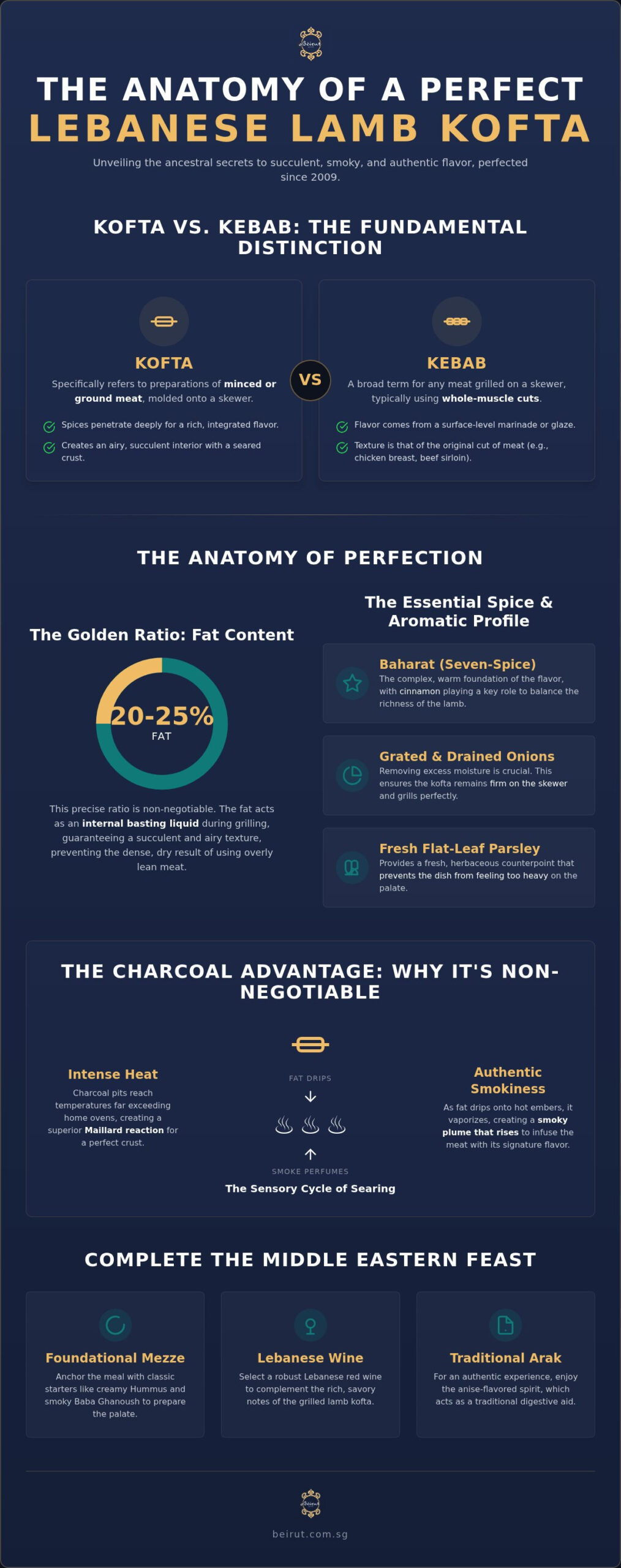
To understand the essence of a Lebanese kitchen, one must first appreciate the linguistic and culinary roots of its most celebrated dish. The term originates from the Persian word kuftan, which translates to the act of grinding or crumbling meat into a versatile, aromatic base. While the history and variations of kofta span across Central Asia to the Mediterranean, the Lebanese expression of this craft is defined by a delicate equilibrium. It isn’t just ground meat; it’s a meticulously balanced composition of finely minced lamb, vibrant flat-leaf parsley, and grated onions that have been drained of excess moisture to ensure the meat remains firm on the skewer.
A masterfully prepared version of this dish possesses a distinct structural duality. When it meets the searing heat of our charcoal pits, the exterior develops a resilient, caramelized crust. Yet, once broken, the interior should be succulent and remarkably airy. This lightness is the hallmark of a skilled hand, one that understands that overworking the meat leads to a dense, rubbery texture that lacks the elegance required for a prestigious table. In the communal atmosphere of a traditional feast, these skewers are never solitary. They’re designed to be shared, acting as a centerpiece that encourages conversation and connection.
Kofta vs. Kebab: Clearing the Culinary Confusion
The Cultural Heritage of the Lebanese Grill
In our dining room, the arrival of a Mixed Grill signifies much more than the serving of a main course; it’s an act of profound hospitality that has defined our identity since 2009. These recipes aren’t merely instructions but are cultural heirlooms passed down through generations of Lebanese families who view the grill as the heart of the home. Every pinch of spice and every turn of the skewer reflects a lineage of expertise that values patience and precision. Lamb Kofta serves as the bridge between ancient spice routes and modern fine dining.
The Anatomy of Perfection: Spices, Fat, and Charcoal
The secret to a transcendent lamb kofta lies in the hidden architecture of the meat itself. While many home cooks mistakenly reach for lean cuts, the true artisan understands the necessity of the “Golden Ratio.” A fat content of approximately 20 to 25 percent is the invisible hand that guides the final texture. This fat doesn’t just provide flavor; it acts as an internal basting liquid. As the meat hits the intense heat of the embers, the fat renders, preserving the succulent texture we’ve perfected since 2009. Without this specific balance, the meat becomes dense and uninviting, losing the airy quality that defines a premium Lebanese skewer.
The Essential Lebanese Spice Profile
The backbone of our seasoning is the Baharat, a complex seven-spice blend that anchors the history of Lebanese cuisine. Cinnamon plays a pivotal role in this symphony. While it’s often associated with sweets, its woody sweetness provides an intoxicating aroma that balances the rich notes of the lamb. We incorporate finely hand-chopped parsley and onions into the mix. These aromatics aren’t just for color; they provide essential moisture and a fresh, herbaceous counterpoint that prevents the dish from feeling overly heavy on the palate.
Why Charcoal Grilling is Non-Negotiable
Gas and electric heat simply cannot replicate the visceral experience of an open flame. We utilize traditional charcoal pits because they reach temperatures far exceeding a domestic oven. This high heat triggers a superior Maillard reaction, creating that thin, savory crust that locks in the juices. When the rendering fat from the lamb kofta drips onto the glowing embers, it vaporizes instantly. This creates a signature smoky plume that rises back up to perfume the meat. It’s a sensory cycle of sound, scent, and sear that requires a master’s touch to manage. If you’re ready to taste the difference that only an open flame can provide, visit us at Beirut Grill for an evening of authentic heritage.
Elevating the Experience: Pairings and Presentation
A Lebanese feast is never a singular event; it is a choreographed sequence of flavors that honors the long history of kofta and its place at the center of the table. To truly appreciate the depth of the grill, one must first lay a foundation with the traditional mezze. We always recommend beginning with the creamy depths of our Hummus and the smoky, silk-like allure of Baba Ghanoush. These cold starters provide a cooling contrast to the intense heat of the meat that follows, preparing the palate for the complex spices of the main course.
When the lamb kofta arrives, steaming from the charcoal embers, the bread ritual begins. In our dining room, we encourage guests to use fresh, warm flatbread as a tool rather than a mere side. By using the bread to grip the meat and slide it firmly from the skewer, you capture every drop of the aromatic juices and rendered fat within the dough. To maintain a perfect equilibrium, the sharp acidity of a fresh Tabbouleh or the sumac-laden crunch of a Fattoush salad is essential. These bright, citrusy notes cut through the richness of the lamb, ensuring each bite feels as vibrant as the first. For a more robust meal, the heat of Batata Harra (spicy potatoes) and the salty, charred edge of Grilled Halloumi provide the final, satisfying layers to the experience.
Lebanese Wine and Arak: The Connoisseur’s Choice
While many casual establishments offer simple beverages, an authentic Lebanese meal demands a more sophisticated pairing. Lebanese Wine, particularly the bold red varietals from the sun-drenched Bekaa Valley, possesses the structural integrity to stand up to our ancestral spice blends. If you prefer a more traditional spirit, Arak is the ultimate companion. Its distinct anise notes act as a powerful palate cleanser, refreshing the tongue between bites of spiced lamb and ensuring the flavors never become overwhelming. It’s a pairing that rewards the curious diner with a truly immersive cultural journey.
The Art of the Platter
Presentation is an extension of our hospitality, designed to create a visual feast that mirrors the vibrancy of Mediterranean food in Singapore. A professional Mixed Grill is carefully arranged to maintain heat, with the lamb kofta resting atop grilled tomatoes and onions. These vegetables aren’t merely garnishes; they absorb the savory drippings from the skewers, becoming tender, flavor-packed morsels themselves. This communal arrangement isn’t just about aesthetics; it’s about inviting every guest to participate in a legacy of shared abundance that we’ve proudly curated since 2009.
The Home Cook’s Dilemma: Why Restaurant Kofta Simply Tastes Better
The most formidable hurdle for the enthusiast is the physical limitation of the domestic kitchen. While a standard home oven typically tops out at 250°C, our charcoal embers reach intensities that allow for an instantaneous, transformative sear. This heat gap is the primary reason home-prepared lamb kofta often lacks the structural integrity and smoky depth found in a professional setting. Without that immediate blast of heat, the meat essentially steams in its own juices, resulting in a grey, uninspiring texture rather than the charred, resilient exterior we’ve perfected since 2009. Precision continues into the resting phase; a step often overlooked at home. We allow the meat to settle, ensuring the internal juices redistribute so they don’t escape on the very first bite.
Equipment vs. Craft
Mastering the specific “squeeze” that binds the meat to the metal is a skill our chefs spend years perfecting. Beginners often face the frustrating “meat drop,” where the kofta slides off the skewer into the flames because the protein hasn’t been worked into a cohesive paste. We utilize wide, flat “sword” skewers specifically designed to prevent the meat from rotating. This ensures a uniform cook that a round wire skewer or a cast iron pan simply cannot provide. Professional chefs spend years mastering the squeeze that binds the meat to the metal, creating a texture that is both airy and firm.
Sourcing Premium Ingredients
A restaurant-grade lamb kofta begins with a custom blend of shoulder and fat, ground through specific plates to achieve a bouncy rather than mushy consistency. Supermarket mince is often too fine or inconsistent, leading to a dense final product. When you dine at an establishment adhering to high-status Middle Eastern food standards, you’re experiencing spices that are often imported directly and toasted fresh to preserve their volatile oils. The difference in aromatic intensity is vast. To bypass the kitchen struggle and enjoy the definitive version of this heritage dish, book your table at Beirut Grill today and let our masters of the grill serve you.
Experience the Legacy at Beirut Grill
Since our founding in 2009, Beirut Grill has stood as a prestigious destination for those seeking an authentic cultural journey. We don’t merely provide a meal; we curate an immersive experience that honors the deep-rooted heritage of the Levant. Our signature lamb kofta serves as the heart of this legacy, prepared by masters of the craft who understand that true flavor requires both patience and precision. Every skewer that leaves our charcoal pit is a testament to our commitment to authenticity, delivering a sensory-rich encounter that rewards the visitor’s curiosity. From the velvety first dip of Hummus to the honeyed, crystalline layers of our Baklava, every element of our menu is designed to transport you to a world of refined indulgence. As a proud, pork-free establishment, we focus on the purity of our ingredients and the traditional techniques that have made us a cornerstone of sophisticated dining for over a decade.
The Signature Mixed Grill
The ultimate expression of our culinary authority is found in the Mixed Grill, which remains our most requested offering. This platter is a grand showcase of the grill master’s art, featuring our succulent lamb kofta alongside perfectly charred Shish Taouk and our celebrated Beirut Lamb Chops. Dining in our evocative, heritage-rich setting allows the scent of the embers and the warmth of our hospitality to slow the world down. To elevate your evening further, we invite you to explore our curated list of Lebanese Wine. These labels are sourced from prestigious regional producers, offering a robust profile that complements the bold, smoky notes of our grilled meats. It is a harmonious pairing that defines the high-status markers of our table.
Planning Your Visit
Whether you are hosting a sophisticated corporate dinner or gathering for an intimate heritage feast, our space provides a scenic stage for your most important moments. We encourage our guests to embrace the full tradition by enjoying a glass of Arak, often called “Lion’s Milk,” alongside their mains. Its refreshing anise finish provides the perfect counterpoint to the richness of our spiced lamb. Our knowledgeable hosts are always on hand to guide you through our menu, ensuring your experience feels both exclusive and welcoming. We invite you to join the legacy of Lebanese dining and discover why we remain a premier destination for those who value genuine cultural expertise. Reserve your table at Beirut Grill today and immerse yourself in the finest traditions of the Mediterranean.
Your Journey into the Heart of Lebanese Tradition
Mastering the art of the lamb kofta is a journey through ancient spice routes and the intense heat of the charcoal pit. We’ve explored how the delicate balance of fat, aromatics, and the “Golden Ratio” creates a succulent texture that simply cannot be replicated in a domestic oven. From the precise “squeeze” on a traditional sword skewer to the essential resting phase, every detail honors a lineage of expertise that we’ve proudly upheld since 2009. True Lebanese hospitality is about more than just food; it’s an invitation to slow down and indulge in a shared legacy.
Whether you’re savoring the smoky char of our signature Mixed Grill or exploring our curated selection of Lebanese wines, you’re participating in a story of cultural pride. Every element of our dining experience is designed to reward your curiosity with authentic, sensory-rich flavors. We invite you to experience this mastery firsthand at our table. Book Your Heritage Table at Beirut Grill and let us transport you to the vibrant heart of the Mediterranean. We look forward to welcoming you soon for an evening of refined indulgence.
Frequently Asked Questions
What is the difference between Lamb Kofta and a Kebab?
Is Lamb Kofta spicy or just flavorful?
Traditional Lebanese versions are characterized by their aromatic depth rather than intense capsaicin heat. The flavor profile is built upon the Baharat or Seven Spice blend, which includes warm notes of allspice, cinnamon, and black pepper. This creates a complex, savory experience that is rich and fragrant. We balance these deep spices with fresh, hand-chopped parsley and onions, ensuring the final dish is vibrantly flavorful and sophisticated without being overwhelmingly spicy on the palate.
What are the best side dishes to serve with Lamb Kofta?
A complete Lebanese feast relies on a foundation of cold and hot mezze to balance the richness of the grilled meat. We recommend starting with the creamy textures of Hummus and Baba Ghanoush, which provide a cooling contrast. To cut through the savory fat, a bright Tabbouleh or Fattoush salad is essential. For a more robust meal, traditional sides like Batata Harra (spicy potatoes) and Grilled Halloumi offer satisfying layers of heat and salt that complete the platter.
Why is charcoal preferred over gas for grilling Kofta?
Charcoal is essential because it reaches temperatures significantly higher than gas, allowing for the superior Maillard reaction that creates a savory, caramelized crust. When the rendering fat from the lamb kofta drips onto glowing embers, it vaporizes to create a signature smoky plume. This smoke rises back up to perfume the meat with a depth of flavor that domestic gas grills or ovens simply cannot replicate, providing that authentic, evocative restaurant quality we’ve mastered.
Can Lamb Kofta be made with other meats?
While lamb is the traditional choice for its rich flavor and fat content, the kofta technique can be applied to other proteins like beef. In many Lebanese kitchens, a blend of beef and lamb is used to achieve a specific texture. At our establishment, we maintain a strictly pork-free menu, ensuring that every grilled dish, from our shish taouk to our beef selections, adheres to the highest standards of authentic Middle Eastern culinary heritage and inclusive hospitality.
What wine pairs best with Lebanese grilled lamb?
Lebanese red wines, particularly those from the prestigious Bekaa Valley, are the connoisseur’s choice for pairing with grilled lamb. These wines possess the robust structure and tannins required to stand up to bold ancestral spices. For those seeking a traditional spirit, Arak is the perfect companion. Its distinct anise notes serve as a powerful palate cleanser, refreshing the tongue between bites of spiced meat and enhancing the overall sensory experience of an indulgent evening at our heritage destination.
Is the Lamb Kofta at Beirut Grill pork-free?
Yes, the entire menu at Beirut Grill is strictly pork-free, reflecting our commitment to authentic Middle Eastern hospitality. Since we were established in 2009, we’ve prioritized the purity of our ingredients and traditional preparation methods. This focus allows us to serve a diverse audience seeking a high-end, inclusive dining experience. Our guests can indulge in our signature Mixed Grill and varied mezze selection with complete confidence in our adherence to these cultural and dietary standards.
What is the secret to keeping Kofta juicy?
The secret to a succulent result lies in the “Golden Ratio” of fat to lean meat, typically around 20 to 25 percent fat. This fat acts as an internal basting agent during the high-heat charcoal grilling process. Additionally, the meat must be handled with care to avoid a dense texture. Finally, allowing the lamb kofta to rest for a few minutes after it leaves the grill ensures the juices redistribute, preventing them from escaping on the very first bite.