
Authentic Lebanese cuisine isn’t a restrictive diet; it’s a centuries-old heritage where the most indulgent flavors are often the most nourishing. While many diners worry about hidden calories, the reality of a traditional table is rooted in the latest 2025-2030 Dietary Guidelines that champion whole, minimally processed ingredients. When you seek out healthy middle eastern food options, you’re returning to a way of eating that prioritizes vibrant vegetables, heart-healthy fats, and lean proteins. It’s a culinary journey that rewards curiosity with both vitality and deep, sensory satisfaction.
You likely appreciate the communal joy of a shared table but perhaps hesitate at the menu, wondering which mezze truly align with your wellness goals. We promise to help you master the art of the Lebanese menu, ensuring you enjoy maximum nutritional benefits without sacrificing the evocative, charcoal-scented flavors of the Middle East. This guide offers a clear framework for ordering a balanced meal. We’ll highlight the “superfood” ingredients in classics like Moutabal and Tabbouleh, while giving you the confidence to choose our signature Shish Taouk and Grilled Fish Fillet over heavier, fried alternatives.
Key Takeaways
- Embrace the Lebanese heritage of health where the marriage of premium olive oils and ancient legumes forms the ultimate Mediterranean foundation for wellness.
- Identify the most nutrient-dense starters by exploring the fiber-rich benefits of smoked eggplant and other healthy middle eastern food options that anchor a traditional mezze spread.
- Elevate your dining experience by prioritizing charcoal-grilled proteins like Shish Taouk, ensuring you enjoy succulent, high-protein mains without the hidden fats of pan-frying.
- Master our connoisseur’s ordering framework to build a balanced plate that harmonizes vibrant raw vegetables with satisfying, lean meats and complex grains.
- Redefine indulgence by selecting lighter, milk-based traditional desserts that provide a sophisticated, sensory conclusion to your meal while maintaining a mindful nutritional profile.
The Mediterranean Foundation: Why Lebanese Cuisine is Inherently Healthy
Long before the modern world codified the Mediterranean Diet as a gold standard for longevity, the sun-drenched hills of the Levant had already perfected a lifestyle rooted in the rhythm of the seasons. To understand healthy middle eastern food options, you must look beyond the plate to a heritage where nutrition and flavor are inseparable. This heritage is a culinary philosophy that has always championed the very principles recently highlighted in the 2025-2030 Dietary Guidelines: a reliance on whole, minimally processed foods, varied plant proteins, and heart-healthy fats. It’s a way of eating that doesn’t feel like a sacrifice because it’s built on a foundation of pride and sensory indulgence.
The Lebanese table is defined by its fresh-first approach. By omitting pork and heavy animal fats in favor of premium, cold-pressed olive oil, the cuisine remains naturally lean and heart-healthy. Ancient grains like bulgur and protein-packed legumes form the backbone of the menu, offering sustained energy and high fiber. This isn’t merely about sustenance; it’s about a prestigious culinary tradition that rewards the curious diner with vitality. When you choose these healthy middle eastern food options, you’re participating in a legacy of wellness that has sustained civilizations for millennia.
The Science of the Lebanese Pantry
The ingredients in a Lebanese kitchen are as functional as they are flavorful. Sumac and za’atar provide a wealth of antioxidants, while the abundant use of fresh parsley in dishes like Tabbouleh offers a significant source of Vitamin K. Lebanese cuisine relies on tahini as a luxurious source of calcium and healthy monounsaturated fats. We use lemon juice and garlic to create bright, clean profiles that dance on the palate. These natural enhancers eliminate the need for the heavy salts or processed additives often found in modern convenience foods, ensuring every bite is as clean as it is delicious.
Middle Eastern Food vs. Generic Mediterranean Options
Unlike Western Mediterranean traditions that often lean on heavy creams, butter, or refined starches, the Lebanese approach remains strictly focused on the raw power of vegetables and legumes. There’s a deliberate avoidance of masked flavors or heavy, masking sauces. When you seek out Mediterranean food in Singapore, the most authentic destinations are those that honor these specific regional markers. By choosing these traditional paths, you’re opting for a dining experience that is both exclusive and fundamentally designed for your well-being, preserving ancient traditions in a modern urban setting.
Mezze Superfoods: Navigating the Cold and Hot Appetisers
A Lebanese table is a vibrant mosaic of colors and textures, where each small plate serves as a testament to a heritage of nutritional wisdom. These starters, known as mezze, represent the most versatile healthy middle eastern food options for the discerning diner. Unlike the heavy, processed appetizers often found in Western cuisines, the traditional Lebanese spread focuses on raw ingredients, ancient legumes, and cold-pressed oils that nourish the body while delighting the senses. It’s a dining style that encourages slow, mindful consumption, allowing the guest to fully immerse themselves in the sensory details of the meal.
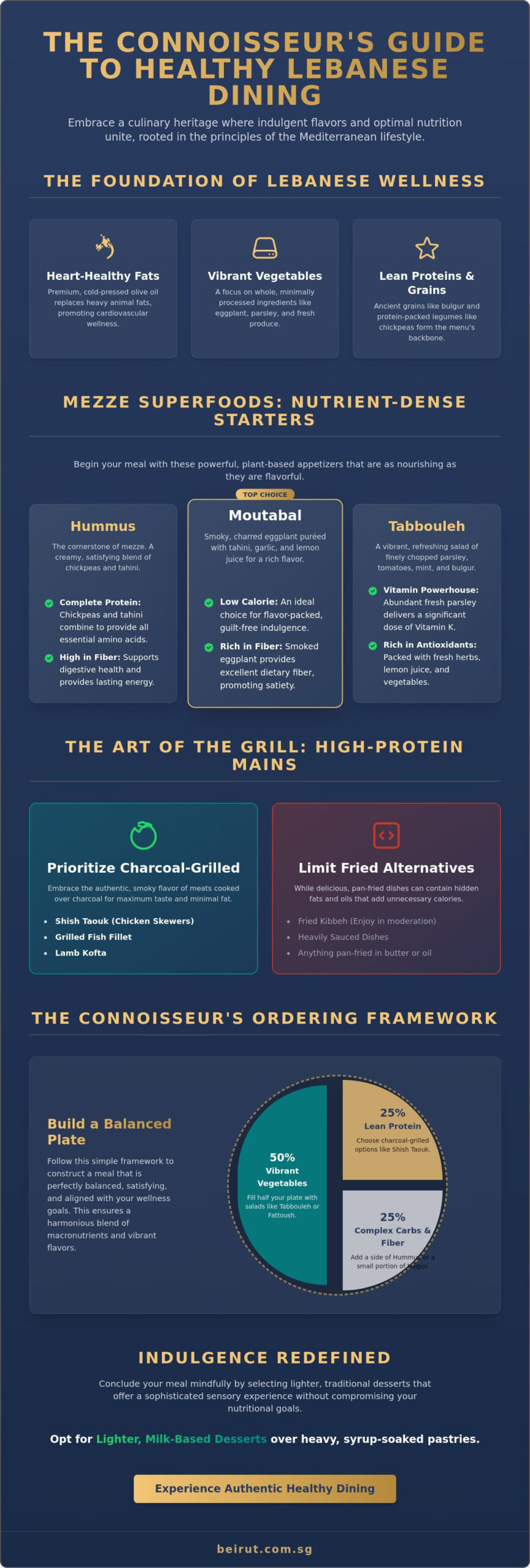
Hummus remains the undisputed cornerstone of this tradition. This protein-rich chickpea puree is far more than a simple dip; it’s a nutritional powerhouse. When prepared authentically, it combines the plant-based protein of chickpeas with the healthy fats of tahini. This combination is vital because tahini provides essential amino acids that turn the legume into a complete protein source. For those seeking a lighter path, Baba Ghanoush and Moutabal offer the evocative, smoky allure of charred eggplant. These dishes are naturally low in calories yet exceptionally high in dietary fiber, making them an ideal choice for maintaining satiety without the fear of overindulgence.
The Nutrient Density of Authentic Dips
When comparing the nutritional profiles of these classics, the differences are subtle but significant. Hummus offers a denser caloric profile due to its higher protein and fat content, whereas Baba Ghanoush is a fiber-forward alternative that rewards the palate with its silky texture. The basics of Middle Eastern cooking emphasize the use of fresh garlic in these dips, which provides metabolic support and antimicrobial properties. Every spoonful of our Moutabal is a testament to this balance of health and heritage. If you wish to experience these flavors in their most authentic form, you can book a sensory journey at our historic location to explore the full breadth of our menu.
Fresh Salads: Fattoush and Tabbouleh
The salads of the Levant are not mere side dishes; they are essential sources of phytonutrients and vitamins. Tabbouleh is a vitamin C and K “bomb,” largely because its primary ingredient is fresh, finely chopped parsley rather than grain. The inclusion of fine bulgur provides a source of complex carbohydrates that release energy slowly throughout your evening. Fattoush complements this with a diverse range of mixed greens, radishes, and cucumbers. The “zesty” profile of these salads comes from fresh lemon juice and sumac, which aid digestion and provide a bright, clean finish. For a deeper look at how these traditions are maintained in a modern setting, our guide to hummus and mezze offers a wealth of knowledge for the true connoisseur.
Finally, no exploration of mezze is complete without Labneh. This probiotic-rich strained yogurt is a sanctuary for gut health. Its thick, creamy texture provides a high-protein, satisfying alternative to heavier cheeses, ensuring that your selection of healthy middle eastern food options remains as restorative as it is indulgent.
The Art of the Grill: High-Protein, Low-Fat Main Courses
As the evening air carries the evocative scent of smoldering charcoal through our historic dining room, you’re witnessing a centuries-old technique for rendering fat while intensifying flavor. Within the heart of a traditional Lebanese kitchen, the charcoal grill represents more than just a method of cooking; it’s a specialized art form that prioritizes the purity of the ingredient. Unlike modern pan-frying, which often traps meats in heavy oils, our charcoal-grilling process allows excess fats to drip away into the embers. This leaves behind only the succulent, smoke-infused essence of the protein, making these selections some of the most prestigious healthy middle eastern food options for the discerning guest.
Choosing grilled mains aligns perfectly with the 2025-2030 Dietary Guidelines, which champion varied protein sources and minimally processed preparation methods. In an era where global meat prices reached record highs in early 2026, the focus has shifted toward quality over quantity. We honor this by sourcing premium cuts that provide maximum nutritional density. Whether you’re seeking a lean post-workout meal or a sophisticated dinner that respects your wellness journey, our grill offers a sanctuary of high-protein, low-fat excellence that never feels like a compromise.
Shish Taouk and Lean Poultry
Our Shish Taouk serves as the gold standard for high-protein dining. We marinate premium chicken breast skewers in a refined blend of yogurt and lemon, a process that naturally tenderizes the meat without the need for calorie-dense fats. This marination doesn’t just add flavor; it preserves the moisture of the breast meat, which is the ultimate lean protein choice. When you pair these skewers with our vibrant grilled vegetables, you’re enjoying a complete micronutrient profile. It’s a dish that rewards your curiosity with a bright, clean finish that is both satisfying and restorative.
Lamb and Beef: Quality Over Quantity
For those who appreciate the rich depth of red meat, our Lamb Kofta and Beef Kebab offer a sophisticated balance of nutrition and heritage. We select high-quality, grass-fed cuts that are naturally rich in Vitamin B12 and Omega-3 fatty acids. To ensure these meats are as digestible as they are delicious, we infuse them with traditional spices like cumin and cinnamon. While our Beirut Lamb Chops offer a prestigious, bone-in experience, the Lamb Kofta provides a leaner alternative for the health-conscious connoisseur. Sharing a Mixed Grill is perhaps the most strategic way to enjoy this variety, allowing you to sample different healthy middle eastern food options while maintaining mindful portion control through communal dining.
The Connoisseur’s Ordering Framework: Building Your Healthy Plate
Stepping into our atmospheric dining room, you aren’t just choosing a meal; you’re curating an experience that honors both your body and your heritage-rich palate. To master the art of the Lebanese table, one must look beyond individual dishes to the harmony of the entire spread. We recommend the 50-25-25 Rule as your visual guide for selecting healthy middle eastern food options. Imagine your plate divided: half filled with vibrant, fiber-rich salads; a quarter dedicated to lean, charcoal-grilled protein; and the final quarter reserved for nutrient-dense healthy fats and complex carbohydrates. This balance ensures you leave the table feeling energized rather than weighed down by the indulgence of the evening.
A sophisticated guest knows that the bread basket is a companion, not the main event. While our fresh pita is a hallmark of hospitality, the strategy for the health-conscious is to enjoy it mindfully. Focus on the rich, evocative flavors of our dips by choosing one legume-based option like Hummus and one vegetable-based choice like Moutabal. This variety provides a broader spectrum of minerals and vitamins while keeping the meal diverse and engaging. By treating the bread as a tool for tasting rather than a primary filler, you preserve space for the high-quality proteins that follow.
Step 1: Start with the “Green Shield”
Your first move should always be to establish a “Green Shield” by ordering Tabbouleh or Fattoush as a pre-meal course. These salads introduce high-volume fiber that naturally increases satiety, helping you make more mindful choices as the heavier dishes arrive. Consider including Warak Enab in this initial phase. These delicate, hand-rolled grape leaves are a high-fiber marvel that offers a sophisticated alternative to heavier starters. While the aroma of fried Sambousek is undeniably tempting, the discerning guest will find greater satisfaction in our Grilled Halloumi. It provides that essential savory richness and protein without the heavy oils of the deep fryer.
Step 2: Balance Your Proteins and Fats
The secret to a balanced Lebanese feast lies in how you pair your proteins and fats. A single skewer of Shish Taouk, when accompanied by a modest portion of our silk-smooth Hummus, creates a complete nutritional profile that stabilizes blood sugar. To manage your carbohydrate intake, adopt the “Dip and Veg” technique. Use crisp cucumber slices or vibrant capsicum strips to enjoy our dips instead of relying solely on bread. After your feast, conclude with a pot of Moroccan Mint Tea or a traditional Lebanese Coffee. These beverages are vital aids for digestion that cleanse the palate and provide a mindful end to your journey. You can reserve your authentic dining experience and put this framework into practice at our historic location, where we specialize in the finest healthy middle eastern food options in the city.
Indulgence Redefined: Healthy Desserts and Fine Beverages
As the evening light softens against the stone walls of our heritage-rich dining room, the Lebanese table transitions from the robust, smoky notes of the grill to a more delicate, floral conclusion. For the true connoisseur, dessert is not an afterthought to be avoided, but a final ritual that honors the “Mindful Sweet” philosophy. This approach recognizes that the most prestigious healthy middle eastern food options are those that satisfy the spirit without overwhelming the body. By choosing high-quality, authentic treats, you discover that a small, sensory-rich portion provides a deeper level of satisfaction than the oversized, processed alternatives found in Western confectionery.
Our Mouhalabieh serves as a prime example of this refined balance. This traditional milk-based pudding, scented with the evocative essence of rose water and orange blossom, offers a much lighter alternative to heavy, pastry-based desserts. It provides a cooling, creamy finish that is naturally lower in fat while remaining deeply rooted in our culinary history. For those who desire the crunch of pastry, our Baklava is crafted with a focus on nutrient-dense ingredients. These small bites are packed with premium pistachios and walnuts, which provide essential healthy fats and minerals, ensuring your indulgence remains a sophisticated part of a balanced lifestyle.
Traditional Sweets in Moderation
The secret to enjoying traditional sweets lies in the communal spirit of the Levant. While our Kunafa is an iconic masterpiece of texture and flavor, it is best experienced as a shared delight among friends. This allows you to appreciate the craftsmanship of the melted cheese and crisp semolina without overindulging. In many Lebanese homes, the ultimate dessert is simply a platter of the season’s finest fresh fruits. This practice aligns perfectly with a heritage of health, providing natural sweetness alongside vital phytonutrients. When you select these healthy middle eastern food options, you’re embracing a culture that values quality and connection over pure caloric volume.
The Ritual of Tea and Coffee
No journey through the flavors of the Middle East is complete without the digestive rituals of tea and coffee. Our Moroccan Mint Tea is served as a sugar-free infusion, utilizing the natural properties of fresh mint to soothe the digestive system after a feast. Similarly, our Lebanese Coffee is infused with cardamom, a spice long celebrated in regional heritage as a metabolic booster and digestive aid. For those who wish to extend their evening with a glass of Lebanese Wine, the Bekaa Valley offers world-class labels rich in antioxidants. Pairing a robust red from this prestigious region with your meal isn’t just an indulgence; it’s a heart-healthy choice that celebrates the longevity and vitality of our culture. Through these mindful selections, you complete your dining experience with the confidence of a true connoisseur.
Embrace a Legacy of Vibrant Living
Navigating a traditional Lebanese menu is an act of discovery where the most prestigious choices are often the most restorative. You’ve learned that by prioritizing fiber-rich mezze and selecting lean, charcoal-grilled proteins, you can honor your wellness goals without sacrificing sensory indulgence. This framework transforms a simple meal into a sophisticated ritual of vitality, rooted in the ancient wisdom of the Levant. Finding healthy middle eastern food options shouldn’t feel like a compromise; it’s a celebration of quality ingredients and time-honored techniques that have sustained generations.
Since 2009, we’ve dedicated ourselves to preserving these traditions through authentic charcoal-grilling and a strictly pork-free menu that rewards your curiosity. From our extensive vegetarian superfood selections to our curated, heart-healthy Lebanese wines, every element of our table is designed for the discerning guest. Experience the heritage of healthy Lebanese dining at Beirut Grill. We invite you to join us in our historic setting, where every bite tells a story of longevity and pride. Your path to a more vibrant lifestyle begins at our table.
Frequently Asked Questions
Is Middle Eastern food generally considered healthy for weight loss?
Yes, it’s exceptionally conducive to weight management because it prioritizes high-volume, low-calorie vegetables and satiating plant-based proteins. By focusing on fiber-dense starters like Fattoush and lean, charcoal-grilled mains, you can achieve a caloric deficit without feeling deprived. The emphasis on slow-digesting complex carbohydrates ensures sustained energy levels, preventing the blood sugar spikes often associated with processed dining options.
What are the lowest-calorie mezze options on a Lebanese menu?
The lowest-calorie choices are typically those centered on raw or grilled vegetables. Baba Ghanoush and Moutabal offer a luxurious, smoky texture with minimal caloric impact; Tabbouleh provides a vitamin-rich, low-density option. Stuffed grape leaves, or Warak Enab, serve as a satisfying, fiber-forward starter. These healthy middle eastern food options allow you to explore a variety of complex flavors while keeping your overall energy intake modest.
Can I eat Middle Eastern food if I am on a high-protein or Keto diet?
High-protein and ketogenic lifestyles find a natural home within the Lebanese culinary tradition. Our Mixed Grill, featuring Shish Taouk and Beef Kebab, provides an abundance of lean, high-quality protein prepared without heavy starches. For those restricting carbohydrates, focusing on Grilled Halloumi, Labneh, and skewers accompanied by fresh greens rather than pita bread ensures a meal that is both compliant and deeply indulgent.
Is pita bread healthy, or should I avoid it?
Authentic pita bread serves as a traditional vessel for our nutrient-dense dips, but it’s best enjoyed in moderation. While it provides necessary energy, the health-conscious connoisseur treats it as a companion rather than the centerpiece. You can easily substitute bread with crisp cucumber or capsicum slices to enjoy our Hummus and Labneh while significantly reducing your refined grain consumption for the evening.
What makes Lebanese charcoal grilling healthier than other cooking methods?
Charcoal grilling is a superior technique because it uses intense, direct heat to render away excess animal fats, which then drip away from the protein. This process eliminates the need for the heavy cooking oils or butter required for pan-searing or deep-frying. The result is a succulent, smoke-infused dish that retains its natural moisture and micronutrients without any unnecessary caloric additions or hidden fats.
Are there healthy dessert options in Middle Eastern cuisine?
Yes, the Lebanese pantry offers several lighter alternatives to traditional honey-soaked pastries. Our Mouhalabieh is a delicate, milk-based pudding that provides a floral, cooling finish with a much lower fat content than fried alternatives. Additionally, a simple platter of fresh, seasonal fruit is a hallmark of hospitality that provides natural sweetness and vital antioxidants to conclude your journey in a mindful way.
How can I identify “hidden” fats in Middle Eastern restaurant dishes?
To maintain a lean profile, identify healthy middle eastern food options by looking for “charcoal-grilled” instead of “fried” descriptors. Hidden fats often reside in deep-fried appetizers like Sambousek or Fried Kibbeh. While olive oil is a foundational healthy fat in our Hummus and salads, you can manage your intake by focusing on vegetable-forward mezze that rely on fresh lemon and sumac for their vibrant, clean profile.
Is Lebanese wine as healthy as other Mediterranean wines?
Lebanese wine from the prestigious Bekaa Valley is celebrated for its high concentrations of polyphenols and antioxidants, rivaling any global Mediterranean label. The unique high-altitude viticulture and limestone-rich soils produce robust grapes that support heart health when enjoyed in moderation. Pairing a glass of our curated red with lean grilled meats enhances the sensory experience while contributing to a balanced, heart-healthy diet.