
Olive oil is more than a finishing touch in Lebanese cooking: it brings richness to salads and mezze, softens bread, enriches pastries and deepens cooked dishes. It may be drizzled over hummus or foul, mixed into dough or simmered with other flavours. Olive oil in Lebanese cooking is both a table staple and a cooking ingredient.
That versatility is part of what makes Lebanese cuisine so inviting. A pour of olive oil can add fruitiness and a gentle peppery note, while the dish determines whether the oil shines uncooked or becomes part of a warm, savoury base.
Here, you’ll learn where olive oil appears in Lebanese dishes and recipes from neighbouring Middle Eastern traditions, how to use it in cooking, and what health benefits are claimed for extra virgin olive oil. We’ll explore its role in salads, bread, pastries and cooked dishes, and how the way it’s used shapes each one.
Key Takeaways
- See how olive oil moves from a bright finishing drizzle on mezze to an ingredient in breads, pastries and cooked dishes.
- Learn how the dish and desired flavour guide whether to use the oil uncooked or in cooking.
- Understand the health benefits claimed for extra virgin olive oil, and why such claims should be read with care.
- Explore Lebanese flavours through Hummus, Mixed Grill or Vegetarian Kebab at Beirut Grill.
Claimed health benefits of extra virgin olive oil
Across Middle Eastern cooking, extra virgin olive oil has a place at the table and in the kitchen. It can accompany dishes such as hummus or foul moudammas, or be used in recipes. Its familiar presence in Lebanese meals helps explain why people ask about its health benefits. But a valued culinary ingredient and a medical treatment are not the same thing.
Claims that extra virgin olive oil lowers Alzheimer’s risk should be treated cautiously, not as proof that it prevents the disease. The figure is an upper limit within that claim, not a personal prediction. It doesn’t mean that eating olive oil prevents Alzheimer’s, or that every person receives the same benefit. Keep that distinction clear when weighing health headlines against everyday cooking traditions.
The phrase “extra-virgin olive oil” is also written “extra virgin olive oil.” Both forms refer to the same thing in everyday writing; the hyphen doesn’t signal an added health benefit. In a Middle Eastern pantry, this oil may be poured over a finished dish or incorporated into a recipe. Those uses describe flavour and cooking, not a guaranteed effect on memory or disease risk.
For a practical perspective, treat the 40% figure as a claim to interpret carefully, rather than a reason to rely on one ingredient for health. A plate of hummus with olive oil, for example, illustrates how the oil can contribute to a meal’s taste and texture. The health question concerns the overall eating pattern, not a single drizzle. Enjoy extra virgin olive oil for its culinary role, while keeping claims about Alzheimer’s risk separate from what it can reliably promise at your table.
The culinary place of the oil is reflected in Amina Al-Saigh’s cookbook Souk to Table: Vibrant Middle Eastern Dishes for Everyday Meals, released in October 2024. Extra virgin olive oil is the first ingredient listed in its My Middle Eastern Pantry section, a detail that places it among the pantry staples used in everyday cooking rather than presenting it as a medical remedy.
In a culinary setting, naming the oil can help identify the ingredient, while claims about disease risk still call for careful interpretation.
Olive oil in salads, pastries, bread and cooked dishes
In fattoush, olive oil dresses crisp vegetables, toasted bread and herbs, carrying the sharpness of lemon through each bite. Classic parsley salads offer another fresh setting: a measured pour brings finely chopped greens, bulgur and tomato together without masking their brightness. Add the oil gradually, then toss and taste. This keeps the dressing balanced and lets the herbs remain the salad’s defining flavour.
Pastry dough uses olive oil differently. In a cheese and olive pastry recipe, about 500 grams of flour is paired with 60 ml of oil in the dough. The oil contributes richness and helps bring the flour mixture together, while the cheese and olives provide savoury character. These quantities belong to that recipe, not a universal ratio. Dough texture and the recipe’s other ingredients guide how it comes together.
Bread and cheese make a simple Lebanese-style snack, with olive oil served alongside or drizzled over them. Dip a piece of bread into the oil, then take a bite with cheese; the contrast highlights the oil’s fruitiness and the cheese’s savoury depth. A small pour on the plate keeps the bread’s texture intact, while dipping lets you control how much oil each bite takes up.
In cooked dishes, olive oil can be the base for gently softening onions or vegetables before you add the remaining ingredients. As it warms, its flavour becomes part of the dish rather than just a finishing note. For a vegetable stew, add the oil to the pot first and cook the aromatics until softened, then continue with the recipe. This builds a savoury foundation without letting the oil dominate.
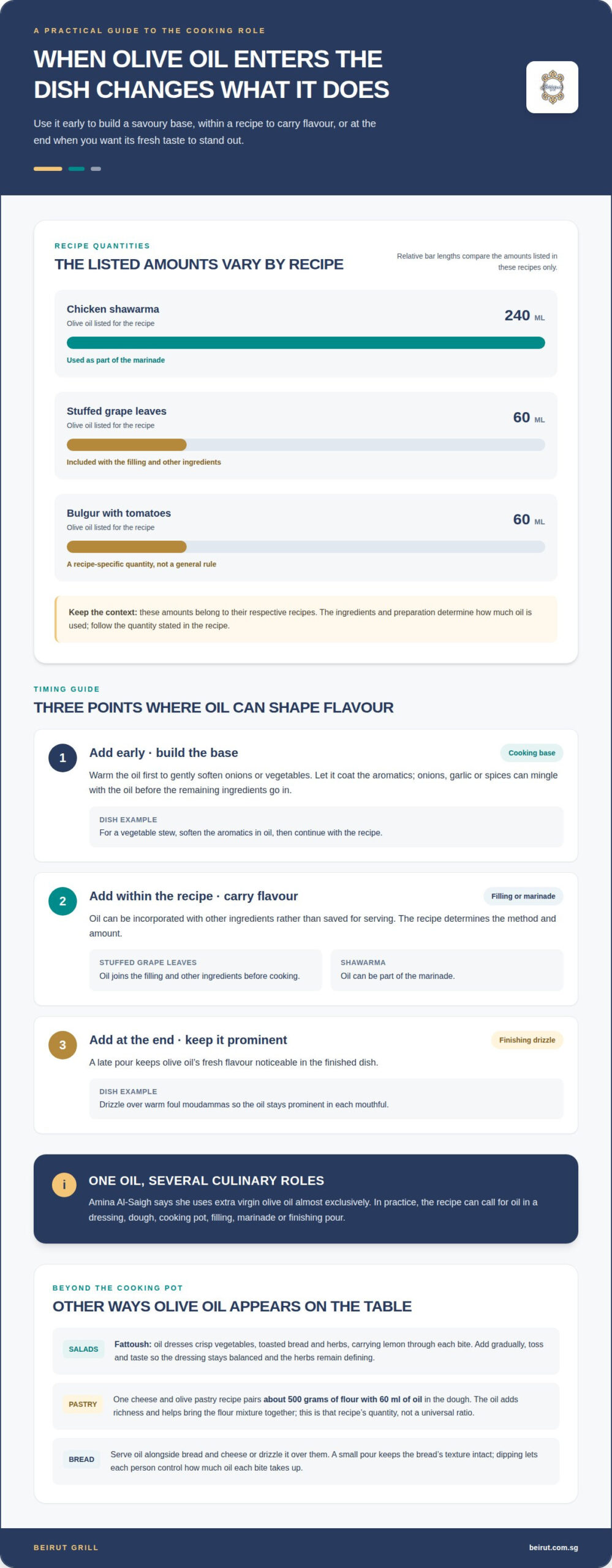
Cooking with olive oil
Add olive oil early when a Lebanese dish needs a cooking base, such as when softening onions before adding other ingredients. Add it at the end when you want its fresh flavour to stand out, as in a finishing drizzle over foul moudammas. The recipe’s purpose determines the timing.
Amina Al-Saigh says she uses extra virgin olive oil almost exclusively. Her approach shows how one oil can be used at different stages of cooking, rather than being reserved for salads or serving. In stuffed grape leaves, oil joins the filling and other ingredients before cooking; in shawarma, it can be part of the marinade. The method depends on how the recipe builds flavour.
Use a light hand when adding oil to a pan, then let it coat the aromatics before adding other ingredients. For a dish with onions, garlic or spices, this gives their flavours time to mingle with the oil. Stir as the ingredients soften, then add the remaining components according to the recipe. A late pour works differently: over warm foul moudammas, the oil stays prominent in each mouthful.
Recipe quantities show why the cooking context matters. A stuffed grape leaves recipe and a bulgur with tomatoes recipe each list 60 ml of olive oil, while a chicken shawarma recipe lists 240 ml. These amounts belong to their respective recipes, not a general rule for every dish. The amount depends on the ingredients and preparation. For home cooking, follow the recipe’s stated quantity, then notice whether the oil is intended for a marinade, a pot or the finished plate. That distinction helps olive oil in Lebanese cooking contribute texture and aroma without overwhelming the dish.
Olive oil in recipes from Lebanon and other Middle Eastern countries
Across Middle Eastern recipes, olive oil can season, enrich or carry flavour. The oil’s role in the recipe helps guide how much to use, when to add it and what taste to expect.
Olive Oil in Lebanese Recipes
Traditional Lebanese cooking uses olive oil in dressings, cooked dishes and finishing pours. Its role matters: a drizzle over foul moudammas tastes different from oil incorporated during cooking. If olive oil isn’t available, another cooking oil can work in some recipes, but its flavour may differ. That difference is more noticeable in uncooked dishes, so choose a substitute whose flavour suits the other ingredients.
Amounts in Common Lebanese Recipes
Recipe quantities vary according to the dish and how its ingredients use the oil. A Lebanese-style foul moudammas recipe lists 60 ml of extra virgin olive oil, while a chicken shawarma recipe lists 240 ml. These amounts aren’t interchangeable rules for every Lebanese dish. Follow the quantity in the recipe you’re making, since a marinade and a finished bean dish use oil differently.
Lebanese Olive Oil Varieties and Regions
The best Lebanese olive oil variety or region depends on the flavour you want in a particular dish. For a finishing pour over foul moudammas, taste the oil on its own first; for a marinade such as chicken shawarma, consider how its flavour will combine with the other ingredients. Matching the oil’s character to the dish is more useful than assuming one choice suits every recipe.
Choosing and Storing Lebanese Olive Oil
Choose Lebanese olive oil according to how you’ll use it: a pronounced flavour can stand out in a finishing drizzle, while a more balanced taste can blend into a marinade. Keep the bottle tightly closed in a cool, dark cupboard, away from the stove and direct light. This helps protect its flavour between uses, whether you’re preparing foul moudammas or dressing a salad.
To enjoy Lebanese cuisine beyond the recipe page, explore Lebanese flavours.
Beirut Grill
Beirut Grill offers a welcoming way to explore Lebanese cuisine beyond recipes. After learning how olive oil can shape dishes, discover the wider table with Hummus, Mixed Grill or Vegetarian Kebab, each offering a different expression of Lebanese cooking.
Hummus is a natural starting point for exploring mezze, while Mixed Grill makes for a heartier meal. For a meat-free choice, Vegetarian Kebab offers another way to enjoy the cuisine. Pair your meal with Lebanese Wine to explore familiar flavours and new combinations. Together, these dishes let you appreciate Lebanese food as a whole, not just the role of one ingredient.
For a taste of Lebanese cooking in Singapore, contact Beirut Grill.
Let the flavours lead your next meal
Olive oil in Lebanese cooking is best appreciated as part of a larger table, where each dish brings its own texture and flavour. Carry that curiosity into your next meal: notice how a creamy dip, grilled dishes and a glass of Lebanese wine offer different ways to experience Lebanese cuisine. The pleasure lies not in one ingredient alone, but in how the meal comes together.
At Beirut Grill, Hummus, Mixed Grill and Lebanese Wine offer distinct ways to explore these flavours. Choose a familiar favourite or let a new combination guide your meal. The table can be a starting point for discovering more of Lebanon’s culinary heritage, one considered bite at a time.
Contact Beirut Grill to plan your next Lebanese dining experience, and enjoy the discovery at your own pace.
Frequently Asked Questions
Which Lebanese dishes commonly use olive oil?
Olive oil commonly appears in hummus, fattoush, tabbouleh and foul moudammas. Its use varies by dish: it can season a salad, enrich a dip or accompany beans at the table. Warak enab and shawarma recipes may also include it during preparation. Think of olive oil as a flavour that connects different dishes, rather than an ingredient limited to one course.
Is extra virgin olive oil preferred in Lebanese cuisine?
Extra virgin olive oil is a popular choice, but it isn’t the only oil used in every Lebanese kitchen or recipe. Amina Al-Saigh says she uses it almost exclusively, reflecting her own approach to cooking. In uncooked dishes, its flavour can be especially noticeable; when oil is cooked with other ingredients, the desired taste and method help guide the choice.
Can olive oil be used for frying in Lebanese cooking?
Yes, olive oil can be used for frying, including shallow frying, provided the cooking temperature suits the oil and method. Use a pan and enough oil to cook the food evenly, and avoid heating the oil until it smokes. The choice also affects flavour: extra virgin olive oil can bring a more pronounced taste that may come through in the finished dish.
What can substitute for olive oil in Lebanese recipes?
Another cooking oil can work in some recipes, but its flavour may differ. That difference is more noticeable in uncooked dishes, so choose a substitute that suits the other ingredients.