
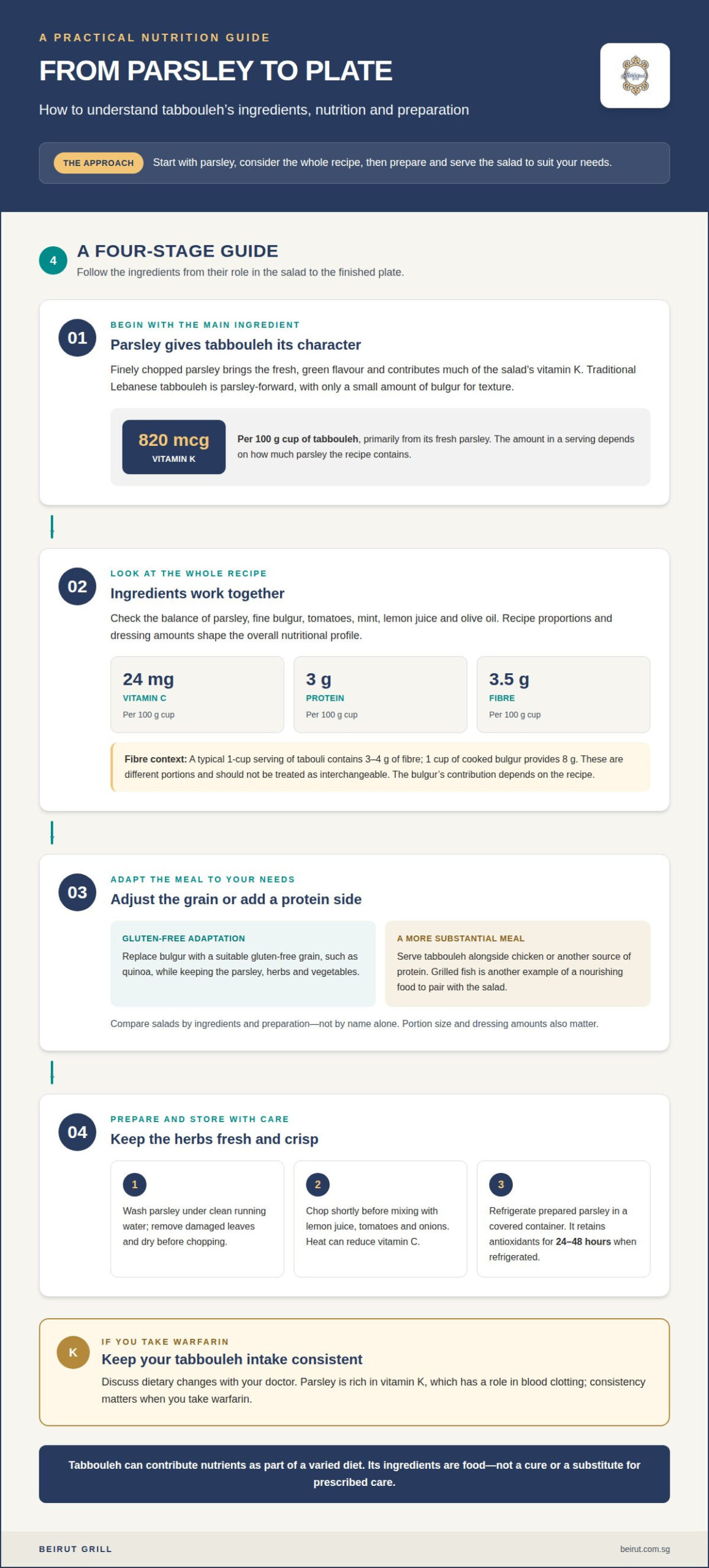
A 100 g cup of tabbouleh contains 820 mcg of vitamin K, primarily from its fresh parsley. That striking contribution is one reason the health benefits of parsley in tabbouleh extend beyond its bright, herbal flavour.
Finely chopped parsley gives Lebanese tabbouleh its vivid character, while lemon, tomatoes and bulgur round out each forkful. If you think of tabbouleh as a refreshing side, you’re right; it can also contribute vitamin K, antioxidant compounds and fibre as part of a varied diet.
Here, you’ll learn what these nutrients do, how parsley’s potential benefits fit into the dish, and what to keep in mind if you take warfarin. We’ll also consider how the ingredients work together, so you can appreciate tabbouleh’s nourishing qualities without mistaking one salad for a cure-all.
Key Takeaways
- Notice how parsley’s generous role gives tabbouleh much of its nutritional character, while the other ingredients shape the overall dish.
- Learn why parsley’s apigenin and other antioxidant compounds are part of the salad’s appeal.
- See how bulgur contributes fibre, and how that fibre fits into a balanced eating pattern.
- If you take warfarin, keep your tabbouleh intake consistent and discuss dietary changes with your doctor.
What are the main health benefits of tabbouleh?
To understand tabbouleh’s nutrition, start with its parsley, then consider how bulgur, tomatoes, lemon juice and olive oil shape the salad. This makes it easier to assess its nutrients and adapt the dish to your needs.
-
Identify Parsley as the Main Ingredient
Begin by noticing how parsley, rather than bulgur, gives traditional Lebanese tabbouleh its character. The finely chopped leaves bring a fresh, green flavour and contribute much of the salad’s vitamin K. A 100 g cup contains 820 mcg of vitamin K, primarily from parsley. This is one reason the health benefits of parsley in tabbouleh draw attention, though a salad is one part of an overall diet.
-
Review the Ingredients and Nutrition
Check the balance of parsley, fine bulgur, tomatoes, mint, lemon juice and olive oil. Traditional Lebanese tabbouleh uses only a small amount of bulgur for texture. A 100 g cup contains 24 mg of vitamin C, 3 g of protein and 3.5 g of fibre. Fibre supports digestive health, while the recipe’s proportions and dressing affect the overall nutritional profile. For a more substantial meal, serve it alongside chicken or another source of protein.
- Compare salads by their ingredients and preparation, not their names alone. Tabbouleh can be a nourishing choice, with parsley, tomatoes and bulgur providing different nutrients; dressing amounts and portion size also matter. For a gluten-free adaptation, replace bulgur with a suitable gluten-free grain, such as quinoa, while keeping the parsley, herbs and vegetables. A registered dietitian can help tailor food choices to individual needs.
- Wash fresh parsley under clean running water, remove damaged leaves, then dry it before chopping. Refrigerate prepared parsley in a covered container; it retains antioxidants for 24-48 hours when refrigerated. Culinary parsley in tabbouleh differs from concentrated parsley remedies. During pregnancy or breastfeeding, discuss medicinal amounts with a healthcare professional rather than assuming they are equivalent to ordinary eating.
Apigenin and antioxidant compounds in parsley
Think of parsley’s antioxidant compounds as part of the whole dish, not as medical treatment. A few preparation choices can help preserve its fresh character.
-
Identify Parsley’s Antioxidant Compounds
Look beyond parsley’s vivid green colour to its plant compounds. Parsley contains apigenin, a flavonoid with antioxidant properties. Flavonoids are compounds found in plants; parsley also provides nutrients such as vitamins A and C. These add nutritional interest, but don’t establish that a serving prevents or treats cancer. Keep that distinction in mind when reading antioxidant claims.
-
Consider Antioxidants and Inflammation
Distinguish antioxidants in food from claims about reducing inflammation. Parsley’s apigenin is an antioxidant compound, but that fact alone doesn’t show that tabbouleh treats inflammation or a health condition. Boiled parsley is sometimes discussed as a remedy, but tabbouleh is a chopped, uncooked salad. Treat it as food, not as a substitute for care or prescribed treatment.
- Prepare parsley close to serving time. Chopping breaks down the leaves’ structure and exposes more surface to air; heat can also reduce vitamin C. Tabbouleh is usually served fresh, so chop the parsley shortly before mixing it with lemon juice, tomatoes and onions. Avoid cooking the herbs if you want their crisp texture and bright flavour to stand out.
- Pair ingredients thoughtfully rather than chasing a single antioxidant. Olive oil brings richness to the salad, while lemon juice adds tartness; neither turns parsley into a cure. For a complete meal, enjoy tabbouleh as one part of a varied plate. A restaurant meal can offer a composed way to appreciate fresh herbs alongside other flavours; explore Lebanese dining in Singapore.
Fibre and digestive health
Assess tabbouleh’s fibre by considering both its bulgur and fresh herbs. Their amounts vary by recipe, so the balance of ingredients matters.
- Use the bulgur as one measure of the salad’s fibre. A typical 1-cup serving of tabouli contains 3-4 grams of fibre, while 1 cup of cooked bulgur provides 8 grams. These figures describe different portions, so they shouldn’t be treated as interchangeable. The bulgur’s share depends on how much the recipe uses.
- Consider whole-grain bulgur when thinking about digestive and heart health. Fibre contributes to normal bowel function, and whole grains such as bulgur are associated with digestive benefits. Harvard T.H. Chan School of Public Health discusses whole grains in connection with digestion and heart disease risk. Tabbouleh can contribute fibre, but its role depends on your overall diet.
- Parsley and mint add more than fibre: they bring freshness, aroma and distinctive plant compounds. They make each bite lively, but shouldn’t be treated as digestive remedies. Tomatoes add juiciness, while lemon juice gives the chopped herbs a bright edge. Together, these ingredients make a salad whose flavour comes from contrast, not from relying on one herb for a health effect.
- Build a balanced plate by serving tabbouleh with another nourishing food, such as grilled fish. The salad’s fibre and fresh ingredients complement a meal, but no single dish guarantees better digestion or heart health. If you’re increasing fibre, do so gradually and drink enough fluids, since fibre absorbs water as it moves through the digestive system. Choose portions that suit your usual eating pattern.
Parsley’s potential health benefits
Think of parsley’s nutrients as part of a varied Mediterranean-style diet, not as disease treatment. These points clarify what tabbouleh may contribute and where its limits lie.
- Vitamin K has established roles in blood clotting and bone health. Parsley is rich in this vitamin, so a parsley-forward recipe can make a meaningful dietary contribution. The amount in a serving depends on how much parsley it contains. Tabbouleh is best enjoyed as part of a varied eating pattern, not as a remedy for a specific condition.
- Consider parsley’s vitamin C, folate and vitamin A alongside the rest of the vegetables. Vitamin C is needed for iron absorption, while vitamin A contributes to normal vision and growth. Tomatoes, herbs and lemon bring different nutrients and flavours to the bowl. Olive oil adds fat alongside the greens, but the salad’s overall value depends on the full meal.
- Enjoy tabbouleh as a satisfying dish, not a weight-loss shortcut. Parsley, tomatoes and bulgur create a fresh, textured combination, and bulgur contributes fibre. Whether the salad supports a weight-loss plan depends on the broader eating pattern and portion choices. It can complement balanced meals without promising a particular result.
- Keep medication and health conditions in mind before substantially increasing your parsley intake. Because vitamin K affects blood clotting, people taking warfarin should keep their tabbouleh intake consistent and discuss dietary changes with their doctor. People with kidney disease should also speak with a doctor before eating large amounts of parsley. Ordinary food portions and concentrated herbal remedies aren’t interchangeable.
- Make the benefits practical: enjoy fresh tabbouleh as part of a varied plate, rather than relying on parsley alone. For a complementary meal, explore grilled fish with fresh herbs. The takeaway is simple: parsley contributes valuable nutrients, while a varied diet provides the wider foundation for health.
Beirut Grill: Tabbouleh
Beirut Grill serves tabbouleh for diners who want to enjoy this parsley-forward Lebanese salad as part of a meal. Its fresh, herbaceous character pairs naturally with hummus or a Mixed Grill, adding a bright contrast to richer flavours.
Choose tabbouleh if you’re curious about the ingredients and traditions behind the dish, or simply want a refreshing addition to your table. Pair it with Lebanese Wine for a meal shaped by familiar Lebanese flavours. Tabbouleh is food to savour, not a substitute for medical advice or treatment, especially if you manage a health condition or take warfarin.
Enjoy parsley-led Lebanese cooking at Beirut Grill.
Make Tabbouleh Part of Your Next Meal
Let curiosity shape your next Lebanese meal. Rather than treating nutrition as a checklist, notice how a dish’s herbs, texture and balance add to the pleasure of eating. The health benefits of parsley in tabbouleh are one reason to appreciate the salad, but its culinary character matters just as much. A thoughtful meal can be both nourishing and memorable.
If you’re exploring Lebanese flavours in Singapore, make tabbouleh your starting point and choose the rest of your meal according to your appetite. Take time to savour the fresh, bright flavours and discover which combinations you enjoy most. That simple attention can turn an everyday meal into a welcome moment of discovery.
Contact Beirut Grill about tabbouleh and take the next step towards enjoying this distinctive Lebanese salad.
Frequently Asked Questions
How much vitamin K is in tabbouleh?
A 100 g serving of tabbouleh contains 820 mcg of vitamin K, primarily from parsley. The exact amount in a bowl depends on its recipe and parsley-to-bulgur balance. Since vitamin K affects blood clotting, people taking warfarin should keep their tabbouleh intake consistent and discuss dietary changes with their doctor.
Is parsley good for you?
Yes. Parsley provides nutrients including vitamins K, A and C, as well as folate. It can add flavour and nutrients to meals without being treated as medicine. Chopped parsley in tabbouleh is one way to include it in an ordinary meal. Its contribution depends on the amount eaten and the rest of your diet.
Is tabbouleh good for weight loss?
Tabbouleh can fit into a weight-loss eating plan, but it doesn’t cause weight loss by itself. Portion size and the whole meal matter, including the amount of olive oil and bulgur in the recipe. Enjoy it with vegetables and a filling source of protein, then consider how the meal fits your usual eating pattern rather than relying on a single food.
What nutrients does parsley provide per 100 g?
Parsley provides vitamins K, C and A, and folate, along with minerals such as iron and potassium. These nutrients are found in the herb itself; values for a prepared serving of tabbouleh also reflect its other ingredients. Bulgur, for example, contributes fibre, while tomatoes add to the salad’s overall nutrient profile.
What are the evidence-based health benefits of parsley?
Parsley supplies vitamin K, which helps blood clot, and contributes vitamins C and A and folate. Vitamin C is needed for iron absorption. These are established nutrient roles, not proof that parsley prevents or treats disease. Enjoy it as part of varied meals, and don’t use parsley or tabbouleh in place of prescribed treatment.
How much parsley is typically used in tabbouleh, and what nutrients does a serving provide?
Traditional tabbouleh uses a parsley-to-bulgur ratio of 3:1, making parsley the dominant ingredient. A 100 g serving contains 820 mcg of vitamin K, 24 mg of vitamin C, 3.5 g of fibre and 3 g of protein. These figures describe prepared tabbouleh, not parsley alone, and vary with the recipe’s proportions.