
The history of baklava reaches back to ancient Mesopotamia, where baklava-like desserts are believed to have appeared around 2,800 BC. Its precise beginnings remain debated, but the pastry familiar today took shape over centuries, gaining prominence in Byzantine and Ottoman kitchens before spreading across regions.
It’s easy to think of baklava as a single, timeless recipe: crisp pastry, nuts and syrup, layered into a rich sweet. Yet its story is also one of cultural exchange, courtly craft and local tastes, with different communities shaping the dessert in distinctive ways.
Here, you’ll discover where baklava may have originated, how it rose to prominence under Byzantine and Ottoman rule, and why regional versions differ in pastry, fillings and sweeteners. From Ottoman palace kitchens to traditions across the Middle East and beyond, its history reveals a dessert shaped by place and celebration as much as by its delicate layers.
Key Takeaways
- Trace the competing accounts of baklava’s beginnings and see why its origins are associated with several cultures rather than a single settled claim.
- Discover how Ottoman palace kitchens refined the pastry and how the Baklava Procession made it part of courtly tradition.
- Compare regional approaches, from Turkish syrup and delicate pastry sheets to the pistachio character associated with Gaziantep.
- Follow the dessert’s historical record through early literary references and the later recognition of Gaziantep baklava.
Which Country Did Baklava Originate In?
No single modern country can be named as baklava’s proven birthplace. One proposed origin lies in ancient Mesopotamia, a region whose history predates today’s national borders.
Ancient Mesopotamian Roots
Ancient Mesopotamian roots describe the proposed beginnings of baklava-like pastries in the region around 2,800 BC. This date places its possible ancestors far earlier than the Ottoman Empire or its palace kitchens. Some accounts also trace an early form to the Assyrian Empire around 800 BC. These traditions suggest a long culinary journey, but they don’t establish that either pastry was identical to baklava today. The distinction matters: an ancient precursor and a later, recognisable dessert aren’t necessarily the same recipe.
Debates Over Its Beginnings
The debate reflects the many cultures that connect their culinary histories to baklava. Some accounts credit the Assyrians with an early pastry resembling it; others point to Byzantine development. The Mesopotamian proposal suggests an older regional origin, while later accounts describe the dessert’s refinement in Ottoman settings. These ideas may represent different stages, rather than competing claims to one unchanged recipe. Baklava’s ancestry is best understood as layered cultural history, not a settled claim for one present-day country.
Early Written Records
The earliest written reference identified in these accounts appears in a poem by Kaygusuz Abdal, who lived in the first half of the 15th century. This gives readers a named literary reference, rather than relying only on stories of ancient pastry. The poem offers evidence that baklava was known by that period, but it doesn’t prove where the first version was made. The history therefore has two strands: proposed ancient origins and a later written record tied to a specific poet and era.
National Traditional Dessert Claims
Turkey and Greece are among the countries most closely associated with baklava, while versions also belong to Middle Eastern and Balkan food cultures. This broad heritage helps explain why a single country of origin is difficult to establish. Bosnia, too, has a distinctive regional variant. Rather than treating these traditions as proof of one exclusive birthplace, consider how different communities have made the pastry their own. Its national associations reflect a shared culinary journey across borders, shaped by local names and customs.
Byzantine and Ottoman-era popularity
Baklava’s rise from an early pastry tradition to a celebrated court dessert unfolded across Byzantine and Ottoman settings. Accounts credit the Byzantines with contributing to its early development, while palace kitchens in both eras prepared it. This places layered pastry within a wider story of elite cooking, rather than assigning every technique to one empire. The Ottoman period later brought baklava into a more recognisable form and carried it across a broad territory.
During the Ottoman Empire, palace cooks refined baklava through careful preparation and presentation. By the 15th and 16th centuries, the dessert had become part of courtly life, served at feasts and special occasions. The palace tradition gave baklava prestige, while travel and exchange helped its variations spread. In the 16th century, trade routes and pilgrimages carried it beyond the imperial centre, including into the Balkans.
One vivid example was the Baklava Procession. Beginning in 1520, the sultan presented trays to Janissaries during Ramadan, on its fifteenth day. Palace kitchens prepared hundreds of trays, with one tray for every ten soldiers. This public ritual made the dessert a symbol of imperial generosity as well as a carefully organised culinary ceremony. The procession continued until the Janissary Corps was liquidated in 1826.
Ottoman communities also shaped baklava according to religious customs. Some Christians prepared it for Lent with up to 40 layers of pastry, echoing the season’s 40 days; others used 33 layers to represent the years of Christ’s life. These examples show how a courtly dessert could carry different meanings across communities. The Assyrian and Byzantine antecedents belong to earlier stages of the story, while Ottoman kitchens and rituals helped baklava travel and acquire lasting cultural significance.
Regional Turkish, Greek and Middle Eastern styles
Baklava’s regional character reflects the routes and communities that carried it across the Middle East, Mediterranean and Balkans. Ottoman expansion, trade and pilgrimage helped spread the pastry, while Arab influence introduced it to the Levant and North Africa.
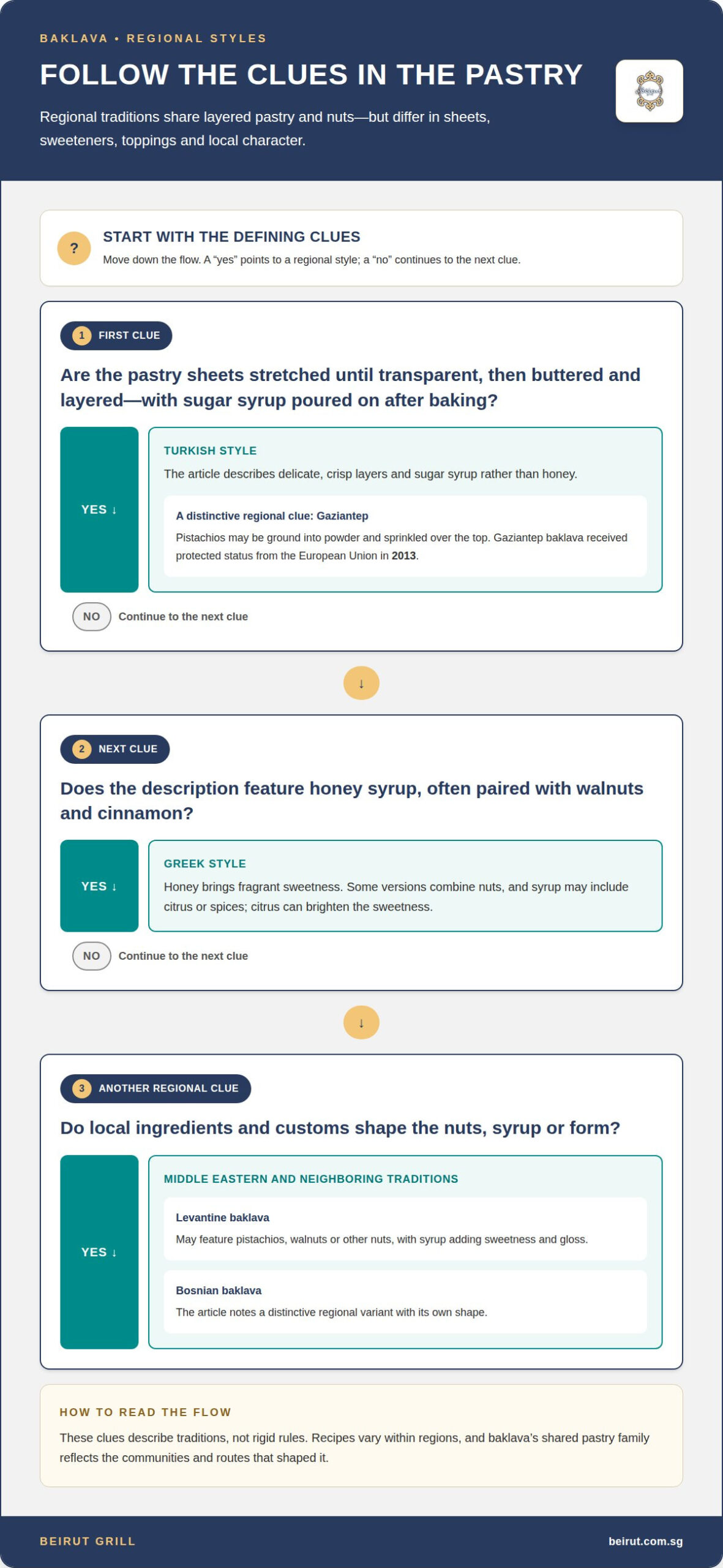
In Turkey, baklava is commonly finished with sugar syrup poured over the pastry after baking, rather than honey. Its sheets are stretched until transparent, then buttered and layered, creating a delicate, crisp structure. Gaziantep offers a distinctive variation: pistachios may be ground into powder and sprinkled over the top. The city’s baklava received protected status from the European Union in 2013, recognising a regional tradition tied to a specific place.
Greek baklava shares the layered pastry and nut filling, but local recipes give familiar ingredients a distinctive balance. Walnuts and cinnamon are common choices, while honey syrup adds fragrant sweetness. Some versions combine nuts, and the syrup may include citrus or spices. These choices shape the finish: honey brings a rounded aroma, while citrus can brighten the sweetness. Greek baklava belongs to the same broad pastry family, but is not identical to every Turkish or Middle Eastern preparation.
Across the Middle East, recipes vary with local ingredients and culinary customs. Levantine baklava may feature pistachios, walnuts or other nuts, with syrup adding the final gloss and sweetness. The Ottoman Empire also carried baklava into the Balkans and beyond, where communities developed their own versions. Bosnia has a distinctive regional variant with its own shape. These differences show how travel spread the pastry and local cooks adapted its ingredients and presentation.
To compare styles, notice three details: the pastry’s texture, the nut filling and the syrup’s flavour. Turkish pastry sheets, a Greek honey finish and a Balkan shape each offer clues to regional tastes. These contrasts make baklava’s journey visible in every carefully layered piece.
Baklava’s history
Baklava changed as cooks carried its pastry across empires and adapted ingredients to local tastes. Its journey through cultures was not a straight line, but a sequence of refinements, from court kitchens to regional traditions. In seventeenth-century Istanbul, the recipe was perfected in the Topkapi Palace kitchens. This milestone helps explain how baklava became recognisable while retaining room for local flavours.
By the Ottoman period, baklava appeared at lavish feasts and celebrations, and became associated with weddings, births and religious holidays. Some communities serve it for Eid al-Fitr, which marks the end of Ramadan; Eastern Orthodox Christian communities may serve it at Christmas. These occasions show how one pastry can carry different meanings. Depending on the community and setting, its sweetness can mark hospitality, celebration or religious observance. That tradition of marking special occasions with heritage confectionery continues across the region today; for example, those exploring festive sweets and bakery essentials in the UAE can look to regalplus.ae.
A family account offers another view of how the tradition travelled. In 1871, Efkan Güllü’s great-grandfather learned to make baklava while stopping in Aleppo and Damascus on his return from the Islamic Hajj pilgrimage. This example links culinary knowledge to travel and personal instruction. It also shows how recipes moved through relationships, not only through palace kitchens or formal trade routes.
In Singapore, baklava’s story belongs to a contemporary, multicultural dining landscape rather than the ancient and imperial settings associated with its earlier origins. Its presence here lets diners encounter a dessert shaped by distinct regional histories, while its ingredients and preparation continue to express those traditions. To explore Lebanese cuisine in Singapore, discover a Lebanese dining experience.
Beirut Grill: Mixed Grill
Beirut Grill offers a way to bring your curiosity about Lebanese food into a meal, with its Mixed Grill as a centrepiece and baklava for dessert. After exploring how regional traditions shaped the pastry, you can experience a menu that also includes Hummus, Vegetarian Kebab and Lebanese Wine. These choices let you build a Lebanese dining experience around the flavours and dishes that interest you, whether you’re sharing a meal or seeking a satisfying introduction to the cuisine.
Baklava’s long journey is best appreciated alongside the broader food culture it belongs to. At Beirut Grill, Mixed Grill offers a savoury counterpoint to the dessert, while Hummus or Vegetarian Kebab can shape a different kind of meal.
Visit beirut.com.sg to explore Beirut Grill.
Let Culinary Curiosity Lead You Further
The history of baklava invites more than a look backward. It offers a way to approach food as a living expression of culture, where each dish can open a path into a place’s flavours and traditions. Carry that curiosity to your next meal: notice which tastes feel familiar, which are new, and how a shared table can turn discovery into conversation.
Explore Lebanese dining at Beirut Grill with Mixed Grill, Hummus and Lebanese Wine. Choose the dishes that appeal to you, and let the experience continue beyond the page. A meal can be another way to connect with the culinary heritage that gives every recipe its meaning.
Contact Beirut Grill today and make your next meal an invitation to explore.
Frequently Asked Questions
Where Does Baklava Come From?
Baklava’s earliest proposed roots are in ancient Mesopotamia, not one present-day country. Accounts place baklava-like pastries there around 2,800 BC, while other traditions point to an early Assyrian version around 800 BC. These dates concern possible predecessors, not a proven modern recipe. The distinction helps explain why Turkey, Greece and communities across the Middle East and Balkans all connect baklava with their culinary heritage.
What is the history of baklava?
The history of baklava is a story of possible ancient origins, imperial refinement and regional adaptation. Traditions associated with Byzantine and Ottoman kitchens helped shape the recognisable pastry, which later developed into distinct local versions. Its meaning also varies by occasion: baklava may accompany Eid al-Fitr, Christmas in Eastern Orthodox communities, weddings and other celebrations. Its changing roles reveal a shared dessert tradition, rather than one fixed recipe.
Where did baklava originate?
The most useful answer is ancient Mesopotamia as a proposed birthplace for baklava-like sweets, not a definitive country of origin. The ancient region does not align neatly with modern national borders, and accounts also credit Assyrian and Byzantine influences. Treat these as separate clues to a long culinary lineage: baklava’s ancestry developed across cultures, rather than beginning with one uncontested national recipe.
How did baklava develop in the Ottoman Empire?
Ottoman kitchens helped shape baklava into the elaborate dessert recognised today. Palace preparation and ceremonial service raised its profile. The procession tradition connected trays of pastry with Ramadan and the Janissaries, while imperial travel helped carry baklava into the Balkans and beyond. This development joined culinary refinement with public ritual, making the pastry both a palace delicacy and a food tradition shared across communities.
What ingredients and techniques were used in historical baklava?
Historical baklava relied on thin pastry layers, nuts and a sweet finish, with regional cooks adjusting the details. Turkish preparation is associated with transparent pastry sheets, butter between layers and sugar syrup poured on after baking. Some Ottoman Christian traditions also used 40 layers for Lent or 33 layers to represent the years of Christ’s life. These examples show how technique and symbolism could shape the same dessert.
How do regional baklava styles differ?
Regional styles differ in pastry handling, sweetener, nut choice and shape. Turkish baklava commonly uses sugar syrup, and Gaziantep versions may feature powdered pistachios. Bosnia has a distinctive regional variant with its own form. Across the Middle East and Balkans, local traditions shape ingredients and presentation. To compare styles, notice the pastry’s texture, the filling’s flavour and the syrup’s finish, rather than assuming every version follows one standard recipe.