
Kunefe fillings can vary, and a cheese that softens into a stretchy centre is a useful choice. If you’re wondering what the cheese in kunefe is called, Hatay is the clearest answer, although Akkawi is also used in Middle Eastern kanafeh. The cheese matters because it should soften into a tender, stretchy centre between crisp kadayif layers.
That signature stretch makes choosing a substitute more nuanced than simply picking any cheese that melts. This guide compares Hatay cheese and Akkawi, explains how Turkish Dil Peyniri fits in, and looks at when mozzarella can work instead. You’ll also see why moisture and texture matter, and which cheeses are less suited to kunefe’s distinctive filling. Understanding these differences helps you choose a cheese that suits the style of dessert you’re making.
Key Takeaways
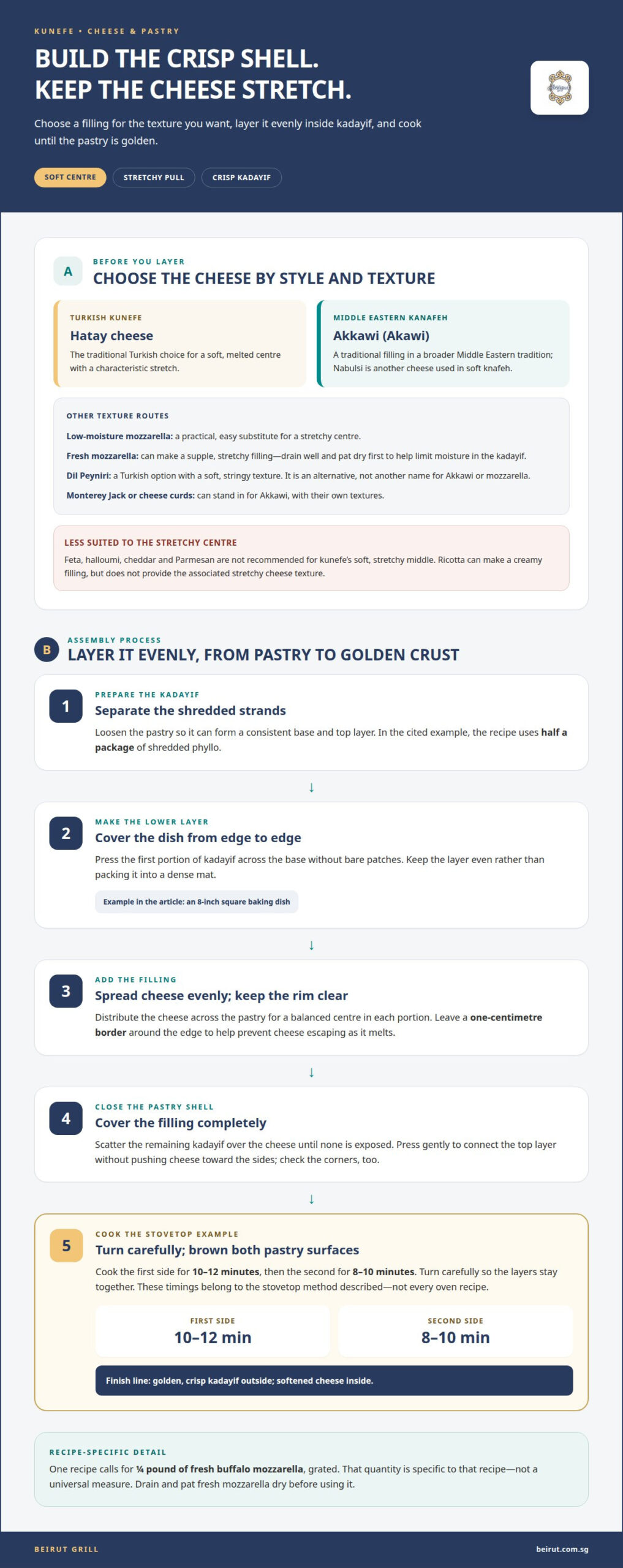
- For Turkish kunefe, look for Hatay cheese; Akkawi belongs to a broader Middle Eastern tradition and offers another route to a stretchy centre.
- If using mozzarella, drain and pat fresh mozzarella dry to help control moisture in the filling.
- Choose a cheese for its soft, stretchy texture, then spread it evenly between the kadayif layers for a balanced bite.
- Dil Peyniri is another option to consider; the right choice depends on the texture you want in the finished dessert.
Cheese substitutes, including mozzarella and Dil Peyniri
- Choose for stretch. Mozzarella is a practical substitute for Akkawi because it melts into a stretchy centre. Low-moisture mozzarella is an easy option for kunefe. Monterey Jack and cheese curds can also stand in for Akkawi, though each has its own texture. Consider the finished filling you want before choosing.
- Prepare fresh mozzarella carefully. Fresh mozzarella can make a supple, stretchy filling, but excess moisture may soften the kadayif. Drain it well and pat it dry before grating or layering. One recipe using fresh buffalo mozzarella calls for ¼ pound, an amount specific to that recipe rather than a universal measure.
- Consider Dil Peyniri. This Turkish cheese is another option for kunefe filling. Its soft, stringy texture suits a dessert where melted cheese should pull apart beneath crisp pastry. Treat it as an alternative, not another name for Akkawi or mozzarella. Choose according to the texture you want in each bite.
- Use ricotta only for a different texture. One kunafa recipe uses 12 ounces of ricotta, showing that some versions include it. Ricotta can bring a creamy filling, but it doesn’t provide the stretchy cheese texture associated with kunefe. Some recipes combine ricotta or cream cheese with mozzarella; treat those as variations, not direct replacements for the cheese pull.
- Skip cheeses that won’t give the desired centre. Feta, halloumi, cheddar, and Parmesan aren’t recommended because they don’t create kunefe’s soft, stretchy middle. For a simple option, start with low-moisture mozzarella; drain and dry fresh buffalo mozzarella first. Layer the cheese evenly so each portion has crisp kadayif around a melted centre.
A recipe-specific example calls for 1⁄4 lb of fresh buffalo mozzarella, grated; that amount belongs to that recipe. Mozzarella’s use as an Akawi substitute reflects its similar texture and stretchy pull. Fresh mozzarella should be drained well and patted dry to limit moisture before it is used.
How cheese fits into the kadayif pastry layers
- Prepare the kadayif evenly. Separate the shredded pastry strands before assembling, so they form a consistent base and lid. A recipe using half a package of shredded phyllo shows how the pastry surrounds the cheese. For an 8-inch square baking dish, distribute the strands across the bottom without leaving bare patches.
- Build a complete lower layer. Press the first portion of kadayif into the dish, covering the base from edge to edge. The strands form a crisp shell around the soft filling. Keep the layer even rather than packing it into a dense mat, so the pastry cooks uniformly beneath the cheese.
- Spread the cheese without reaching the rim. Add the filling over the pastry, leaving a one-centimetre border around the edge. This gap helps prevent cheese from escaping as it melts. An even layer also gives each slice a balanced centre, rather than leaving some portions rich with cheese and others mostly pastry.
- Cover the filling with the remaining kadayif. Scatter the strands across the cheese until no filling remains exposed. Press gently to connect the upper layer without squeezing the cheese toward the sides. In an 8-inch dish, check the corners carefully; uncovered spots can leave the filling exposed during cooking.
- Cook until both pastry surfaces are golden. In a stovetop method, cook the first side for 10 to 12 minutes, then the second for 8 to 10 minutes. Turn the pastry carefully so the layers stay together. These timings belong to that method, not every oven recipe. As the kadayif crisps, the cheese softens inside. For a broader taste of Lebanese dining in Singapore, explore the cuisine beyond this dessert.
Traditional Akkawi (Akawi) cheese filling
- Identify the cheese by both spellings. Akkawi is also spelled Akawi; both names refer to a cheese used in Middle Eastern kanafeh. Distinguish it from Hatay cheese, the traditional choice for Turkish kunefe. The names reflect different regional traditions, so match the cheese to the style of dessert you’re preparing.
- Choose Akkawi for a Middle Eastern-style filling. Akkawi gives kanafeh its cheese centre, while Nabulsi is another cheese used in soft knafeh. These examples show that no single cheese name covers every regional version. Akkawi is a traditional option, not the only cheese associated with kunefe and kanafeh.
- Prepare the filling to suit your chosen recipe. Follow the recipe’s instructions for cutting or arranging the Akkawi. Distribute it evenly over the kadayif rather than piling it in the centre. Even placement helps each portion contain both pastry and cheese, instead of concentrating the filling in just a few slices.
- Keep the cheese inside the pastry layers. Leave the edge clear as you arrange the Akkawi, then cover it fully with the upper layer of kadayif. This encloses the cheese in pastry as it warms. Avoid letting pieces protrude at the sides, where they may escape during cooking.
- Let regional preference guide the final choice. Kanafeh traditions use local cheeses, and Akkawi is one example of this broader practice. For a Middle Eastern version, choose Akkawi; for Turkish kunefe, consider traditional Hatay cheese. Identify the style first, then choose a suitable cheese instead of treating every regional name as interchangeable.
Traditional cheese used in Turkish kunefe
Turkish kunefe traditionally uses Hatay cheese. Its defining qualities are a soft, melted centre and the stretch that gives each serving its characteristic cheese pull.
- Start with the Turkish regional tradition. Choose Hatay cheese for traditional Turkish kunefe. The regional name distinguishes this style from kanafeh made with other cheeses. Akkawi belongs to a broader Middle Eastern tradition, while Turkish kunefe has its own local cheese choice.
- Look for the right melting behaviour. Kunefe cheese should soften inside the kadayif and create a tender, stretchy centre. That texture is the practical clue to its role: the cheese contrasts with crisp pastry instead of staying firm or turning crumbly.
- Use the recipe’s stated amount. A Turkish kunefe recipe uses 150 grams of kunefe cheese or mozzarella. Treat that as the quantity for that recipe, not a universal measurement. The amount needed depends on the recipe and how its cheese layer fits between the pastry.
- Use mozzarella as a functional alternative. The same recipe presents mozzarella alongside kunefe cheese, making it a useful option when preparing the dessert. Choose it for its ability to melt and stretch, while remembering that mozzarella is an alternative, not the traditional Hatay name.
- Keep regional identity clear as you serve. Call the Turkish choice Hatay cheese, and describe mozzarella as a substitute when that’s what you’ve used. This distinction honours the dish’s regional character while making the filling easy to understand. For a taste of kunefe in Singapore, explore this traditional dessert on the menu.
Each region uses local cheese for kanafeh filling, so an accessible local cheese can be a practical choice. When the traditional regional option isn’t available, choose a local cheese with a texture suited to the dessert rather than assuming one cheese works for every version. The familiar contrast between crisp pastry and a soft, stretchy centre remains the goal.
Cheese is one of knafeh’s main ingredients, so choosing it carefully matters to the finished dessert. Treat the filling as a central part of the dish, not a detail to overlook.
Beirut Grill: Mixed Grill
After exploring kunefe’s delicate cheese filling and crisp kadayif, Beirut Grill’s Mixed Grill offers a savoury next course. Choose it to enjoy a selection of Lebanese grilled flavours. Hummus makes a fitting mezze alongside it, while Vegetarian Kebab is a meat-free alternative.
For a more leisurely meal, Lebanese Wine can accompany the table, adding another element of Lebanese tradition. The contrast between savoury grilled food and kunefe’s sweet, tender layers offers a satisfying way to explore different tastes in one meal.
Contact Beirut Grill to plan your visit.
Let the next tasting answer the question
Knowing what the cheese in kunefe is called reveals more than an ingredient name. It shows how regional traditions shape a familiar dessert, where crisp pastry and a tender centre create a distinctive contrast. Enjoy kunefe as part of a meal, letting its sweetness provide a final note to a broader Lebanese dining experience.
Beirut Grill serves kunefe for diners who would rather savour the dessert than prepare it themselves. Bring your curiosity about its filling to the table and enjoy the contrast of its layers and textures. It’s a relaxed way to turn culinary discovery into an occasion, whether you’re planning a meal or simply drawn to this distinctive sweet.
Contact Beirut Grill about kunefe, and take the next step toward enjoying this cherished dessert.
Frequently Asked Questions
What is Kunefe?
Kunefe is a cheese-filled dessert made with fine shredded pastry, often called kadayif, and finished with syrup. Its appeal comes from contrast: delicate strands crisp around a warm, soft centre, while syrup adds sweetness. Regional versions vary; some kanafeh styles use nuts or cream instead of cheese, so the name can describe related desserts with different fillings.
What cheese is traditionally used in künefe?
If you’re asking what the cheese in kunefe is called in the Turkish tradition, the answer is Hatay cheese. The regional name distinguishes this style from other Middle Eastern cheese desserts, which may use Akkawi or Nabulsi. In a recipe, this distinction helps identify whether the filling follows a Turkish tradition or another regional approach.
Can mozzarella be used instead of traditional künefe cheese?
Yes, mozzarella can replace künefe cheese in a recipe, though the result uses a substitute rather than traditional Hatay cheese. One Turkish recipe specifies 150 grams of kunefe cheese or mozzarella, illustrating a direct swap within that recipe. Low-moisture mozzarella is a straightforward choice; fresh mozzarella needs careful moisture management to keep the pastry from becoming too wet.
What other cheeses can substitute for künefe cheese?
Dil Peyniri, Monterey Jack, and cheese curds are other possible substitutes. Beyond the Turkish regional name, Dil Peyniri is another cheese to know. Choose a cheese that softens and stretches for a classic-style centre. Feta, halloumi, cheddar, and Parmesan are poor matches; ricotta or cream cheese make a creamier, less stretchy filling.
What is künefe cheese called in Turkish grocery stores?
Look for Hatay cheese, the traditional cheese used in Turkish künefe.