
Confidence begins with a simple method: to learn how to pronounce Lebanese food names, break each one into syllables, say the sounds slowly, then bring them together at a natural pace. Clear vowels and an unhurried first attempt matter more than sounding perfect. Pronunciation can vary between speakers, so treat English sound guides as helpful approximations.
It’s understandable to hesitate over a name you haven’t said aloud before, especially when the menu is filled with unfamiliar, heritage-rich words. A little practice makes ordering feel easier and lets your curiosity take the lead. You’ll learn practical ways to approach names such as hummus, tabbouleh and shish taouk, with simple sound cues and tips for handling sounds that English doesn’t use in quite the same way. From mezze to charcoal-grilled favourites, this guide will help you speak more comfortably and enjoy discovering each dish.
Key Takeaways
- Break unfamiliar dish names into syllables, then say them slowly before trying a natural pace.
- Use English sound cues as a guide, while remembering that pronunciations can vary between speakers.
- Practise with familiar menu names such as hummus, tabbouleh and shish taouk to build confidence.
- At Beirut Grill, explore Lebanese favourites such as Mixed Grill, Hummus and Vegetarian Kebab while putting your new skills to use.
How to pronounce lebanese food names
Learning how to pronounce Lebanese food names begins with listening for syllables, stress and vowel sounds. English spellings offer useful clues, but they cannot represent every Arabic sound precisely. Pronunciations can also vary between speakers. Treat each guide below as a practical approximation, not a test of authenticity.
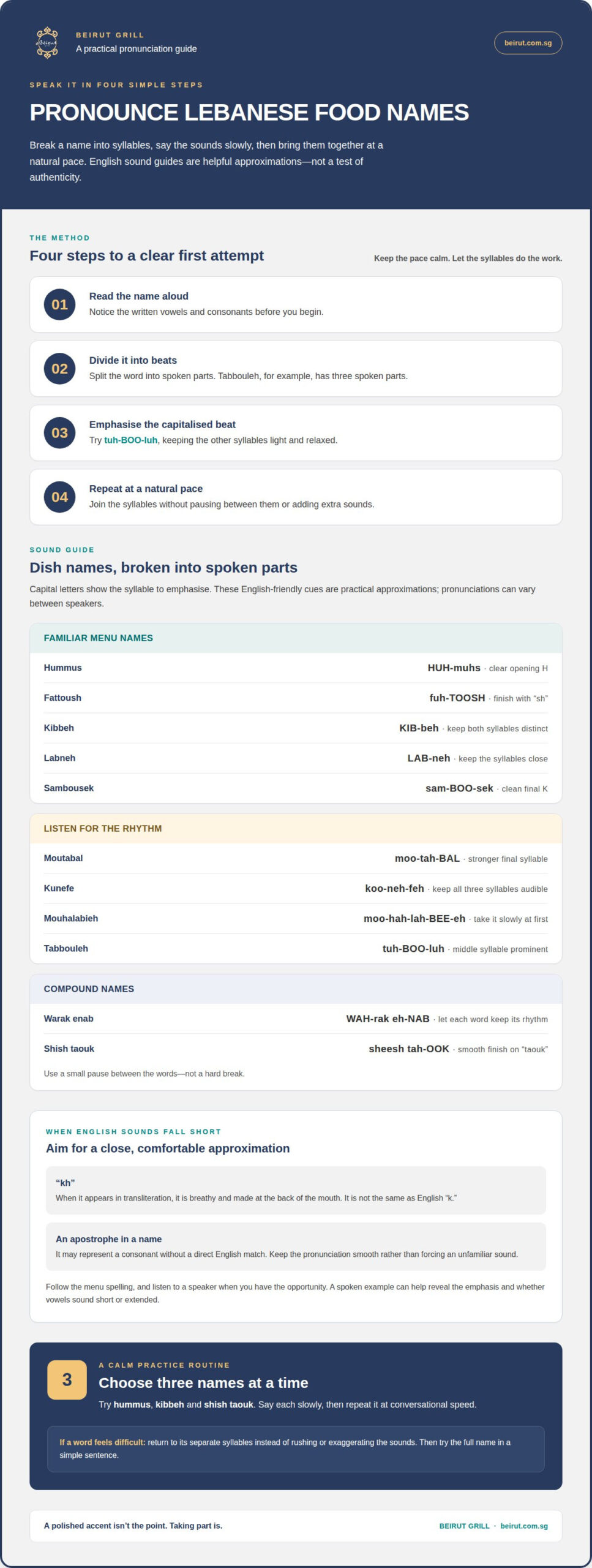
Start by marking the syllables in a dish name. Say each part slowly, then join the parts without adding extra sounds. In the examples below, capital letters show the syllable to emphasise. Keep the other syllables light and relaxed.
- Read the name aloud: notice its written vowels and consonants.
- Divide it into beats: for example, split “tabbouleh” into three spoken parts.
- Emphasise the capitalised beat: try “tuh-BOO-luh” as an English-friendly guide.
- Repeat at a natural pace: say the full name without pausing between syllables.
Use familiar English sounds as a starting point. “Hummus” is often approximated as “HUH-muhs,” with a clear opening H. “Fattoush” can be approached as “fuh-TOOSH,” ending with the same sound as “push.” For “kibbeh,” try “KIB-beh,” keeping both syllables distinct rather than swallowing the second.
Some names have a rhythm that becomes clearer when spoken in parts. “Moutabal” can be practised as “moo-tah-BAL,” with emphasis on the final syllable. For “labneh,” say “LAB-neh,” keeping the two syllables close. “Sambousek” is easier as “sam-BOO-sek,” with a clean final K.
Compound names need a small pause between their parts, not a hard break. Try “warak enab” as “WAH-rak eh-NAB,” letting each word keep its own rhythm. “Shish taouk” can be approximated as “sheesh tah-OOK.” Say “shish” first, then give “taouk” a smooth, single-word finish.
- Tabbouleh: “tuh-BOO-luh,” with the middle syllable prominent.
- Fattoush: “fuh-TOOSH,” finishing with a clear “sh.”
- Moutabal: “moo-tah-BAL,” with a light opening and stronger ending.
- Kunefe: “koo-neh-feh,” keeping all three syllables audible.
- Mouhalabieh: “moo-hah-lah-BEE-eh,” taken slowly at first.
Arabic contains sounds that English speakers may not have practised, so a close approximation is a sensible first attempt. The “kh” sound, when it appears in transliteration, is breathy and made at the back of the mouth. It is not the same as English “k.” Names written with an apostrophe may represent a consonant without a direct English match; keep the pronunciation smooth rather than forcing an unfamiliar sound.
When deciding how to pronounce a name, follow the spelling on the menu, then listen to how a speaker says it if you have the opportunity. A spoken example can reveal which syllable carries emphasis and whether vowels sound short or extended. Repeat the name, then use it in a simple sentence, such as ordering “tabbouleh” or asking about “kunefe.”
For a calm practice routine, choose three names at a time, such as “hummus,” “kibbeh” and “shish taouk.” Say each slowly, then repeat it at conversational speed. If a word feels difficult, return to its separate syllables instead of rushing or exaggerating the sounds. That steady approach helps unfamiliar names feel more natural at the table.
Beirut Grill: Mixed Grill
Beirut Grill makes a natural next stop after practising Lebanese dish names: bring your new confidence to the table and order a Mixed Grill aloud. Its name gives you a chance to practise the clear, steady syllables you’ve been working on, while exploring Lebanese flavours in Singapore.
Prefer to begin with a familiar mezze name? Try Hummus, then move on to a Vegetarian Kebab. Lebanese Wine offers another traditional menu name to say with ease. Each is an invitation to enjoy the meal as well as the words behind it, without needing perfect pronunciation to take part.
For a relaxed meal centred on Lebanese dishes, visit Beirut Grill. You’re welcome to contact Beirut Grill or visit beirut.com.sg.
Let your curiosity lead to the table
Practising how to pronounce Lebanese food names is about more than getting each sound right. It gives you another way to approach a culinary tradition with curiosity. At the table, let the menu become part of the experience: say a dish name at your own pace, listen and enjoy the conversation that follows. A polished accent isn’t the point. Taking part is.
Make your next meal an opportunity to put that confidence into practice. Beirut Grill’s menu includes Mixed Grill, Hummus and Lebanese Wine, each offering another name to recognise and say as you explore Lebanese flavours. Choose a familiar favourite or let a new dish catch your attention. The pleasure lies in being open to the experience, one name and one taste at a time.
Contact Beirut Grill today and take your curiosity to the table. Say the words with confidence, and enjoy discovering what comes next.