
What makes tender stuffed vine leaves is not a complicated technique, but a balanced filling and gentle cooking. This stuffed vine leaves recipe vegetarian cooks can follow at home combines fragrant rice, fresh herbs and lemon in leaves that stay intact from pot to plate.
If you’ve worried about tearing the leaves, spilling the filling or guessing when the rice is ready, this guide walks you through each step. Learn how to prepare fresh or jarred leaves, season the filling, roll each parcel with room for the rice to expand, and simmer until tender. You’ll also find practical doneness checks to help keep the rice flavourful rather than mushy.
Known in Lebanon as Warak Enab bi Zeit, or grape leaves in olive oil, this vegetarian dish is a familiar part of the mezze table. The steps below make it approachable for beginners, with serving ideas for enjoying the rolls at room temperature or chilled. It’s a lovely way to bring Lebanese mezze to your table, much like the Warak Enab on Beirut Grill’s Lebanese menu.
Key Takeaways
- Learn how Lebanese vegetarian stuffed vine leaves, or Warak Enab bi Zeit, fit into the tradition of mezze.
- Prepare fresh or jarred leaves so they’re easier to fill and less likely to tear.
- Build a balanced rice-and-herb filling, then follow a beginner-friendly rolling and cooking method in this stuffed vine leaves recipe vegetarian guide.
- Identify common causes of torn leaves, dry filling or uneven cooking, and make practical adjustments.
- Find serving ideas for a Lebanese-inspired mezze table, with Warak Enab alongside other shared dishes.
What are vegetarian stuffed vine leaves, and what makes them Lebanese?
Fold back a glossy vine leaf and you’ll find a compact parcel of rice, herbs and seasoning, softened by a slow, gentle cook. Vegetarian stuffed vine leaves are grape leaves wrapped around a meat-free filling, often made with rice, fresh herbs, tomato, onion, olive oil and lemon. Ingredients and proportions vary from kitchen to kitchen, so no single formula represents every Lebanese family’s table.
In Lebanon, stuffed vine leaves are commonly known as Warak Enab. The name refers to grape leaves, while Warak Enab bi Zeit describes a meatless version cooked with olive oil. The distinction is useful when comparing recipes, but the name alone doesn’t guarantee a particular filling: some versions include meat, while others centre on rice and herbs. For a stuffed vine leaves recipe vegetarian, the character comes from the balance of bright lemon, fragrant greens and soft rice rather than a meat-based stuffing.
What does Warak Enab mean?
Warak Enab is a Lebanese name associated with stuffed grape leaves. Each leaf is folded around a small portion of filling to make a neat bite that’s easy to serve and share as part of mezze. The dish belongs to a wider family of wrapped foods found across the region; Dolma (stuffed dishes) on Wikipedia offers an overview of their varied forms. Lebanese recipes, like other household dishes, reflect the cooks and ingredients behind them.
That variety is part of the pleasure. A Lebanese mezze spread brings small dishes together for sharing, and vine-leaf parcels contribute herbal fragrance, gentle acidity and tender texture. They’re served alongside other dishes rather than being tied to one fixed menu or occasion. Recipes may use different fillings or cooking liquids, so check the ingredients rather than assume every Warak Enab is prepared identically.
What makes a stuffed vine leaf vegetarian?
Vegetarian stuffed vine leaves are grape leaves wrapped around a rice-based filling flavoured with herbs, vegetables, olive oil, lemon and seasonings, without meat or fish. Parsley and other herbs bring freshness; tomato and onion add savoury depth, while lemon lifts the rice and olive oil gives the filling a rounded finish. Some cooks add chickpeas or other ingredients, and seasoning choices vary.
Vegetarian and vegan aren’t interchangeable. A filling can be meat-free yet include an animal-derived ingredient, such as butter, or be cooked in meat-based stock. For a fully plant-based version, check both the filling and cooking liquid for animal products. Meat-filled versions may use minced meat with rice and spices, but that is one variation, not the definition of Warak Enab. This guide focuses on rice and herbs while recognising that family recipes across Lebanon may take a different, equally cherished path.
Choose the leaves, rice, herbs, and seasonings for a balanced filling
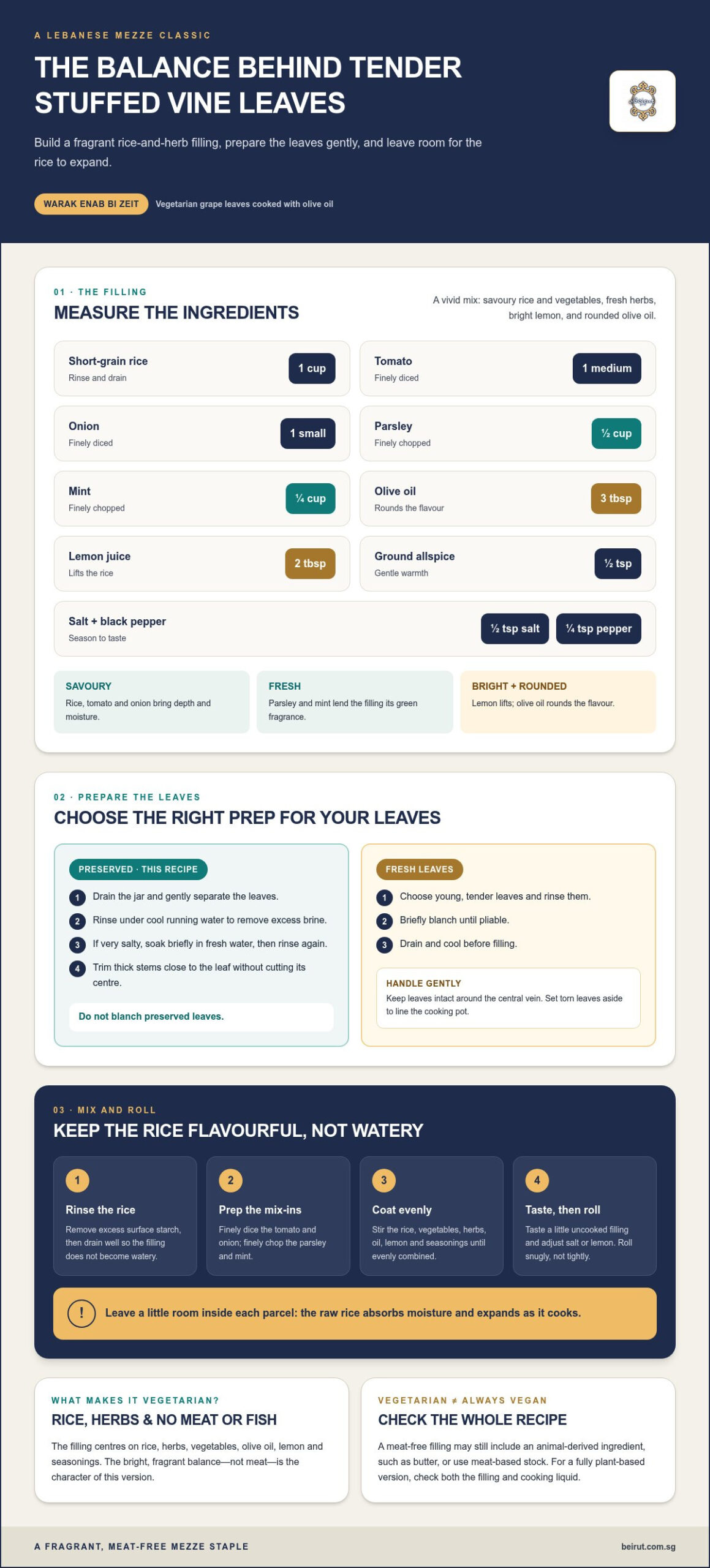
A balanced filling should taste vivid before it’s wrapped: savoury from onion and rice, green with herbs, and lifted by lemon. For this stuffed vine leaves recipe vegetarian, use preserved vine leaves packed in brine and short-grain rice, which holds its shape as it cooks. The quantities below make a fragrant, meat-free mixture without overwhelming the leaves’ delicate, tangy flavour.
How to prepare vine leaves before filling
Preserved leaves are ready to use after rinsing, while fresh leaves need blanching to soften. Drain the jar and gently separate the leaves, then rinse them under cool running water to remove excess brine. If they’re very salty, soak them briefly in fresh water and rinse again. Trim thick stems close to the leaf without cutting into its centre, as a tough stem can make rolling awkward.
Handle each leaf gently, especially around the central vein. Set torn leaves aside rather than discarding them; they can line the cooking pot. To prepare fresh leaves, choose young, tender ones, rinse them, then briefly blanch until pliable before draining and cooling. This recipe uses preserved leaves, so don’t blanch them.
Build a fragrant, meat-free rice filling
Measure the ingredients before mixing so the herbs and seasonings distribute evenly. The rice goes into the leaves raw and absorbs moisture as it cooks. Rinse it first to remove excess surface starch, then drain well so the filling doesn’t become watery.
- 1 cup short-grain rice, rinsed and drained
- 1 medium tomato, finely diced
- 1 small onion, finely diced
- ½ cup finely chopped parsley
- ¼ cup finely chopped mint
- 3 tablespoons olive oil
- 2 tablespoons lemon juice
- ½ teaspoon ground allspice
- ½ teaspoon salt and ¼ teaspoon black pepper
Tomato and onion lend moisture and savoury depth, while parsley and mint bring freshness. Olive oil rounds the flavour, lemon keeps it lively, and allspice adds gentle warmth without masking the herbs. Stir until the rice is evenly coated, then taste a small amount of the uncooked filling and adjust the salt or lemon to suit your palate.
Keep the base mixture simple the first time. To plan a complementary spread, the guide to authentic hummus and baba ghanoush offers pairing ideas. For a table of Lebanese flavours, explore Beirut Grill’s Lebanese mezze.
How to roll and cook vegetarian stuffed vine leaves
Once the filling is ready, roll each parcel snugly without compressing the rice. Leave a little room for the grains to expand during cooking. The method below uses the one-cup rice filling from the previous section and a gentle simmer to soften the leaves without unraveling the rolls.
How to roll each leaf without overfilling it
Spread a leaf vein-side up on a clean surface, with the stem end nearest you. For an average-sized leaf, start with about one teaspoon of filling; use slightly more for a large leaf and less for a small one. A modest mound is easier to enclose than a heaped spoonful and helps prevent rice from pushing through the seams.
- Place the filling in a short line near the stem end, leaving space at either side.
- Fold the bottom of the leaf over the filling, then bring both sides inward to enclose it.
- Roll towards the tip until the parcel is neat and secure. Keep it firm, but don’t pull hard enough to stretch or tear the leaf.
Set each roll seam-side down while you work. If a leaf splits, wrap the parcel in a second leaf, or save the damaged leaf to line the pot.
How to simmer the rolls until tender
Arrange the parcels close together in a heavy-based pot, seam-side down, in compact layers. A snug arrangement supports the rolls as they cook. Line the base with spare leaves or a few slices of potato to buffer the bottom layer from direct heat. For the quantities here, begin with 2 cups water, ¼ cup lemon juice and 2 tablespoons olive oil. The liquid should reach the rolls; add a little water if needed.
- Set a heatproof plate directly on top of the rolls to keep them submerged and steady.
- Bring the liquid just to a boil over medium heat, then reduce the heat to low. Aim for a gentle simmer, with only occasional small bubbles.
- Cover and cook for about 45-55 minutes. Near the end, carefully lift one roll and taste it once cool enough.
- Look for softened leaves and rice that is tender throughout, with no hard or chalky centre. If the rice is still firm, cover the pot and continue simmering, checking again after a few minutes.
- Turn off the heat and leave the rolls covered for about 15 minutes before lifting them out. Resting helps the parcels settle and makes them easier to handle.
Stoves, pots and leaves can differ, so use the timing as a guide and let the texture of the rice and leaves determine when they’re ready. For a Lebanese mezze meal without the rolling, explore Beirut Grill’s Lebanese menu, which includes Warak Enab.
Why stuffed vine leaves tear, dry out, or cook unevenly, and how to fix them
Even careful cooks may find a leaf that splits or a roll that cooks more slowly than its neighbours. These parcels are delicate, and small adjustments often solve the problem. For a stuffed vine leaves recipe vegetarian, check the condition of the leaves, how tightly the rolls sit in the pot, and whether the rice has enough liquid and steady heat.
Use this guide to identify a likely cause and make a practical correction:
- The leaf tears while rolling: It may be dry, tough, or caught on a thick stem. Rinse preserved leaves well, trim only the tough stem, and handle the leaf gently. Patch a small tear with a piece cut from another leaf, overlapping the edges before rolling.
- Filling escapes: Too much filling or a loose roll leaves gaps for rice to push through as it expands. Use a smaller spoonful, fold both sides over the filling, and roll snugly without stretching the leaf. Place repaired rolls seam-side down among the others so they’re supported.
- The filling tastes dry or the rice is firm: The pot may have lost too much liquid, or the rolls may need more time. Keep the lid on and maintain a gentle simmer. If the liquid drops below the rolls before the rice is tender, carefully add a little hot water down the side of the pot, then cover again.
- Some rolls are tender while others remain firm: Uneven sizes, loose gaps or inconsistent heat can lead to uneven cooking. Arrange similarly sized rolls together in compact layers, keep them submerged with a heatproof plate, and lower the heat if the liquid is boiling vigorously.
What to do when leaves tear or filling escapes
A torn leaf doesn’t have to go to waste. For a small split, overlap a suitable piece of leaf over the damaged area, then finish rolling. If the leaf is badly torn, wrap the parcel in a larger intact leaf. Keep repaired rolls seam-side down on the bottom or among tightly packed rolls, where neighbouring parcels help hold them in place. Avoid lifting or rearranging them once the simmer begins, as movement can loosen the folds.
How to prevent dry or unevenly cooked rolls
Gentle, consistent heat gives the rice time to absorb the cooking liquid while the leaves soften. A vigorous boil can jostle the rolls, reduce liquid quickly and cook the outer layers faster than the centre. Keep the liquid at a quiet simmer and the pot covered. Carefully taste one roll once it’s cool enough: the grains should be tender throughout, not hard or chalky. If they need longer, cover the pot and continue cooking gently, checking again after a few minutes.
Prefer to enjoy this Lebanese dish without tending a pot? Explore Beirut Grill’s Warak Enab and Lebanese mezze as part of a shared meal.
Serve vegetarian stuffed vine leaves as part of a Lebanese mezze
After cooking, let the vine leaves rest until they’re settled and easy to lift without splitting. They’re lovely at room temperature or chilled, when the rice, herbs and lemon have had time to come together. Arrange the rolls on a wide platter, seam-side down, and finish with a light drizzle of olive oil or lemon wedges for extra brightness. Keep garnishes simple so they complement the delicate leaves.
For a relaxed mezze meal, set the platter among dishes with contrasting textures and flavours. The rolls are soft and tangy, so crisp vegetables, creamy dips and warm, savoury bites create balance. A fresh salad brings crunch, a dip adds richness, and bread gives guests an easy way to gather flavours. A few well-chosen dishes can make the spread feel generous without requiring every item to be elaborate.
What to serve alongside stuffed vine leaves
Choose a few companions rather than crowding the table. Tabbouleh offers fresh herbs and a lively citrus note, while fattoush adds crisp vegetables and toasted bread. Hummus or baba ghanoush brings a smooth contrast to the tender rice parcels. For another warm element, falafel or spinach fatayer can make the spread more substantial. These familiar mezze pairings give each dish a distinct role. For wider culinary context, explore this guide to Mediterranean flavours and heritage.
Think about contrast as you arrange the dishes: place the stuffed leaves beside something crisp, then add a creamy dip and a fresh salad. Put lemon on the side so guests can brighten their own portions. If serving the rolls chilled, let other dishes bring warmth and fragrance to the spread. For more context around ingredients and traditions, the guide to Middle Eastern food offers a broader introduction.
From a home recipe to a Lebanese mezze experience
Preparing a stuffed vine leaves recipe vegetarian at home is one way to appreciate the care behind Lebanese cooking: simple ingredients, thoughtfully seasoned and made to share. Mezze is more than a collection of dishes. It’s an invitation to linger, taste a little of everything and enjoy the company around the table. Serve the platter with the other dishes rather than treating it as a course that must stand alone.
Beirut Grill serves Warak Enab as part of its Lebanese menu, offering another way to enjoy this familiar mezze. Add the rolls to a shared meal with other Lebanese dishes and explore a range of flavours in one sitting. For a taste of that dining experience, explore Beirut Grill’s Lebanese menu.
Bring Lebanese flavours to your next table
Let your first batch be the beginning of a Lebanese-inspired mezze ritual. Share the preparation, make room for a few favourite dishes, and let the table invite conversation and another taste. With this stuffed vine leaves recipe vegetarian, you can build confidence one roll at a time, then make the meal your own with the people and dishes you bring together.
To continue exploring Lebanese cooking beyond your kitchen, discover the flavours and hospitality of Beirut Grill. Explore Beirut Grill’s Lebanese menu and plan your next shared meal.
Take your time, trust your hands, and enjoy making a dish meant to be shared.
Frequently Asked Questions
Are vegetarian stuffed vine leaves vegan?
Not always. A vegetarian filling may still contain butter, yoghurt or another animal-derived ingredient, and some versions use stock. The recipe here uses olive oil and water, so its listed ingredients are plant-based. If adapting it, check every ingredient, including the cooking liquid and prepared vine leaves. Choose plant-based accompaniments too, since dips such as labneh contain dairy.
Are vegetarian stuffed vine leaves gluten-free?
They can be gluten-free when made with rice and ingredients that contain no gluten. Vine leaves, herbs, vegetables, olive oil and lemon are naturally gluten-free, but prepared products and seasonings can vary. Read the jar label and check for cross-contact information if gluten avoidance is essential. Avoid adding bulgur, which is made from wheat, and serve with gluten-free sides rather than wheat-based bread.
Can I make vegetarian stuffed vine leaves without rice?
Yes, but the filling and cooking time will change. Finely chopped mushrooms and cooked lentils can make a savoury, substantial rice-free filling. Avoid packing it tightly, since it won’t expand like raw rice. Because the mixture is already cooked, simmer only until the leaves are tender and the filling is hot. This is a useful variation, though it won’t have the classic rice texture of a stuffed vine leaves recipe vegetarian.
Can vegetarian stuffed vine leaves be cooked in a pressure cooker?
Yes, but pressure cooking needs a separate timing and liquid adjustment, so don’t transfer the stovetop cooking time directly. Arrange the rolls in a stable layer, use the pressure cooker’s trivet if appropriate, and follow the manufacturer’s instructions for minimum liquid, filling level and pressure release. Check a roll after cooking: the leaves should be tender and the rice fully cooked. If it remains firm, finish gently on the stovetop.
Can I make the filling ahead of time?
Yes. Mix the filling ahead and refrigerate it in a covered container, then stir it before rolling because tomato and onion can release moisture as they stand. For fresh herbs and evenly distributed seasoning, prepare it earlier the same day rather than leaving it for an extended period. Keep the raw rice in the mixture until you’re ready to fill the leaves, so it doesn’t sit soaking in the liquid.