
Could a single glass of “Lion’s Milk” hold the entire history of the Levant within its cloudy, translucent depths? While many guests at Beirut Grill on historic Bussorah Street are initially drawn to our award winning mezza, the true soul of the Lebanese experience often lies in a bottle of triple distilled arak. You might feel a lingering hesitation regarding its potent 53% alcohol by volume, or perhaps you find yourself confusing this grape based spirit with its Southeast Asian namesakes. It is perfectly natural to feel uncertain about how to approach such a powerful and storied drink.
We promise to transform that uncertainty into sophisticated confidence. In this guide, you will discover the precise rituals that turn this clear spirit into a milky masterpiece and learn why it is the essential partner for dishes like grilled halloumi or creamy hummus. Since 2009, we have curated the finest selections from the Beqaa Valley, and now we are sharing the secrets of the perfect water to spirit ratio. You will soon understand how to enjoy this legendary spirit with the poise of a seasoned connoisseur during your next divine dining experience at our hidden gem in the heart of Singapore.
Key Takeaways
- Distinguish authentic Levantine spirits from unrelated regional variants by identifying the specific grape and aniseed base required for a true connoisseur’s experience.
- Master the delicate preparation ritual to trigger the mesmerizing Louche effect, turning your glass of arak from clear to a beautiful, milky white.
- Learn how the cooling aniseed notes act as the ultimate palate cleanser, cutting through the rich olive oils of traditional mezza like baba ghanoush and labneh.
- Discover the chemical secrets of anethole and why the order of pouring water and ice is vital to maintaining a stable, silky emulsion.
- Identify the most prestigious Lebanese labels to look for when ordering at a high-end restaurant, ensuring an authentic and premium journey into Middle Eastern culture.
What is Arak? Understanding the Spirit of the Levant
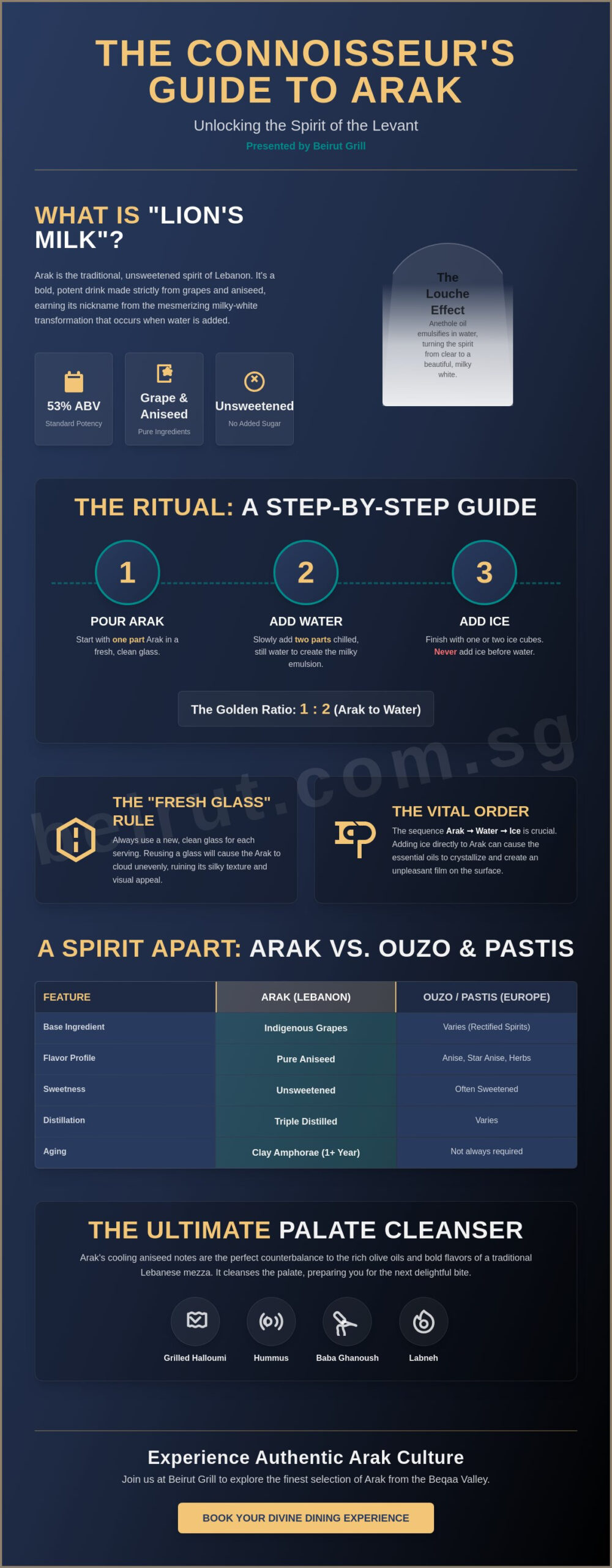
To the uninitiated, arak appears as a crystal-clear liquid. It’s a bold, unsweetened spirit that carries the potent essence of aniseed. Understanding What is Arak? requires looking past the glass to the sun-drenched vineyards of Lebanon. Unlike the rice-based spirits of Bali or the coconut distillates often found in Southeast Asia, authentic Levantine arak is strictly a product of the vine. It’s the national drink of Lebanon, famously known as “Lion’s Milk” or Laban al-Hamir. This nickname stems from the mesmerizing way the spirit clouds into a milky white emulsion when water is added. This transformation is more than a chemical curiosity; it’s a symbol of courage and hospitality that has defined social gatherings since our establishment in 2009 and for centuries before.
The spirit commands respect with its high alcohol content. Regulated Lebanese varieties must maintain a standard 53% ABV to ensure the purity of the experience. It’s a drink designed for the slow pace of a long afternoon mezza, where the “Lion’s Milk” provides a cooling contrast to the warmth of the sun and the richness of the table.
The Heritage of the Beqaa Valley
The Beqaa Valley serves as the geographic soul of arak production. In this high-altitude landscape, indigenous white grapes like Obeideh and Merwah are harvested to create the base spirit. To meet the rigorous standards established in the Levant, the liquid undergoes a traditional triple-distillation process in copper pot stills. The third distillation is where the highest quality aniseed is added, imparting that signature licorice aroma. Finally, the spirit is aged in clay amphorae for at least one year. This resting period in porous clay allows the harsher alcohols to evaporate. It results in a smooth, majestic finish that distinguishes premium labels like Chateau Musar from mass-produced alternatives.
Arak vs. Ouzo and Pastis: Key Differences
While it shares a flavor profile with Ouzo or Pastis, this Levantine spirit remains the purer ancestor of the Mediterranean anise family. Most European variants rely on star anise or a complex blend of herbs and frequently include added sugars to soften the bite. In contrast, traditional Lebanese styles are entirely unsweetened. The flavor comes solely from the quality of the grapes and the purity of the aniseed. This lack of sugar makes it a cleaner, more bracing companion to food. It allows the spirit to cleanse the palate without leaving a cloying residue, making it the superior choice for a divine dining experience.
The Ritual: How to Prepare Arak Like a Connoisseur
Stepping into the warm embrace of Beirut Grill on historic Bussorah Street, you’ll notice a deliberate pace to the evening. Preparation is not merely a means to an end; it’s a sacred ceremony that honors the spirit’s heritage. You should never consume arak neat. Its high potency, typically around 53% ABV, is designed to be unlocked through dilution. Drinking it straight is considered a faux pas in Lebanese culture, as the intense heat of the alcohol masks the delicate, floral notes of the aniseed. Instead, the goal is to create a refreshing, milky elixir that complements a long, indulgent meal.
A hallmark of the true connoisseur is the “fresh glass” rule. When you’re ready for a second serving, you must always use a clean glass. If you pour fresh spirit into a glass that previously held a diluted mixture, the residual oils will cause the new pour to cloud instantly and unevenly. This ruins the texture and the visual appeal of the drink. Since 2009, our staff has upheld this standard of excellence, ensuring every round is as pristine as the first. You can witness this attention to detail yourself when you book a divine dining experience at our award winning restaurant.
The 1:2 Golden Ratio
Achieving the perfect balance requires a specific sequence. While some prefer a 1:1 mix, the traditional Lebanese standard for hospitality is the one-third ratio. Follow these steps to prepare your glass with precision:
- Step 1: Pour one part of the clear spirit into a small, fresh glass. Usually, this is about 30ml to 50ml.
- Step 2: Slowly add two parts of chilled, still water. Using room temperature water can dull the brightness of the anise.
- Step 3: Observe the spontaneous transformation. As the water meets the spirit, the clear liquid begins to swirl with white clouds, eventually turning entirely opaque.
The Critical Ice Rule
The order of operations is the most vital part of the ritual. You must always add water before the ice. If ice cubes are dropped directly into the undiluted arak, the sudden drop in temperature causes the anise oils to crystallize. This creates an unappealing, oily film on the surface of your drink and ruins the silky mouthfeel. By adding the water first, you buffer the spirit, allowing the oils to emulsify properly. The Louche effect is the spontaneous emulsification of anethole when diluted with water. Only after this milky cloud has fully formed should you add one or two cubes of ice to maintain the chill. This careful process ensures a smooth, majestic sip that lingers pleasantly on the palate.
The Art of the Pairing: Arak and the Mezze Table
At Beirut Grill, located along the vibrant and historic Bussorah Street, we believe that a meal is a narrative of flavors. While many diners are familiar with pairing wine with dinner, arak serves as the ultimate conductor for the Lebanese culinary orchestra. When you’re exploring the most authentic mediterranean food singapore provides, the beverage choice is as vital as the spice blend. The spirit’s cooling aniseed profile offers a necessary counterpoint to the rich, earthy foundations of Levantine cuisine. It functions as a master palate cleanser. Between bites of various mezza, a sip of the diluted spirit resets your taste buds, ensuring the final bite of moutabal is as vibrant as the first.
This synergy explains why the tradition of the “long lunch” remains so vital to our heritage. Since our doors opened in 2009, we’ve watched guests spend hours over a table where food and conversation flow in equal measure. The spirit’s high ABV, once tempered with water, aids digestion and sustains the appetite through multiple courses. It’s a slow, indulgent process that rewards patience. It transforms a simple meal into a divine dining experience that honors the conviviality of the Levant.
Cold Mezze Pairings
The interaction between the spirit and cold mezza is a study in balance. Creamy textures like Hummus and Baba Ghanoush rely heavily on tahini, which can coat the tongue with its rich sesame oils. The sharp, clean bite of the aniseed cuts through this oiliness instantly, refreshing the mouth for the next savory morsel. Similarly, the spirit provides a bracing contrast to the saltiness of Grilled Halloumi. It also bridges the gap between the citrus-heavy notes of Tabbouleh and the deep, roasted flavors of our signature Labneh or Warak Enab.
Charcoal-Grilled Meat Pairings
As the meal moves toward the charcoal grill, the spirit takes on a more robust role. It’s the traditional partner for Shish Taouk and Lamb Kofta because it stands up to the intense, smoky “char” of the grill. Garlic is a cornerstone of our award winning kitchen; the spirit’s bold profile is one of the few things that can harmonize with a potent Toum sauce without being overwhelmed. Whether you’re indulging in our Beirut Lamb Chops or a succulent Beef Kebab, the spirit ensures the heavy fats of the meat feel light and manageable on the palate.
The Science of the Sip: Why Arak Turns White
Beyond the cultural ritual lies a fascinating chemical transformation that has captivated scientists and diners alike. The secret resides in anethole. This essential oil, derived from the aniseed added during the third distillation, is naturally soluble in high-proof alcohol but entirely insoluble in water. While the spirit remains at its regulated 53% ABV, the oil stays hidden within the clear liquid. As you introduce water, the alcohol concentration drops. The oil is forced out of solution, creating billions of tiny droplets that scatter light in every direction. This phenomenon is scientifically known as the Ouzo Effect. It creates a stable micro-emulsion that remains cloudy for hours without the need for stirring or chemical stabilizers.
The transformation is more than just a visual spectacle. It fundamentally alters the flavor profile. In its undiluted state, the high alcohol content can numb the palate, masking the intricate botanical work of the master distiller. Dilution releases the full aromatic bouquet. It allows the floral and spicy notes of the anise to bloom. You will notice a distinct cooling sensation on the tongue. Anethole possesses natural properties that mimic the refreshing chill of menthol. This creates a majestic sensory experience that balances the heat of the spirit with a crisp, clean finish. Experience the science of the sip by making a reservation at Beirut Grill.
Aniseed and Digestion
Since 2009, our guests have often turned to arak as the perfect bookend to a divine dining experience. Aniseed has been used as a traditional digestive aid for centuries across the Levant. The spirit acts as an effective “opening” act to stimulate the appetite and a soothing “closing” act after a heavy feast of grilled meats and rich mezza. Its natural oils help calm the stomach and reduce the feeling of bloating. This makes it an essential companion for those indulging in a full Lebanese spread on historic Bussorah Street.
Temperature and Clarity
Precision in temperature ensures the most evocative presentation. We recommend storing your bottle at room temperature rather than in a refrigerator. If the spirit becomes too cold before the ritual, the oils can solidify prematurely, leading to a duller Louche effect. We serve the drink in small, thin-walled glasses to keep the liquid crisp without overwhelming the senses. The visual aesthetics of a cloudy glass, condensation beading on the side, provides a beautiful contrast to the sun-drenched atmosphere of our Singapore home. It’s a display of heritage that rewards the visitor’s curiosity with every sip.
Experience Authentic Arak Culture at Beirut Grill
With the majestic Sultan Mosque standing as a silent sentinel in the background, Beirut Grill offers more than just a meal; it’s a sanctuary of Levantine heritage. Since 2009, we’ve dedicated ourselves to bringing the true spirit of Lebanon to the heart of Singapore. While our kitchen prepares mouth-watering mezza, our bar serves as a dedicated curator of the finest arak available. We understand that for the true connoisseur, the quality of the spirit is non-negotiable. That’s why we meticulously source our bottles from artisanal producers who respect the ancient, triple-distilled traditions of the Beqaa Valley. It’s a commitment to authenticity that has made us a hidden gem for those seeking a divine dining experience.
The atmosphere on historic Bussorah Street complements the heritage of the drink perfectly. As the evening sun dips below the shophouses, the ritual of the “Lion’s Milk” begins at tables across our restaurant. It’s a communal experience that encourages guests to slow down and savor the moment. When you’re looking for the most authentic middle eastern food singapore provides, the presence of a properly prepared spirit is the hallmark of a genuine cultural journey. We invite you to join us and discover why this legendary spirit remains the beating heart of Lebanese hospitality.
Our Curated Arak Selection
Our cellar is home to some of the most prestigious names in Lebanese viticulture, including world-renowned labels like Chateau Musar and Chateau Kefraya. These spirits are imported directly to ensure they meet our exacting standards for purity and flavor. Our staff is trained in the precise art of preparation, ensuring your glass is mixed with the correct ratio of chilled water to unlock the full aromatic bouquet. For a truly balanced meal, we suggest pairing your selection with our signature Mixed Grill. The smoky, charcoal-grilled essence of our Beirut Lamb Chops and Shish Taouk provides a majestic contrast to the cooling, crisp finish of the aniseed.
A Journey Through Lebanese Hospitality
At Beirut Grill, we’ve spent over 15 years preserving the traditions of the Levant in a sophisticated, modern setting. The role of the spirit in our restaurant is central to the celebratory and communal dining experiences we create. It bridges the gap between our award-winning mezza and our succulent mains, acting as the thread that ties the entire meal together. We’re proud of our longevity and the seasoned expertise we bring to every table. We invite you to explore the divine combination of heritage spirits and critically acclaimed cuisine. It’s an invitation to indulge in a culture that prizes patience, quality, and the joy of a shared glass.
Savor the Spirit of Lebanese Hospitality
Mastering the ritual of arak is more than a lesson in mixology; it is an invitation into a culture that celebrates patience and community. From witnessing the mesmerizing Louche effect to discovering how aniseed perfectly cleanses the palate between bites of rich hummus and smoky mixed grills, you now possess the knowledge of a true connoisseur. You understand that this majestic spirit is the soul of the Levant, best enjoyed slowly while the world passes by on historic Bussorah Street. The transformation from clear liquid to “Lion’s Milk” serves as a timeless bridge between the ancient Beqaa Valley and your modern dining table.
At Beirut Grill, we have been curators of this authentic heritage since 2009. Our award winning kitchen and extensive list of premium Lebanese spirits provide the perfect stage for your discovery. Whether you are revisiting a familiar favorite or trying this legendary spirit for the first time, our seasoned experts are here to guide your journey. We invite you to book your table at Beirut Grill to experience the authentic Arak ritual and indulge in a divine dining experience that has captivated Singapore for over 15 years. We look forward to welcoming you to our hidden gem soon.
Frequently Asked Questions
Is Arak the same as vodka?
No, these two spirits are fundamentally different in both base and flavor. While vodka is a neutral spirit typically distilled from grains or potatoes, authentic Lebanese arak is distilled from indigenous white grapes like Obeideh or Merwah and flavored with high-quality aniseed. The triple-distillation process in copper stills gives our spirit a distinct, licorice-scented identity that lacks the neutrality of vodka.
Why does Arak turn white when you add water?
This mesmerizing transformation is caused by anethole, the essential oil found in aniseed. This oil is soluble in alcohol at a high 53% ABV but becomes insoluble as the alcohol concentration drops during dilution. Billions of tiny oil droplets scatter light to create a stable micro-emulsion. This scientific phenomenon, known as the Louche effect, creates the signature cloudy appearance that characterizes a perfect pour.
Can you drink Arak straight?
Connoisseurs almost never consume this spirit neat because its intense potency can overwhelm the palate. Drinking it straight numbs the taste buds and masks the delicate, floral notes of the Beqaa Valley grapes. Dilution with water is essential to unlock the aromatic bouquet and ensure a smooth, majestic finish that complements a long, indulgent mezza feast on historic Bussorah Street.
What is the best water-to-Arak ratio for beginners?
A ratio of two parts water to one part spirit is the ideal starting point for those new to the ritual. This 2:1 dilution effectively tempers the high alcohol content while allowing the cooling anise flavors to bloom beautifully. As you become more accustomed to the spirit’s palate-cleansing properties, you can adjust the water slightly to find your personal balance of strength and aroma.
Does Arak expire or go bad over time?
No, high-proof spirits like these don’t expire and can remain shelf-stable for many years. Because it’s triple-distilled and contains a high alcohol volume, it acts as its own preservative. You should store your bottle in a cool, dark place at room temperature. Since 2009, we’ve found that keeping the bottle away from direct sunlight preserves the integrity of the delicate anise oils indefinitely.
What is the difference between Lebanese Arak and Turkish Raki?
The primary differences lie in the sugar content and the aging process. Lebanese standards require the spirit to be entirely unsweetened and aged for at least one year in clay amphorae to achieve superior smoothness. While Turkish Raki is also a grape-based anise spirit, it often contains added sugar and may not undergo the same traditional clay-aging ritual that defines the premium labels we serve. Just as these culinary traditions are preserved, other aspects of heritage like Turkish grooming are also kept alive; for instance, you can learn more about Pasha Barbers and their use of traditional techniques.
Is Arak gluten-free and vegan-friendly?
Yes, authentic arak is naturally gluten-free and vegan-friendly. It’s produced exclusively from grapes and aniseed, containing no grain-based ingredients or animal-derived fining agents. This makes it an excellent choice for guests with specific dietary preferences seeking a divine dining experience. You can enjoy it with confidence alongside our vegetarian kebab or a fresh plate of falafel at our award winning restaurant.
Why is Arak called “Lion’s Milk”?
The nickname “Lion’s Milk” refers to both the spirit’s milky white appearance when diluted and the courage associated with its formidable 53% ABV strength. It’s a title of pride that reflects the spirit’s status as the national drink of Lebanon. Since our establishment in 2009, we’ve shared this “milk” as a symbol of the bold and inviting hospitality that defines the heritage of the Levant.